Showing posts with label Nuremberg War Crimes Trials. Show all posts

Monday, December 27, 2021

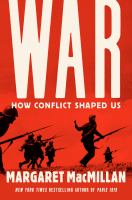
War

 In many historical accounts the emphasis is on wars--who won them and the consequences.  Others declare that historians overlook the more important cultural developments.  Margaret MacMillan contends that wars have shaped us in ways that deserve serious study.  To run an organized military assault (or defense) requires organization that came after the Agricultural Revolution.  Ironically cultures both transfer organization to military powers, but also receive many cultural items from military experiences.  One example, Norman Bethune developed blood transfusions during the Chinese Revolution.

Society is pulled in different directions by warfare.  There are many factors encouraging war, but there are also many counterpoints.  Margaret has studied both sides. 

 Margaret quotes Carl von Clausewitz for a definition,  "War is an act of violence intended to compel our opponent to fulfill our will."

Warfare advanced as civilization advanced.  Mankind discovered how to shape metals and tamed horses for our ends.  Many developments boosted our ability to kill others.  Horse stirrups provided a more stable platform to inflict killing.  Napoleon marching at night caught the enemy off guard. The  Manhattan Project to develop the atomic bomb was the most intensive use of science for military goals.  

Strategies include developing superior weapons, more effective discipline and as Sun Tzu declares, "All War is based on deception."  That reminds me of a book title "The Name of the Game is Deception" describing basketball, but in reality could be used for almost any sport.  All sports could be considered preparation for warfare which is leveraging your resources effectively.

Reasons for war are many, but they boil down to greed and fear and include religion.  In reality it the ruling class who sees an opportunity or is fearful.  They then attempt to persuade the citizens that the cause effects them war can break out.

Frederick the Great felt "A soldier must fear his officer more than the enemy."  All procedures to reinforce obedience were critical.  In contrast the author has Tim O'Brien tell us "Man killed and died because they were embarrassed not to.  It was what had brought them to war in the first place  Nothing positive, no dreams of glory or  honor just to avoid the blush of dishonor."  On the other hand some men developed fighting skills and would hire themselves out.

Women played a variety of roles.  Unfortunately prostitutes followed the armies--the term hooker comes from brothel prostitutes that followed the army of General Joseph Hooker.   In the last century or two many women filled in for the men gone to war leaving factory jobs more important than ever.  Women gradually picked up roles closer to combat such as nurses, ambulance drivers, clerical support.  By the time of the WWI they were no longer ready to go back to their old roles with many countries opened up the vote for women.  Too often women are affected in another way:  http://www.therealjohndavidson.com/2013/11/remembrance-day-is-not-just-for.html

Legalities are difficult to get nations to agree to and even more difficult to enforce.   Agreements were made for prisoners of war civilians, women.  Flame throwers were legal, but not poison   The Nuremberg trials were intended to make war criminals accountable with following orders not acceptable as an excuse.  One irony was that one activity not indicted was mass bombings.  United States does not accept judgments from the International Criminal Court (but would quote findings for their own purposes)

Manufacturers benefited from warfare.  Eisenhower warned the American public about the military industrial complex and we can see today that their lobbyists are very successful in boosting military budgets in many nations.  Alfred Noble invented more effective explosives, originally for the mining industry, but realized the military increased his profits.  His guilt feelings led to the Nobel Peace Prize.

Newspapers and the media profit from increased attention.  Winston Churchill was a correspondent during the Boer War and like many war correspondents supported "patriotic" efforts.  

The Arts have been involved with wars.   They have been used to glorify and spur, but also to protest.  Censorship has been used to control critical information and also to mislead.

 Marching music is not only used to recruit, but also to move troops in battle.  A wide variety of orders can be communicated with drums and bugles over the battle sounds.

Photography was used for the American Civil War.  Most of the early photography could be controlled through censorship, but as both the size and price of cameras came down it was more difficult to control the distribution of photos.  Vietnam photos turned off the American pubic convincing many it was unjust and unwinnable.

Paintings have been used to commemorate and glority.  Picasso's famous "Guernica" was used to denounce war and the arttist refused to let it go to Spain until democracy restored.  As of 1981 it sits in Madrid.   It is said that a Gestapo official visited Picasso in occupied France and upon seeing a photo of "Guernica" asked if Picasso had done it and the reply was, "You did."

Wars create heroes or you might say they churn them out.  Incentives are used to lure recruits such as money, glory, travel, learn a trade.  On average it is easier to attract the poor.  For the wealthier glory is used.

 As a youngster G. A. Henty adventure stories fascinated me.  Not conscious that I was being indoctrinated, but looking back Margaret was right to point out the indoctrination was deliberately encouraged.

Costa Rica is one country that decided to dispense with a national army so they could apply that expense to boosting literacy for its citizens. The ancient Chinese glorified scholars more than warriors.

All groups make decisions. President Dwight Eisenhower had a quote that behooves us to weigh more carefully.  "Every gun that is made, every warship launched, every rocket fired signifies, in the final sense, a theft from those who hunger and are not fed, those who are cold and are not clothed.  This world in arms is not spending money alone.  It is spending the sweat of its laborers, the genius of its scientists, the hopes of its children."   

The future of warfare seems likely to be cyber warfare  Get ready as it will change things all over again.  Already attacks have taken place. 

Thursday, July 25, 2019

JOHN FORD

John Ford is considered by many to have been one of the best directors America has ever produced.  One such claim came from Orson Welles.  Born in 1894 in Maine as John Feeney he followed an older brother who had changed his name to Francis Ford, to Hollywood.  Francis had taken the plunge into acting eventually taking part in close to 500 films and also doing some directing.  John, now Jack Ford started as an actor, but in 1923 deciding to be a director changed his name to John Ford.

One of his attractive qualities was his ability to tell a compelling story.  He was fond of a number of actors that he felt comfortable with allowing him to shoot scenes with only one or two takes.  Preparation was key. He once said "never let them talk unless they have something to say."

He was noted to have spoken French, German, Gaelic and even Chinese in the course of his work.  

As he was best known for westerns where Indians were usually portrayed  as the antagonists, there was curiosity as to what he really thought of the Indians.  One quote dug up, "We've treated them badly, it's a blot on our shield.  we've robbed, cheated, murdered and massacred them, but if they kill one white man and God out come the troops."  Mostly Indians were stereo typed in his films.

Just watched one interview in which he appeared arrogant while at the same time self-deprecating--he said he only did movies for the money. 

His first success was "The Iron Horse" in 1924.  The subject was a trans continental railroad that had been authorized by Abraham Lincoln.  This film represented at the time the greatest migration from Hollywood for a location.  Location was preferred by John and he spent a lot of time trying to get the right one.  There were thousands of extras, including many Chinese who had been some of the workers on the railroad.  Ford depicted a cattle drive and battle scenes that were realistic.  The plot revolved around a short cut that would cut time and expense, but not desired by other financial interests.

Did 3 films with Will Rogers, America's favorite humorist.  In 1933 Ford directed "Doctor Bull," in 1934 directed "Judge Priest" and 1935 directed "Steamboat Round the Bend."

In 1931 he won his first Oscar for "The Informer"  a psychological drama starring Victor McLagen who won the best actor Oscar.  With a limited budged Ford used cinematography to enhance psychological tension.

"Drums along the Mohawk"  (1939) was Ford's only film regarding the American Revolution and it focuses on upstate New York.  Henry Fonda and Claudette Colbert play a young married couple and the viewer watches how they change over the course of about two years during the early Revolution.  We see the conflicts between the Americans and the Tories supported by Indians from Six Nations that were eventually brought to Canada less than an hour from where I live.  In the movie they are depicted as cruel savages who are sedated by the end leaving out that they were victimized by a scorched earth policy.

"Mary of Scotland" (1936) was an early movie for Katherine Hepburn.  Lots of bagpipes and drums to heighten tension for battles.  Fredric March also starred.

"Wee Willie Winkie" (1937) with Shirley Temple and Victor McLagen.

"Young Mr. Lincoln" (1939) showed the character building days of Lincoln.  Ford talked Henry Fonda into role.  Highlights an early criminal trial that helped establish Lincoln's reputation.

"Stagecoach" (1939) was his first film with John Wayne.   It won two Oscars (for music and Thomas Mitchell as best supporting actor.  The movie itself and Ford were nominated. A more realistic western that helped solidify Ford's reputation in that genre.


"The Grapes of Wrath" (1940) based on the John Steinbeck novel was a social protest.   Ford won an Oscar as did supporting actress Jane Darnell.  Five other nominations including for Henry Fonda and for best picture. 

"How Green was My Valley" (1941)  with Maureen O'Hara and Walter Pidgeon.  Filmed in California to look like Wales.

"The Battle of Midway" (1942) won an Oscar 18 minute ovation.

In World War II he enlisted and was assigned to make documentary films.  He was awarded an Oscar for a short and another for documentary.  Interesting one of his documentaries, "Nazi Concentatrion and Prison Camps" was submitted as evidence in the Nuremberg War Crimes Trials.

"Pinky" (1949) not credited with director, but did assist Elia Kazan--racially sensitive--Oscar nominations

"The Quiet Man" (1952) was an obsession of Ford's, but no one was willing to help finance it--Maureen O'Hara was on board--a deal was finally made that Ford would direct some profitable westerns to justify the expense.  The last of three westerns, "Rio Grande" (1950) brought Maureen together with John Wayne which worked out very well.  The film won two Oscars, one for John Ford and one for cinematographer Winton C. Hoch who also won Oscars for two other films directed by John Ford.  "The Quiet Man"  not only did well with awards, but also did much better at the box office than expected.

From "Rio Grande" (1950) I was able to see some special feature.   A man who filmed so many westerns must have thoughts on horses and riders.  For Rio Grande he decided a demonstration of Roman riding- (standing on two horses in motion).  Ben Johnson had been a stunt man who happened to rescue some actors and was promoted to an acting role as a reward and became Ford's most reliable rider

"Wagon Master" (1950) with Ben Johnson and some other familiar Ford actors, Jane Darwell, Harry Carey Jr. and his  brother Francis Ford.  James Arness who later made it big with "Gunsmoke,"  a tv show I watched with my father.

"The Long Gray Line"  (1955) more comedy, but set at West Point   Tyrone Power and Maureen O'Hara.  Ford received an Oscar nomination.

"The Horse Soldiers" (1959) was another John Wayne vehicle with William Holden. and old time silent star Hoot Gibson.  Another Oscar nomination for Ford.

"The Man who Shot Liberty Valance"(1962)  with John Wayne, James Stewart, Vera Miles and Lee Marvin.  A few familiar faces with Andy Devine and John Carradine.  The only one of all these movies and a rarity for all my blogs that I actually saw at a movie theatre.  Must have been 14 and using my paper route earnings.

Movies are just a way of telling stories and John Ford provided a stream of enjoyable movies.   He was rewarded with 4 Oscars, the most for any director to date.

John died in California in 1993.  The only one to win 4 Oscars as a director.