Showing posts with label Dwight Eisenhower. Show all posts

Friday, February 24, 2023

Slouching Towards Utopia

 J. Bradford DeLong is a economics historian trying to explain how society got to its present stage.  After looking at events and statistics he concluded that our real wealth growth revolves around 1870 to 2010.  He makes a strong case.  There was lots happening before 1870.  We went from hunter gatherers, to manufacturers, developed a variety of complex cultures.  As a civilization we did make progress, but the author points the average person in terms of wealth, income, nutrition, longevity made only marginal progress.  However by 1870 many events have piled on top of one another and the average person does gain a share in an increase of global wealth.  Technology developed in fits and starts, but the population grew faster than wealth until 1870.

Slouching refers to the fact that much progress is diverted away from the idea of utopia.  Global wealth grows, but is not fairly distributed.

 Robert Malthus espoused the theory that mankind would breed so fast that we would annihilate ourselves with overpopulation.  In practicatl terms he noted that although mankind discovered or developed things that made human lives better our uncontrolled desires assured that there would be a diminishing amount of resources to sustain us.  Up until about 1870 that was true.  The Industrial Revolution started in England about 1770 and did boost the living standards of the rich and was part of the leadup to the greatest global economic growth period labeled the longest century.

A number of factors combined to lift more of mankind above sustenance.  Innovations in many fields were not only reinforcing one another, but research laboratories were assuring more innovations.  The  world was globalizing on many fronts including trans Atlantic transportation and underwater cable connections  Immigration and trade increased dramatically.   

Education was recognized at least in America and the British Empire as critical and suffrage gradually occurred around the world.  There was resistance, partly fueled by a misused Darwinian concept of "survival of the fittest" that seemed to justify increasing inequality.  Slavery had been reduced in Britain and America, but acceptance had a long way to go.  

Several European powers colonized huge parts of the world, Africa, Asia, Central and South America.  One country that escaped colonial efforts was Japan because they were able to initially resist contact with the outside world, but developed literacy and urbanization by adopting many westernizing methods.   They were able to send selected citizens to study in Europe or America.

An example of nationalization was the Boer War.  South Africa had a huge settlement of Dutch people.  They ran up against British ambitions and a war resulted in 1899.  Britain sent 250,000 military people and had so many prisoners they set up what came to be known as "concentration camps."  With a lot of brutal tactics the Brits won with the strong support of the British voters.  As a young boy I came across a book in our family home lauding the British effort in the Boer War.

Nationalism was on the rise.  When the heir to the Austrian Hapsburg throne was assassinated it was an effort to remove Serbia and Croatia from the grasp of the Austrian Hapsburg Empire.  It untangled alliances involving England, France, Russia, Romania and Germany resulting in World War I.  Otto von Bismarck was quoted "It is not by speeches and debates that the great issues of the day will be decided, but by blood and iron."

Despite Woodrow Wilson proposing the League of Nations, the American reaction to the war was isolationism.  The Republicans forced the U.S. to withdraw from the League of Nations.  Heavy restrictions were imposed for immigration.  

John Maynard Keynes felt it was a big mistake to make Germany suffer which in turn was a grievance latched onto by Adolf Hitler.  

The Roaring Twenties ended with the start of one of the most serious global Depression.  Lots of action laying with the gold standard and interest rates.  Ironically Adolf Hitler understood better than Americans the importance of full employment and they came out of the troubled times better.  

Japan had become an industrial power, but were dependent on oil.  America blocked them from getting oil and the resentment led to Pearl Harbor.  After the brutality of WWII, the U.S. took on the role of a hegemon for the rest of the world.  Hegemon refers to a leadership role due to dominance.

United States, to placate returning military offered a GI bill that amongst others things encouraged  them to seek further education which not only raised standards, but gave the labor market time to sort itself out.  The Marshall plan helped to restore Europe to previous status.  President Eisenhower pushed for a greatly expanded highway system.

As racial minorities and females rose in stature there was resentment.  In 1964 the Civil Rights Act solidified rights.  Quoting the author, "Productivity depends on the division of labor...if you invite more people into your tent, your division can be finer and more productive".  Admittedly not everyone saw it that way.

From the 1990"s the Global South increased their real income faster than the Global North.  Information technology spurted ahead starting from the 1980's.  Another  factor was containerization meaning goods could be transported for lower income areas to areas of high consumption. 

In 2008 the world suffered a significant recession.  The author admitted he was wrong in his prescription (he actually started this book just before this new crisis and changed his outlook), but added most of the world did not handle it properly.  One exception was the Chinese who adopted the principle that the priority (remember Hitler) was to have full employment.  

Now we come to 2010, the author's designated end of the long century.  The world is going in different directions.  One alarming trend is the relative ignoring of climate change which will have life changing global impact.  Donald Trump was an indicator of a new economy.  He took advantage of people's natural desire to blame someone for their personal dissatisfaction.  His main policies were tax cuts and deregulation to support the already very rich.  The author thought that cruelty was also part of his legacy.  And he bungled the Covid crisis that negatively affected billions of us.  Not to mention stirring up a number of divisions of Americans.

One of those memorable passages for me was when the author paraphrased Abraham Lincoln.  "You only had the right to eat what you had earned by the work of your hands.  That was part of your rights to life, liberty and the pursuit of happiness.  To keep others from taking the bread that you had earned was the point of government.  Moreover, any such government was legitimate only through your consent." 

The author seems to be an admirer of John Maynard Keynes, suggesting his wisdom should have and still should be paid attention to.    http://www.therealjohndavidson.com/2012/04/book-on-john-maynard-keynes.htm

There is much to ponder in this heavy book well worth reading to better understand how the world got this way.  We are still only "slouching towards utopia".  The average global inhabitant is much better off than they were in 1870, but there is still serious inequality.  Some have more freedom, but there are still a lot of restrictions limiting the enjoyment of most of the world.  I would like to close with a quote from John Maynard Keynes who felt the most permanent problem is "how to live wisely and agreeably and well."

Monday, December 27, 2021

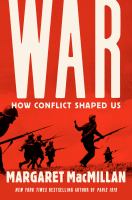
War

 In many historical accounts the emphasis is on wars--who won them and the consequences.  Others declare that historians overlook the more important cultural developments.  Margaret MacMillan contends that wars have shaped us in ways that deserve serious study.  To run an organized military assault (or defense) requires organization that came after the Agricultural Revolution.  Ironically cultures both transfer organization to military powers, but also receive many cultural items from military experiences.  One example, Norman Bethune developed blood transfusions during the Chinese Revolution.

Society is pulled in different directions by warfare.  There are many factors encouraging war, but there are also many counterpoints.  Margaret has studied both sides. 

 Margaret quotes Carl von Clausewitz for a definition,  "War is an act of violence intended to compel our opponent to fulfill our will."

Warfare advanced as civilization advanced.  Mankind discovered how to shape metals and tamed horses for our ends.  Many developments boosted our ability to kill others.  Horse stirrups provided a more stable platform to inflict killing.  Napoleon marching at night caught the enemy off guard. The  Manhattan Project to develop the atomic bomb was the most intensive use of science for military goals.  

Strategies include developing superior weapons, more effective discipline and as Sun Tzu declares, "All War is based on deception."  That reminds me of a book title "The Name of the Game is Deception" describing basketball, but in reality could be used for almost any sport.  All sports could be considered preparation for warfare which is leveraging your resources effectively.

Reasons for war are many, but they boil down to greed and fear and include religion.  In reality it the ruling class who sees an opportunity or is fearful.  They then attempt to persuade the citizens that the cause effects them war can break out.

Frederick the Great felt "A soldier must fear his officer more than the enemy."  All procedures to reinforce obedience were critical.  In contrast the author has Tim O'Brien tell us "Man killed and died because they were embarrassed not to.  It was what had brought them to war in the first place  Nothing positive, no dreams of glory or  honor just to avoid the blush of dishonor."  On the other hand some men developed fighting skills and would hire themselves out.

Women played a variety of roles.  Unfortunately prostitutes followed the armies--the term hooker comes from brothel prostitutes that followed the army of General Joseph Hooker.   In the last century or two many women filled in for the men gone to war leaving factory jobs more important than ever.  Women gradually picked up roles closer to combat such as nurses, ambulance drivers, clerical support.  By the time of the WWI they were no longer ready to go back to their old roles with many countries opened up the vote for women.  Too often women are affected in another way:  http://www.therealjohndavidson.com/2013/11/remembrance-day-is-not-just-for.html

Legalities are difficult to get nations to agree to and even more difficult to enforce.   Agreements were made for prisoners of war civilians, women.  Flame throwers were legal, but not poison   The Nuremberg trials were intended to make war criminals accountable with following orders not acceptable as an excuse.  One irony was that one activity not indicted was mass bombings.  United States does not accept judgments from the International Criminal Court (but would quote findings for their own purposes)

Manufacturers benefited from warfare.  Eisenhower warned the American public about the military industrial complex and we can see today that their lobbyists are very successful in boosting military budgets in many nations.  Alfred Noble invented more effective explosives, originally for the mining industry, but realized the military increased his profits.  His guilt feelings led to the Nobel Peace Prize.

Newspapers and the media profit from increased attention.  Winston Churchill was a correspondent during the Boer War and like many war correspondents supported "patriotic" efforts.  

The Arts have been involved with wars.   They have been used to glorify and spur, but also to protest.  Censorship has been used to control critical information and also to mislead.

 Marching music is not only used to recruit, but also to move troops in battle.  A wide variety of orders can be communicated with drums and bugles over the battle sounds.

Photography was used for the American Civil War.  Most of the early photography could be controlled through censorship, but as both the size and price of cameras came down it was more difficult to control the distribution of photos.  Vietnam photos turned off the American pubic convincing many it was unjust and unwinnable.

Paintings have been used to commemorate and glority.  Picasso's famous "Guernica" was used to denounce war and the arttist refused to let it go to Spain until democracy restored.  As of 1981 it sits in Madrid.   It is said that a Gestapo official visited Picasso in occupied France and upon seeing a photo of "Guernica" asked if Picasso had done it and the reply was, "You did."

Wars create heroes or you might say they churn them out.  Incentives are used to lure recruits such as money, glory, travel, learn a trade.  On average it is easier to attract the poor.  For the wealthier glory is used.

 As a youngster G. A. Henty adventure stories fascinated me.  Not conscious that I was being indoctrinated, but looking back Margaret was right to point out the indoctrination was deliberately encouraged.

Costa Rica is one country that decided to dispense with a national army so they could apply that expense to boosting literacy for its citizens. The ancient Chinese glorified scholars more than warriors.

All groups make decisions. President Dwight Eisenhower had a quote that behooves us to weigh more carefully.  "Every gun that is made, every warship launched, every rocket fired signifies, in the final sense, a theft from those who hunger and are not fed, those who are cold and are not clothed.  This world in arms is not spending money alone.  It is spending the sweat of its laborers, the genius of its scientists, the hopes of its children."   

The future of warfare seems likely to be cyber warfare  Get ready as it will change things all over again.  Already attacks have taken place. 

Sunday, May 30, 2021

Should we defund the Police? What does that mean?

The big question put by some people is should we defund the police.  This is interpreted from a range of cutting all budgets for existing police forces to diverting some funds to other conflict resolving entities.  In the United States the situation regarding police killings of blacks has inflamed public opinions.  W. Kamau Bell recently did an episode of "United Shades of America" that inspired this effort.  No blog post is going to solve the dilemma, but my goal is merely to offer some thoughts to stimulate constructive decisions.

 The slogan "Defund the police" is offensive to many.    Most everyone recognizes a need for police services, but lately with the greater use of videos we are aware of serious flaws.  With taxes being a dirty word there is a limit on how we can divvy up limited resources.  Part of the problem is that most of us think of taxes as a sacrifice instead of an investment.  Taxes should be thought of more like "the price of civilization." Some thoughts on taxation:  http://www.therealjohndavidson.com/2021/05/taxation-necessary-tool-for.html

Do we really want to throw the baby out with the bath water?  We don't want anyone to suffer unnecessary violence and death, but that is hardly the whole story of police.  A lot of what they do is not stated--their mere presence deters a wide variety of misbehavior.  Thousands and thousands of police officers have protected people from harm.  They have helped to recover stolen property.  Many have even steered misguided youth on a better path.  As in so many other issues a balance is needed.

Fear is a powerful factor, even more than greed when resources are being prioritized.  Politicians want power for different reasons, but the successful ones soon learn how to get attention.  Short term concerns are more effective than long term concerns.  Newscasts and newspapers learn to draw ratings with sensationalism with the motto "if it bleeds it leads."

Law enforcement will be a necessity as long as some humans harm or exploit others and we still believe everyone deserves a "fair chance."  Violence and theft are concerns we all feel.   It cannot be argued that everyone would obey whatever laws the majority agree to without some fear of possible violence or imprisonment.  On the other hand conflicts are normal and often require only a better understanding to be resolved.  An important factor sometimes turns out to be mental health.  

Politicians have found that running on a law and order campaign guarantees a core following.  Some are fearful and others can be encouraged to fear all sorts of things, many of them unspoken.  Once in power the elected decision makers have to prioritize spending while also trying to minimize taxes.  If fear causes police budgets to be bolstered, it has to be offset with cuts elsewhere.  Parents value schools, but non parents see little value.  To me education is crucial for society to function:  http://www.therealjohndavidson.com/2011/05/central-role-of-education.htmland http://www.therealjohndavidson.com/2012/11/what-teachers-make-by-taylor-mali.html

 How does education help reduce crime?   It must be admitted that education allows some to defraud others, but that should be minimal to how more people are liberated.  An educated citizen is not just one with a lot of knowledge, but also with the realization that no one knows everything.  A good education should suit individuals to their talents and opportunities.  Critical thinking skills may not be attainable by everyone, but the more that such skills are developed the better for everyone.

We are headed where the production and services expected by citizens will be done by fewer and fewer people.  This could create much greater inequality unless enough people take steps to avoid it.  Inequality would exacerbate violence and deception for those who are not satisfied with their lot in life.  This may well be another critical factor.

A lot of attention is being given to bad cops, but it would be unfair to depict all police as violent trigger happy racists.  Recruiting and training are key, but so are enforcing standards.  At one time a stereotypical image was of an Irish cop which in reality was the result of economic factors that discriminated against the Irish.  Today it does seem that blacks are one minority that has been attracted to law enforcement.

How does society attract decent men and women who can not only enforce the law, but resolve conflicts without using violence or even the threat of violence? That is a key question with no easy answers as such people are in demand elsewhere.  Given the right education such people do exist, but many would prefer other challenging vocations.  Pay and working conditions need to be considered.

Education is for everyone.  With the right education (and a fair economy) for everyone there may well be less need for law enforcement, but it is wise to assume humankind will never reach this level, at least not in our lifetime.  Too many youngsters drop out and too many others flounder for reasons that need examining.  Education needs to be a much higher priority and should receive more resources than police as they currently exist in too many jurisdictions.  It is true that most voters do not share this viewpoint when it comes to dollars and cents, but overcoming this obstacle needs to be a mission for everyone who has power.

We no longer live in isolated villages and need to better understand what makes other people function.   There are so many things humans with a variety of talents need to know that it is a separate topic.   

Individuals need a general education, but also a specific education.  Those who will help enforce laws require skills.  Wisdom is not reacting to circumstances with set responses, but evaluating and considering reasonable options.  In dealing with other people  (in my opinion) psychology and sociology are useful to understanding people.  Diversity is actually normal even in closed societies, but too often discounted in open societies.  Some differences are obvious, if too often dismissed.  The more the differences can be understood, the less need for conflict.

As we have learned in medicine and science there is so much knowledge that we have to develop skills to co-ordinate various aspects of it.  Nobody has the answer to all problems.  One skill is to determine what higher level of skills are required.  The crux of dealing with problems is to understand.  If we can learn (and some of us already have) to apply skills more effectively there will be less need for forceful interventions.  Career guidance is key--theoretically everyone is suitable for some job, but some are especially suited for demanding jobs.  

Some police forces have access to resources that allow them to use military weapons.  A few years ago there was discussion about sharing helicopters to thwart car thieves in the Toronto to Hamilton corridor.  It came down to there were other  options that were less expensive.  Force settles some problems, but aggravates others.  President Eisenhower wisely pointed out that a bomber displaced several schools.  Society has to decide more wisely where our resources are best allocated for the most harmony.

Police unions may be an obstacle to any rearrangement of resources.  It is their duty to protect members, and it should be expected they would want to protect job security.  We hear reports that too often they represent bad cops and have been effective in reducing any punishment.  Assuming that existing police jobs are displaced in favor of specialized conflict resolvers might it be possible for the same union to represent the new ones?  There are potential conflicts and perhaps the new members might feel they are not understood properly.

The core problem is people.  We are greedy and we are fearful.  We are not equal and are easily misunderstood.  But we need to get our act together before it is too late.  An effective police force supported by appropriate specialists could help steer us to a better future.  Even so, this would only be part of the puzzle.

Wednesday, June 7, 2017

War as explained by Gwynne Dyer

A few weeks ago I was able to listen to Gwynne at my local library http://www.therealjohndavidson.com/2017/04/gwynne-dyer.html   His talk inspired me to read one of his earlier books (based on a tv series), "War."

War seems like a natural part of human history.  All our history seems to revolve around wars with the winners telling the stories.  Gwynne goes beyond recorded history to start his account.

Studies done in World War II and further back to the American Civil War revealed a strange thing in that most soldiers did not fire their guns to kill.  Up until recently most soldiers were trained how to use weapons and obey orders, but little attention focused on motivating them to actually kill.  That has changed and Dyer gives the example of marine basic training.

War as we know was not natural for hunter gatherers who often kept away from contested areas and even needed other groups for intermarriage.  When conflicts occurred (sometimes a result of famine or drought) humans learned that aggressiveness paid off resulting in more resources including mating which in turn led to more aggressiveness.

When historical forces resulted in cities, conflicts became more common.  To reinforce the need to kill one early development was the phalanx, originating in Mesopotamia.  It was with soldiers lined up in rows with the back rows pushing forward.  The Romans perfected this strategy and conquered much of the known world.

Tactics didn't change much, although many elements were added.  Horses were effective and had been bred to carry heavier loads.  They could be counteracted, and even elephants as well.  The big development was with guns preceded by bows and arrows.  They killed at a distance.  A little before WW I one response to guns was trenches.  They effectively stalled forward movement.  Airplanes first used in WW I were used for reconnaissance, and bombing.

A strategy developed to cut off supplies meaning that cities and civilians would be attacked.  Previously one's fate was decided on the battlefield, but non combatants became targets.

World War II ushered in the nuclear age.  The Germans had previously used V2 rockets to inflict danger from a distance.  It was possible to kill people without being consciously aware of them as humans.  The nuclear option obviously changed ideas.  The great powers realized if they used them against other great powers it would be the end for all.  Conventional wars were generally involving lesser powers.

Dwight Eisenhower warned about the power and influence of the military industrial complex. Ammunition and weapons manufacturing have been politically powerful and naturally identify enemies to cause fear.

Dyer discusses guerrilla wars that can only succeed when there is political will behind them.  Two successful examples are Mao Tse Tung and Fidel Castro.  Terrorists do what they do because they cannot mount an army.

The book was revised in 2004, so does not cover drones or ISIL.  Gwynne has been keeping up with developments and thinks the dynamics have not changed critically.

Dyer sees some hope after a case study of baboons in Kenya using a quote from Frans de Waal., "The good news for humans is that it looks like once established peaceful conditions can be maintained.  And if baboons can do it why not us?"  It seems over twenty years ago the leaders of one baboon group, very aggressive and belligerent to females and lesser males claimed exclusivity over a dump that contained poisonous food resulting in their deaths.  Anthropologists studying the result over the years noted that the surviving baboons did not pick up the aggressiveness and belligerency of their predecessors and managed to live in peace.

The author traces the problem to the beginning of civilization.  Prior to that hunter-gatherers lived in small groups that were relatively equalitarian,  It is only when agriculture allowed humans to live in one place and to greatly increase their numbers that top down decisions became common.  This began power struggles that escalated to nation states contesting one another on a wide variety of issues.

Dyer identifies three trends that will demand global attention.  Climate change if not checked will accelerate and cross all borders.  New nations will rise in power for example China, India, Korea and Brazil questioning the old order.  And third, technology will advance beyond the nuclear threat.

Quoting: "the rising powers must be absorbed into a system that emphasizes co-operation and makes room for them, rather than one one that deals in confrontation and raw military power.  If they are obliged to play the traditional great power game of winners and losers then history will repeat itself and everyone loses."  Military concerns take attention from climate change.  Multi lateral systems must survive or we won't.

The United Nations is certainly imperfect, but it is the best tool we have.  The League of Nations was a first step, but founders afraid of being too restricted.  The United Nations was formed with a more realistic format, but still faces a long path to world wide peace.  Progress will be uneven.

Nuclear weapons still attract insecure nations and the more widespread the more likely a problem.  Still some nations have rejected including Canada, Japan, Germany, Sweden and Switzerland.  A few others have pulled back such as Argentina, Brazil and more recently Libya.

There are a lot of details with many historical examples to ponder.  Dyer, even today is fairly optimistic.  The critical factor now is mass communications.  People at all levels are more aware of world news.

To be well informed about international dynamics you really should read his weekly columns and if you do not have access to the over 100 newspapers you can catch up at his website, http://gwynnedyer.com

Sunday, August 14, 2016

"DECISIVE" CAN HELP YOU MAKE BETTER DECISIONS.

You got to where you are by millions of decisions.  Most of them were seemingly trivial.  Some of them turned out ok perhaps by correctness or maybe by luck.  Many were positive, but not quite what you had hoped for.  And then there are others you wish you could take back.  You can move towards a more satisfying life by making better decisions.  "Decisive" by Chip and Dan Heath offer a different perspective and lots of practical suggestions.  I am sure many readers, including myself will wish they had read this book sooner.  It is never too late to improve your situation. and reading this book would be a good decision.

Some decisions are more important than others.  Personally I have recommended and tried to use the Ben Franklin method (weighing the pros and cons) when confronted with a serious decision.  Chip and Dan Heath have found serious limitations with this standard method, especially for the more important decisions.  Studies show that process is more critical than analytical by a factor of 6.

That got my attention.  The following is a short form of what they suggest is a better way.

They identify four problems with decision making regarding analysis.  Lots of examples.

One problem is the decision is too narrowly defined.  It is not necessarily one action or a different action.

Analysis is subject to confirmation bias.  That is, we have a tendency to select facts that bolster our preference.

A common problem is we are trapped in our circumstances If we can take an outside perspective we can detach ourselves from short term emotions.

A fourth problem is that we are often over-confident of how we see the future.

Taking a different angle, the authors propose a different strategy, one that focuses on process.  They label it WRAP.  Widen options.  Reality-test your assumptions, Attain Distance before Deciding.  Prepare to be wrong.

Of course these strategies are easier to state than to actually do.  There are many practical details with interesting examples.

One example was a reference to President Dwight Eisenhower when he explains the cost of a heavy bomber not in dollar terms, but as equivalent to 30 brick school houses.  There are always alternatives.

Another  example was David Lee Roth, famous rock star with apparently weird requests.  For a rock concert they requested containers of M and M candies with all the brown ones removed.  This request was actually buried amongst others reflecting their need for technical requirements for their performance.  Arriving at a new performance site they would check this seemingly vain preference  feeling relieved if it was adhered to, but if not they immediately set up a check of the critical technical details necessary for an optimal performance.  The authors label this a "tripwire."

Most decisions involve other people who often are not included in the process.  The success of a decision often revolves around those who are not consulted.  The authors advocate greater inclusion to get greater commitment.  This sense of fairness was reflected in another book I read, "The Art of Engagement."  Read more:  http://www.therealjohndavidson.com/2014/12/the-art-of-engagement.html

There are many other examples and explanations to better think of decisions as a process rather than merely an analysis.

A quote that got my attention;  "Sometimes the hardest part of making a good decision is knowing there is one to be made."  This points out the merit of having a tripwire.

To read more of what Chip and Dan have to say go to:  http://www.heathbrothers.com

Friday, March 11, 2016

THE RIGHT WAY TO LOSE A WAR


With the American election looming lots of people have something to say about American military ventures.  Since World War II Americans have had a lot of frustrating experiences.  Dominic Tierney suggests there will be more wars of the type that have ended poorly for Americans.  By examining the past he suggests better strategies.  This book was recommended by Fareed Zakaria, always a good indicator.

The author starts with a personal history to explain the often peculiar consequences of war.  His Great-Grandmother after having two children was widowed after her husband had spent several years fighting in WW I and died near the end.  The author feels there were several logical points to end the war, but unfortunately it went on too long for literally hundreds of thousands of casualties.  But for him his Great- Grandmother remarried and gave birth to his grandfather.  History is full of similar adjustments to military conflicts.

The book is loaded with historical examples from Ancient Rome right up to current Mid-East conflicts.

Americans after WW II had changed.  They felt capable of dealing militarily with remote places and a sense of responsibility.  Most of their allies suffered a lot more from the war and those they conquered, Japan and Germany had military ambitions knocked out of them.  Americans got involved with places they didn't really understand:  Korea, Vietnam, Afghanistan, Iraq.  Assumptions were made and all too often action was commenced without really sorting out the consequences.

The outcome of war is not binary, ie. it is not all successful or all failure.  To optimize your chances, a state that is considering an attack, should not first  think of the first strike, but needs to plan the end game and work backwards.  He uses example of Cuban chess master, Capablanca who always thought how he wanted a match to end and worked backwards to achieve that result.  War is admittedly different, but the same principles can apply.  The author's strategy is surge, talk, leave.

A surge is a quick well thought out effort to consolidate your position.  Talking should start at the first practical opportunity.  Leaving requires some delicate manoeuvring.

Almost all wars discussed could have been ended sooner with less expense and loss of life.  They could have ended much more to mutual benefit,

The War of 1812 was a good example.  One could argue the Americans were lucky to avoid the full resources of the British Empire, but they were smart to realize Britain had higher priorities thanks to Napoleon.  The Treaty of Ghent, negotiated by John Quincey Adams and Henry Clay served the Americans well.

There are a number of factors that inhibit leaders from negotiating peace.  The concern for reputation-as a nation, as an individual, or as a political party.  Democrats are often accused of being weak.  Once committed in war the military feel they have much to lose.  Sunk costs seem like a waste unless redeemed by victory.   It is especially hard to end a war you started as the Kennedy/Johnson presidency and later George W. Bush can attest.

Prisoners are a concern to both sides and can be an early issue.  During the Korean War, President Truman wanted to give North Korean and Chinese prisoners a chance to defect if that is what they wanted, but of course the other side wanted to avoid that.  Both sides want to save face and that should be taken into account early.

After an army has left a country there are still concerns.  Too often the returning soldiers are not taken proper care of.  We are now aware of PTSD in a way we never were before, but it still has an impact. How the soldiers are treated has ripple effects and can make the rest of the population doubt that the cost was worth the effort.

The aftermath can be diverse.  The Americans fought the Vietnamese under the mistaken assumption it was necessary to avoid giving the Chinese more power and ironically the Americans are now working together with the Vietnamese to offset the Chinese.  Trade is more effective than aid, in resetting relationships.  Afghanistan is the world's leader in illegal opium, but they do have other assets that could be traded including pomegranates, gold, copper and lithium.

This brief summary doesn't cover all the concerns warring nations have, but the author has devoted much thought and research to finding better solutions.  He predicts that there will be many civil wars in far distant lands that can affect us, but do not need to be quagmires.

I would like to close with a few words found in the text quoting Dwight Eisenhower.  "Every gun that is made, every warship launched, every rocket fired signifies, in the final sense a theft from those who hunger and are not fed and those who are cold and are not clothed."

You can read more of Domenic Tierney's opinions at http://www.fpri.org/contributor/dominic-tierney/