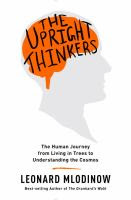
A bit about the author, Leonard Mlodinow. His father had been imprisoned in a Nazi concentration camp in Poland and as a non scientist is used as a reference point a couple of times. Leonard himself is a physicist, but has also been on the writing team for "Star Trek; the Next Generation" and "MacGyver."
The title reflects the monumental change when our ancestors operated on four legs to taking a two legged approach to life. The disadvantage was that we were not able to move as fast as our predators or our prey. On the other hand, we had the use of hands and we were able to see further. From there we evolved further.
We fancy ourselves as modern thinkers, but take for granted the countless efforts (often opposed by the majority) to develop our understanding of the world. The author thinks the first step was turning stones into cutting tools.
At early stages humans were generalists meaning each person did everything. Advancement came with specialization. Agriculture and domestication of animals developed. In turn this inspired humans to better understand nature. Another innovation was developing irrigation which the author considers a true wonder requiring much labor using crude tools. All this led to a surplus of food. Another step would be to develop a bureaucracy to keep track and a militia to protect resources and then to a priest-king. There was no separation of church and state.
Rulers needed information. Languages developed and writing provided another breakthrough allowing information to spread over distance and time. Arithmetic needed to keep track of supplies and to measure a wide range of things. The concept of laws developed. I would say this signaled the recognition of collective rights.
The author draws our attention to the city of Miletus in today's Turkey. About 600 B.C. they had a population of 100,000 with an agricultural base and a trading network. They had colonized as far as Egypt where knowledge of geometry was learned. Nature was being understood better with one example being eclipses were not the result of Gods. Questions are being asked.
Aristotle had been a student of Plato and went on to become a tutor to Alexander (the Great). He returned to Athens and wrote his famous works. Greek science was advancing, but when Romans took over science declined while engineering advanced. I had read that the Etruscans are the ones that gave the Romans a head start with engineering projects, but thinking themselves more practical had less interest in science.
After the Roman Empire fell, the Arabs were fascinated with Greek science and even made their own contributions. Eventually Europeans re translated many Greek texts to Latin. Muslim fundamentalists gained control of education and the Arab contributions to science declined. The printing press opened up communication for all sorts of ideas. which led to paper being more available.
Galilei Galileo was the next scientific breakthrough noted by Leonard. Scientific method requires a questioning mind. He developed a telescope and was able to see craters on the moon and moons around Jupiter. Perhaps more importantly he developed theories about motion that helped Isaac Newton develop more accurate theories.
Isaac Newton takes Galileo's work to another level with his three laws. He also invented calculus. Driven by curiosity and attention to detail. Although not traveled very much he did correspond extensively.
The physicist author switches attention to chemistry which focuses on matter. At one time philosophers thought everything was made up from only four elements--earth, air, fire and water, not realizing that each of these elements are composed of more basic elements. Dmitri Mendeleev broke down elements with known facts and recognizing that there were many unknown facts. With persistence spread over many years this Russian developed the periodic table. He knew there were gaps in the table, but was able to predict the characteristics of elements and even weights not yet discovered. The periodic table was first published in 1869.
Biology was another major science field. Back in 1664 Robert Hooke had been able to identify small components for all living creatures and plants that he called "cells" as they reminded him of monastic cells. Cells had the ability to copy themselves. This led to conflicts with established religion.
It took a deeply religious man, Charles Darwin to advance our understanding. It a series of fortuitous flukes he went on the famous Beagle voyage and gathered much material which he shared with naturalists who gave him feedback. It was years in developing his theory of natural selection that led us to more modern concepts of evolution. It was more years before he felt comfortable to release his work and ever since there has been opposition.
Knowledge has advanced through the efforts of thousands of curious people gradually given more resources and the information from predecessors. Newton and Darwin were not aware of atom structures, but along with many others prepared that path for people like Albert Einstein and Max Planck. Read more on Einstein: http://www.therealjohndavidson.com/2021/03/einstein-by-walter-isaacson.html
The author notes that even scientists can get too comfortable with what they know and resist accepting new ideas Fortunately there seems to be a good supply of curious people willing to ask further questions.
I found that book difficult to read at times, but also compelling. I have skimmed over much information, but assure you there is much meat to be discovered. Non scientists take a lot for granted, but all of us would benefit from a better understanding of what makes up the universe and how knowledge has been accumulated. Leonard Mlodinow is a gifted writer who makes it all seem to make sense. The future is unknown, but there is much information to uncover. Personally I have a greater understanding of what happened before me.
How are we advancing today? Teachers are essential; http://www.therealjohndavidson.com/2012/11/what-teachers-make-by-taylor-mali.html

