Showing posts with label Isaac Newton. Show all posts

Wednesday, June 15, 2022

Cosmos: Revisited 40 years later

The title is well explained by Carl Sagan,  "The cosmos is all that is or ever was or ever will be."  He further points out genetic connection between trees and animals.  In effect this subject is the most all encompassing blog I have ever attempted.

 Originally released to PBS in 1980,I can remember viewing it in parts with Dan Lovranski, a second cousin to my wife.   This version had updates and another more recent version with Neil DeGrasse Tyson is further updated.  A copy of the book has been on my shelf for a few decades and proved useful.

Science can be difficult to explain to non scientists.  They used animated segments, art work dramatized video reenactments.  Locations visited, included Siberia, Alexandria,Egypt; Calcutta, India; a Navajo reservation, Angkor Wat, Rome, Paris and Tokyo.  Carl Sagan is a good showman and very articulate presenting his case,

 Carl Sagan, not only was a legitimate scientist but has been a popularizer of science which some resented.  He inspired many and was thought provoking   Carl Sagan suffered a lot of criticism for his popularizing efforts, but also was able to penetrate the public's disregard for science.  For some he opened the door to a more detailed study of science and how science impacts public issues.  There is room for detailed studies, but honestly they don't have the impact with the public if they cannot be explained.  It is a similar skill to putting an 800 page book into a two hour movie--something gets left out and something is subject to distortion.

Carl was an advisor to NASA and helped develop some of the ideas.  Robotic mobile equipment and determining difficult landing choices.  He helped develop message to aliens on a disc to include different languages, music and mathematics symbols.  He failed to make contact with aliens.  The odds indicate there must be other developed life forms.  One speculation was that perhaps as other societies reach the technical capabilities to communicate they self-destruct, which hopefully makes us take a closer look at our own projection.  He advocated for more robotic missions rather than manned flights.

The concepts of infinity and eternity are incomprehensible.  He gives examples of large numbers and pointed no matter how large number one can devise you can always add one to make an even bigger number.   Sagan points out the Hindu religion is the only religion that deals with the infinite universe.  In addition to long time scales they have the concept of destruction and rebirth.  

He suggests perhaps the spark of life may have come from meteors. Likely life was one cellular for millions of years, but gradually we evolved towards the variety we see today.  Sagan points out that all life is connected including trees and humans.  Plants need carbon dioxide while animals need oxygen.  Plants convert energy from the sun that provide animals with energy and building blocks.  The brain evolved and Sagan points out we all have a connection to a reptile brain.  He speculates may that aliens might have  more developed neuron system that allows them to think much faster. 

Knowledge  is accumulated gradually.  One of the early breakthroughs was from Erastothenes, a scientist in Alexandria was able to calculate the circumference of the world by the shadows of a stick in two different parts of Egypt.  He posted that the world was about 40,000 kilometres around and that was amazingly close considering the primitive tools available.  

Science is built on small understandings.  Isaac Newton made a big breakthrough regarding gravity, but admitted that  "If I have seen further it is by standing on the shoulders of giants."  Sagan recounts many small steps with such as Euclid, Hypatia, Johannes Kepler, Leonardo Da Vinci, Albert Einstein and many others.

The Russians were first to land a rocket on another planet, Venus.    We learned about the surface beneath an impenetrable cloud like atmosphere that was essentially lifeless.  Sagan was one of the ones that realized there was a greenhouse effect and further considered such a prospect could be in earth's future.

Mankind is vain, including many leaders and would be leaders.  Too many of us take for granted our good life and assume the best is yet to come.  As "Cosmos" points out life is fragile. It has taken billions of years for life to evolve to its current point with humans on top of the ladder.  Knowledge has gradually built up and  we truly do understand much more than our ancestors, but it has gone through many dark periods where we have lost many thoughts and calculations.   Best to remember that species have died, civilizations have disappeared, even stars die.  Climate change and a nuclear winter are real risks. Last episode was about the big risk--did other civilizations self destruct--nuclear war--lost knowledge

Communication with foreigners has always been a challenge, but more so with aliens.  Sagan suggests we look at animals, especially whales who have shown ability to "speak" over thousands of kilometers. Cuneiform writing on rocks was an early precursor led more sophisticated form and with the invention of paper, ink, and printing on wooden blocks in China.  Moveable printing in Europe allowed the more rapid spread of information.  Now of course ideas spread electronically.  Writing allows us to communicate across ages and over great distances where before we relied on word of mouth.

 Misinformation and misunderstandings are common.   Wild speculations (including his own) can capture the public's fancy, but real breakthroughs generally come through tedious calculations.

In short, Carl Sagan opened up our awareness to the Cosmos.   We are really very small, but part of a glorious entity.  Will we learn how to get along?  Will we use the accumulated wisdom of the year for a happy future? 

Earlier blog:  http://www.therealjohndavidson.com/2012/10/carl-sagan-and-our-future.html

Thursday, January 20, 2022

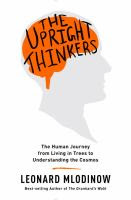
The Upright Thinkers

A personal quest is to better understand how we reached our present level of civilization and our unique role in the world.  Leonard Mlodinow has tackled this in an illuminating and humorous manner.  The main theme is that it took a long time, so long we cannot really comprehend it.  In reality it took many small steps to reach our state of being with each step breaking down into smaller steps.  Sir Isaac Newton has been quoted "If I have seen further it is by standing on the shoulders of giants."

A bit about the author, Leonard Mlodinow.  His father had been imprisoned in a Nazi concentration camp in Poland and as a non scientist is used as a reference point a couple of times.  Leonard himself is a physicist, but has also been on the writing team for "Star Trek; the Next Generation" and "MacGyver."

 The title reflects the monumental change when our ancestors operated on four legs to taking a two legged approach to life.  The disadvantage was that we were not able to move as fast as our predators or our prey.  On the other hand, we had the use of hands and we were able to see further.  From there we evolved further.

We fancy ourselves as modern thinkers, but take for granted the countless efforts (often opposed by the majority) to develop our understanding of the world.  The author thinks the first step was turning stones into cutting tools. 

At early stages humans were generalists meaning each person did everything.  Advancement came with specialization.  Agriculture and domestication of animals developed.  In turn this inspired humans to better understand nature. Another innovation was developing irrigation which the author considers a true wonder requiring much labor using crude tools.  All this led to a surplus of food.  Another step would be to develop a bureaucracy to keep track and a militia to protect resources and then to a priest-king.  There was no separation of church and state.  

Rulers needed information.  Languages developed and writing provided another breakthrough allowing information to spread over distance and time.  Arithmetic needed to keep track of supplies and to measure a wide range of things.  The concept of laws developed.  I would say this signaled the recognition of collective rights.

The author draws our attention to the city of Miletus in today's Turkey.  About 600 B.C. they had a population of 100,000 with an agricultural base and a trading network.  They had colonized as far as Egypt where knowledge of geometry was learned.  Nature was being understood better with one example being eclipses were not the result of Gods.  Questions are being asked.

Aristotle had been a student of Plato and went on to become a tutor to Alexander (the Great).  He returned to Athens and wrote his famous works.   Greek science was advancing, but when Romans took over science declined while engineering advanced.  I had read that the Etruscans are the ones that  gave the Romans a head start with engineering projects, but thinking themselves more practical had less interest in science.

After the Roman Empire fell, the Arabs were fascinated with Greek science and even made their own contributions.  Eventually Europeans re translated many Greek texts to Latin.  Muslim fundamentalists gained control of education and the Arab contributions to science declined.  The printing press opened up communication for all sorts of ideas. which led to paper being more available. 

Galilei Galileo was the next scientific breakthrough noted by Leonard.  Scientific method requires a questioning mind.  He developed a telescope and was able to see craters on the moon and moons around Jupiter.  Perhaps more importantly he developed theories about motion that helped Isaac Newton develop more accurate theories.

Isaac Newton takes Galileo's work to another level with his three laws.  He also invented calculus.  Driven by curiosity and attention to detail.  Although not traveled very much he did correspond extensively.  

The physicist author switches attention to chemistry which focuses on matter.  At one time philosophers thought everything was made up from only four elements--earth, air, fire and water, not realizing that each of these elements are composed of more basic elements.  Dmitri Mendeleev broke down elements with known facts and recognizing that there were many unknown facts.  With persistence spread over many years  this Russian developed the periodic table.  He knew there were gaps in the table, but was able to predict the characteristics of elements and even weights not yet discovered.  The periodic table was first published in 1869.

Biology was another major science field.  Back in 1664 Robert Hooke had been able to identify small components for all living creatures and plants that he called "cells" as they reminded him of monastic cells.  Cells had the ability to copy themselves.  This led to conflicts with established religion.

It took a deeply religious man, Charles Darwin to advance our understanding.  It a series of fortuitous flukes he went on the famous Beagle voyage and gathered much material which he shared with naturalists who gave him feedback.  It was years in developing his theory of natural selection that led us to more modern concepts of evolution.  It was more years before he felt comfortable to release his work and ever since there has been opposition.

Knowledge has advanced through the efforts of thousands of curious people gradually given more resources and the information from predecessors.  Newton and Darwin were not aware of atom structures, but along with many others prepared that path for people like Albert Einstein and Max Planck.  Read more on Einstein:  http://www.therealjohndavidson.com/2021/03/einstein-by-walter-isaacson.html

The author notes that even scientists can get too comfortable with what they know and resist accepting new ideas  Fortunately there seems to be a good supply of curious people willing to ask further questions.  

I found that book difficult to read at times, but also compelling.  I have skimmed over much information, but assure you there is much meat to be discovered.  Non scientists take a lot for granted, but all of us would benefit from a better understanding of what makes up the universe and how knowledge has been accumulated.  Leonard Mlodinow is a gifted writer who makes it all seem to make sense.  The future is unknown, but there is much information to uncover.  Personally I have a greater understanding of what happened before me. 

How are we advancing today?  Teachers are essential;  http://www.therealjohndavidson.com/2012/11/what-teachers-make-by-taylor-mali.html

Thursday, August 16, 2012

Some thoughts on Ayn Rand

The recent nomination of Paul Ryan as the Republican candidate for Vice President has reminded me of one of my youthful literary escapades.  In my twenties I bought a copy of Ayn Rand's "The Virtue of Selfishness."

I read it a few times, underlining many passages.  I was quite struck by many of her arguments and have retained some respect even today.  Essentially she argues that if everyone pursues their selfish interests it is best for society.  For instance, my example, if enough people with enough money want to drive a car then there will be jobs for people making cars.  The system falls down when someone decides that we have too many cars and people should buy bicycles instead.  This causes unhappiness:  those making a living making cars lose their jobs and those who want to drive cars are frustrated.   I am reminded of a quote of Zig Ziglar:  " You can get whatever you want if you help enough people get what they want."

One point I still agree with whole heartedly is that to really follow your selfish interests it is best to take a long term view rather than a short term view.  To me this is one of the biggest issues of society today, impatience to get what we want.

The decision boils down to individualism vs. collectivism as how I read it recently.  Like many dichotomies there is merit to both sides, but there is also danger should either one dominate.

Balancing her contentions in some ways is Stephen R Covey.  In essence his book, "The Seven Habits of Highly Effective People" is a guide to how an individual can be more effective, that is get more of what they want.  But the thinking is more all encompassing.  One of the habits is to understand deeply what the other person thinks and feels.  Another habit is to look for a win-win solution, very strongly stating that if only one side wins it is not the best solution.  Covey believes that society is inter-dependent and if you want to be effective (ie. succeed) you need to work within that framework.

Civilization did not get to where it is by constantly re-starting from scratch.  Isaac Newton said he stood on the shoulders of giants who came before him.  Over eons of time a lot of good ideas were gradually discovered by individuals and even more slowly accepted by others.  All individuals are totally dependent on the good will of others when born, but as they matured were able to contribute to the good of others.  As we mature our feeling of independence grows, but some of us never really realize we are always dependent on others.

Peer pressure is not always for the benefit of individuals or even of the group.  Most people, most of the time like to keep things the way they are and resist any change (including who makes different decisions for different concerns).  Change is how we progress.  Just as we want and need freedom to express ourselves and to contribute so do others.  We need to give them the room and the opportunity.

Implicit in these discussions are judgments on other people.  Ayn Rand contends they deserve what they get because they made a lot of decisions that put them there.  It is true that we are where we are not only because of decisions we made, but also because of decisions made by others.  If we are honest most of us have made bad decisions.  Sometimes we learned from them, sometimes we got locked in.  Sometimes we realized other people had been confronted by the same problem and learning how they handled it could be helpful.  Often someone else' decision created obstacles. It is true that some people are better than others at over coming obstacles, but it is also true that some people have more difficult obstacles to overcome.

Can we say all decisions are rational?  I would say too many decisions are emotional and that includes intellectuals.

As a society we will all suffer the consequences of poor decisions.  We all lose when the best person doesn't get the job, when talent gets wasted, when anyone suffers unjustly, when deserving people don't get a chance, when greed wins over justice.  Every individual in many ways got their power with the help of many other individuals and of circumstances.  How they exercise their power affects everyone.

Another set of thoughts that enter my thinking is from Bertrand Russell who wrote an essay, "In Praise of Idleness."  There are many people it seems to me who are quick to criticize those who apparently are not doing anything "useful" or who are not pursuing a normal path. They are just enjoying something.  We look down on such people, but we should respect what they want out of life as long as it doesn't hurt others.  If you cannot enjoy life what is the point?

Human nature should be the basis of how we organize ourselves.  We have many commendable traits, but unfortunately most look out for ourselves most of the time.  Some of us are talented at getting more than our share in relation to what we contribute.  A few are very adept at bending the rules for their own advantage.  When we get a little power we almost immediately try to figure out how we can increase our power and it is usually at the expense of someone else.  If this is just extrapolating my own nature I apologize, but believe there is some rational basis for my thoughts..

We need to find more effective ways to co-operate or we will all suffer, but at the same time we need to encourage individuals to fully use their talents and find their own solutions.  Problems like avoiding war, especially nuclear war, climate change, energy and food shortages, contagious disease, terrorism., etc require wide spread co-operation.   We cannot leave these decisions to powerful people with narrow interests.  There is merit in people speaking up for individualism, but there needs to be those advocating intelligent co-operation to help unleash individual talent.