Showing posts with label India. Show all posts

Sunday, December 28, 2025

"The Golden Road" demonstrates India's role in Civilization

 This book is quite different from what I learned during my school years in history and even a little bit since then.  The role of India was overlooked and more often credited to some other nation. 

 As the west subjugated the east we at first extracted as much wealth as we could.  As we progressed to modern times we realized much of the wealth was not material.  We also realized that the east has a long intertwined history. In many ways Asia for over a thousand years had a more advanced society than Europe.

The Monsoon winds were a key to developing trade routes.  For part of the year the wind blows to the east and for the other part it blows to the west.  Traveling by sea enabled traders to cover a greater distance and carry a bigger load.  Westerners soon developed a liking for spices, cloths, ivory, drugs and jewels.

Emperor Ashoka (ca 304-233 BC) was a most unusual ruler.  In his early days he expanded his empire, but at one point was overwhelmed with guilt feelings for all the deaths he had caused.  He listened to a commoner Buddhist and took it to heart.  In Bollywood he was portrayed by my favorite actor, Shah Rukh Khan.  He encouraged more people to convert, but did not use force.

Over the centuries India reverted to Hinduism while China with a lot of input from India became Buddhist including large sections of South East Asia, Thailand, Cambodia, Laos and Vietnam.  Empress Wu Zeitian started as a fifth concubine and with a combination of circumstances manoeuvred her way to being the first and only woman to be an empress in China.  Influenced by missionaries from India she fostered Buddhist scholarship and encouraged missionary activities that eventually reaped results in China.

A lot of mathematics many westerners credit Arabs for actually originated in India.  Zero opened up many doors.  Adding and subtracting using zero as an anchor gave more flexibility.  The zero actually led to decimal and infinite numbers.  Of note is that in part of Hinduism, destruction is as important as construction in understanding infinity.  The so called Arabic numbers were based on Indian symbols.  Even the beginnings of algebra can be traced to India.  The Fibonacci sequence is credited to an Italian, but the beginnings were again in India. Their mathematical contributions led to better book keeping and tracking astronomy.  Earth rotation was better understood long before Copernicus and Galileo.  Two names that stand out are:  Bramagupta (598-670) and Aryabhata (476-550).

Indians were also advancing on medicine.  They developed what is called Ayurveda.  They established hospitals in the Arab world that became models and expanded.  Many Indian medical documents were translated from Sanskrit on such concerns as poisons and how the heart works.

The largest religious structure in the world is Hindu, but not in India.  The design allows for astronomical measurements and Angkor Wat is located in Cambodia. Many interesting architecture is found in India including buildings carved in rock.  

Perhaps the most identifiable India legacy is chess, one of the most popular game in the world.

Most Canadians are given the European perspective on history.  The truth is cultures inter mingled and trade was an important element.  Ethiopia, Persia, Turkey, Arabs, Greeks and Romans all gathered ideas and information from each other.  Europe learned and improved.

I am always looking for personal connections and will confess I have been interested in India since my early youth and her is an explanation:  http://www.therealjohndavidson.com/2012/08/gandhi-life-long-fascination.html

The author, brought up a relationship between King Frederick II, Holy Roman Emperor and King of Jerusalem and Sicily withArabs.  Much of the knowledge the Arabs brought to Europe originated in India.  When in Palermo we were shown a UNESCO site of a church that had been built by Normans and Arabs.  A quote from King Frederick II that symbolizes some of what this book taught me "..the possession of knowledge is not weakened when shared with others, but made more fruitful and more enduring."


Sunday, February 13, 2022

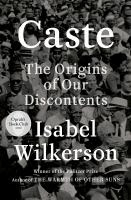
Caste: The Origins of Our Discontents

Caste was thought to be another form of racism, however the author points out that caste is more basic.  Caste is society's way of classifying and ranking humans and it can be done in many forms.  Racism is a common factor in caste.  Racism is a tool that fits with caste, but other tools are available. Human psychology is more basic.

Wilkerson focuses on three examples of a caste system, the United States, India and Nazi Germany.  Martin Luther King Jr. had formed the idea that the caste system of India had similar characteristics to Jim Crow America.  On a visit to that country he was surprised to learn that he was considered an "untouchable."  At first he thought it strange, but later agreed.  To the Indian that term, "untouchable" was the lowest of the low.  

Bhimrao Ambedkar was born an untouchable, but as an educated and politically active man he was able to change the official designation  to "Dalit" which translates to "broken".

Europeans in North America at first tried to use indigenous people as slaves, but found they were too subject to European diseases, but learned that Africans were not.  Many Americans think slavery is old history, but in fact it formed a key factor in the American economy that has impacts today.  http://www.therealjohndavidson.com/2016/12/the-half-has-never-been-told.html

Wilkerson notes 8 pillars of a caste system.  It has a divine justification.  Your rank is inherited.  Endogamy meaning marriage and sex only within the caste.  Purity must be maintained with very restricted contact.  A division of labor which dictates your occupation is dictated by one's position in the hierarchy meaning the most distasteful jobs are done by the lowest.  The lowest are dehumanized in a variety of ways.  Rules are enforced by terrorizing.  Superiority of the dominant caste is demanded on every occasion.

It is common for the dominant caste to use the the subservient caste as scapegoats.  The Nazis famously blamed Jews for their loss in the Great War.  Confederates blamed their former slaves for their loss.  Today blacks are blamed for high crime rates and drugs.  Whites with money commercialized marijuana and CBD.  Blaming blacks for economic problems overlooked that they had very little influence on the economy and were more often the victims.  

The 2008 financial crisis had its roots in abuse of blacks.  They had been targeted for subprime loans that were misleading, leading to ever greater debt.  Proving successful, the financiers moved to whites.  The end result was houses were abandoned and investors found themselves with declining assets.  

Black American men have relatively high blood pressure compared to white men.  Sub Saharan men actually have lower blood pressure.  Prejudice does have an impact.  Black women die at higher rates when giving birth.  Life expectancy is less for blacks than whites.  However it should be noted that the overall expectancy for Americans is the lowest of all the major industrial countries.  Education results are also poorer for relative lack of financial support. 

Albert Einstein, the great physicist had fled Germany just before the Nazis had taken over.  He identified blacks as oppressed and spoke up.  He had provided housing for famous singer Marian Anderson when she had been refused hotel accommodation in Princeton, New Jersey.  Einstein joined the NAACP and spoke out against lynching.  He felt "I can escape the feeling of complicity in it <lynching> only by speaking out."  http://www.therealjohndavidson.com/2021/03/einstein-by-walter-isaacson.html

By 2042 non whites are predicted to be in the majority of Americans, creating fear and repulsion among whites.  Wilkerson points out that whites are not likely to lose their dominant financial powers.  In South Africa whites have maintained a strong economic position.  It may also turn out the definition of "white" might loosen a bit.  

Wilkerson points out that Germany has no monuments to Nazism, but has for the victims.  Displaying a swastika was a punishable crime.  The government pays restitution to the Nazi victims, including to the state of Israel.  By contrast the American government paid restitution to the former slave holders rather than to the former enslaved. 

Black movie stars and athletes have moved up in class, but not caste .  They could still be humiliated and reminded that they are part of subordinate caste.  Slave owners often listened to their slaves singing and liked to see their smiling faces and as a demonstration of their power, encouraging their underlings to entertain as a show.  Hattie McDonald won the first Oscar for a black, but had to play a very subordinate role to Vivian Leigh as Scarlett O'Hara.

Barrack Obama was supposed to herald the post racial era.  Isabel offers contrary evidence.  Both Barrack and his wife were both Harvard grads and good speakers.  They were up against John McCain who made a few mistakes, including picking Sarah Palin as a running mate.  To tip the scales further towards Obama there was a financial disaster just before the election.  Despite these advantages Obama lost the white vote, with only 43% of the white vote in 2008 which fell to 39% in 2012.  Not only that but hate groups increased membership.  

In 2016, white women preferred Donald Trump, a fraudster and womanizer to Hilary Clinton, a champion of women"s rights.  Wilkerson maintains that unlike the Republicans the Democrats didn't support their base enough.  Evangelicals, the base for the Republicans wanted a ban on abortions, restrict immigration, protect gun rights, a denial of climate change and these desires were reflected in the Republican platform.  Wilkerson feels the Democrats don't support their base which is blacks and other non whites to the same degree, taking their votes too much for granted.

About the same time while reading this book I also watched a satirical film "Watermelon Man" (1970) written and directed by Melvin Van Peebles.  A bigoted man is transposed to be a black man and we see a lot of payback, but some insight.  Apparently as a white man the Godfrey Cambridge character had sold one sided insurance policies to black families, but as a black man he advised them to change their policies to something fairer.  Neighbors wanted him to move to protect their house values--but "it's not personal."  His wife was upset and said he was taking advantage of their "friends" by being a negro.  At least one woman finds him sexier, but in the end he feels she doesn't appreciate him as a person.    http://www.therealjohndavidson.com/2022/02/three-films-of-melvin-van-peebles.html

Isabel Wilkerson's last words sum up what could be our future, "A world without caste would set everyone free."  

Thursday, November 20, 2014

WORLD TOILET DAY...something you might have missed

Did you miss it?  I did.  November 19th, 2014 was only the second day designated World Toilet Day and for most of us it might have seemed a weird thing to celebrate.

Only it is not so much a celebration as a call to do something about the lack of toilets for over 2.5 billion people.  Most westerners take toilets for granted and the thought of being somewhere without acceptable access turns up our noses.  We are vaguely aware that some people use outhouses and other facilities we do not know of or care to know about.

It (the lack of toilet access) is a problem with international implications, but of course impacts locally a lot more for some.  One of the prime concerns is the spread of disease.  With proper sanitation which includes more than just toilets much disease is controlled and in western cultures is a prime reason we live longer, healthier lives.  Open defecation, common in parts of the world helps spread disease, including diarrhea.

Easy access to toilets actually helps productivity.  This becomes evident when toilets are not accessible and great efforts (or suffering) to find one take away from other activities.  Some people of course are quite used to going anywhere and too often privacy is not a big concern.

Prime Minister Narendra Modi of India has made increasing toilet accessibility a priority of his government.  He has pledged to increase toilet accessibility to 600 million more people by 2019.  Prime Minister Modi realizes that not only is the current situation unhealthy it is holding back his country just as they are becoming a major economic power.

The lack of toilets is a special concern for women.  The lack of toilets at schools has discouraged girls from going to school particularly when they reach an age when they menstruate.  Going outdoors at night has been found to attract sexual attacks.  Women (and men) are reluctant to go some places where they know there is not reasonable access to toilets.  It may seem trivial but toilet accessibility has an impact on education as well as productivity.

The problem is not just one of supplying toilets, but sometimes of breaking old habits to ensure newer healthier habits.  Public health workers are being trained to help educate the public.  I am sure someone will be able to make money from dealing with this problem/opportunity but it is also a need for government to facilitate a solution that benefits everyone.

Awhile back I remember watching a Bollywood movie, "Paa" that alluded to the problem of people defecating publicly and how difficult it would be to deal with the problem.  It was just a small issue, but drew attention of many people who prefer not to think of the problem.

This is not a problem I have thought much of as with most of you I take access to toilets for granted.  For more information including how you can help:  http://worldtoilet.org

Friday, July 6, 2012

ENERGY AND OUR FUTURE, RISING POWERS AND OUR SHRINKING PLANET

A few weeks ago I finished a book that covered up until just before the 2008 American election, "Rising Powers, Shrinking Planet" by Michael T Klare.  It is another of the books that is basically ignored by those who could most fix the identified problems.

First contention is that traditional sources of energy are becoming scarcer as more parts of the world are getting more desperate to get their share (really more than their share).  Second contention  is that while that is going on global climate change threatens to accelerate and the author believes the first problem will take away resources to deal with it.

Bottom line is that we as a planet are running out of time, but are oblivious to the problem.  I think we have all heard fearful predictions and just rush ahead with our life.  There is very little that most of us can do and we can become unsociable by trying to go beyond that.

When China and India the two biggest new players in the oil procurement race realized that they were really just bidding up the price when they competed for the same deals.  They joined together for their mutual benefit.  Michael had suggested that this pattern should be expanded to include research and manufacturing co-ordination with the ideal partners being United States and China or China and Japan.  During the Cold War when fears of nuclear conflict were at their highest Russia and United States took steps to cool things down with Summit meetings.  Now would not be too soon to start summits over scarcity of energy resources that would also allow greater efforts for the alternatives.

The second book, "The Race for What's Left" brings the readers more up to date.  Most of the easy hanging fruit of energy has been taken.


Conflicts over access to energy or distribution of revenues are becoming more common. It is obvious to me that the problem is exacerbated in the political arena.  There are so many books and presentations that have pointed out at least part of the problem.  I suspect that some of the people in power do understand the urgency, but are bogged down in the reality of global politics.  There are other powerful blocks of decision makers who are working against solving the problem i.e. those who think they can lose more by changing--those invested in current energy

Very few new oil fields are being discovered and they tend to be smaller and more inaccessible.  In general the energy sources that we have been relying on are fraught with political stresses and environmental concerns

In the second book Michael Klare discusses minerals and food, recognizing that they are also under pressure..

Some examples.  In Afghanistan the Chinese have bought mineral rights, but Americans are resentful. In the Arctic global warming is melting ice, but creating ice bergs and five nations are taking steps to grab as big a share as possible--United States, Russia, Canada, Norway and Denmark.  The Chinese by undercutting, and avoiding environmental constraints cornered the market on essential rare earth minerals and then cut off Japan who had offended them.  Russia cut off Ukraine from gas supplies in the winter.

Food is now part of the diminishing resources.  Saudi Arabia has bought large tracts of land in 'Ethiopia to safeguard future food supplies.  They are not nearly alone.  China has bought up farming land in several African nations.  They offer a sweet deal to the national government, both of whom overlook the people that are already using the same land (without recognized land deeds).  China, United States and Russia have found that offering military arms gives them the inside track.

Corruption seems to follow many deals.  The leaders at the top take the cream and those at the bottom are often boxed in more securely than before.  Part of the deal often includes military and police weaponry.  The Chinese boast that they do not interfere with the internal politics of those countries they do business with, but that is very hollow.  They usually knowingly reinforce the established status quo. Corruption seems to be the norm in many countries coming into sudden oil/mineral wealth.  It does not flow to the people.

Corporations are struggling against one another.   Nations are becoming more and more involved in negotiations.   Russia discouraged one international company by suddenly enforcing environmental laws that had been ignored allowing Russians to take back.

I wondered what has been going on since he wrote his book. One response is here  http://www.huffingtonpost.com/michael-t-klare/the-energy-wars-heat-up_b_1505934.html

Michael T. Klare uncovers for me geo political stresses that I was unaware of.  He believes that more and more future geopolitcal news will reflect the results of fights for resources or disasters because of desperate searching for resources.  I believe him and expect that more of the news that will dominate our medium will be resource and environment oriented.  Do we just absorb the information or do we do something?