Wednesday, March 26, 2014

AGE OF GREED by Jeff Madrick

"Age of Greed" reinforces my feelings of corporate conspiracies.  If you are a member of the 99% you must sometimes wonder why you are relatively poor and some others are so rich.  It is easy to  pick up on conspiracies that explain that others have played unfairly.  Really there is more to it than that, but it is sometimes comforting.  Not to relegate" Age of Greed" to weird conspiracy literature, but rather to use it as an example of how our western Capitalism works.

Jeff Madrick brings in history, starting from the 1960s' but with references further back, such as Roosevelt and the hatred of his New Deal.  Although we can become pretty disgusted with the shenanigans of today's political and economical power players, the problem goes back to human nature.

The first steps are bankers wanting to evade regulations.  Banking has always seemed a safe vocation, but not terribly exciting.  When they are able to evade, distort and change the rules banking becomes more exciting and profitable.  Risk taking increases and fraud becomes more common.

Around the 1970's a movement grew where conservative philosophers proclaimed that rich people deserve to be rich.  It was framed a little differently.  The marketplace was the tool of rationality and central government planning was disparaged.  The truth as others see it is that powerful people resent restrictions on their freedom.  They are attracted to philosophies and stories that justify their view of the world.

William Buckley,Jr. was able to articulate a conservative philosophy that was respected by other intellectuals.  Alan Greenspan, an admirer of Ayn Rand was accepted as adviser to presidents. Ronald Reagan, was able to use Hollywood looks and charm to convince many that "Government is not the solution.  Government is the problem. "  Lots of fraud artists such as  Ivan Boesky are described, but it was the philosophical and political groundwork that enabled them to prosper.

The proof that all men are not equal comes with the statistics that show productivity and wages not aligned as before.  The 1% are able to skim off what might have gone to the 99%.

One counter trend was exemplified by "In Search of Excellence" by Tom Peters who demonstrated that more money could be made by respecting and empowering the workers.  This movement had influence for awhile, but gradually waned as other forces took over.

George Soros, famous left wing sympathizer felt the markets were not rational and was able to take advantage of that amassing billions.  Herd behavior is not always predictable, but for those like George Soros who can pick out a trend overlooked by others there is an opportunity to make money. He is a man who is aware of social inequalities and has taken a good part of his fortune for progressive causes.

Eliot Spitzer, a very effective prosecutor of Wall Street abuse was put out of the picture.  It is true that his own human weaknesses brought him down from power, but it seems strange that few if any Wall Street bigwigs suffered from the financial shenanigans that led to disaster.

Inequality starts when someone is able to use leverage to gain an advantage.  At the same time that is the advice we are often given.  Save money, make a deposit on a house, borrow some money and wait for the price to go up.  Saving and risking can be virtues, but at some point some people are able to manipulate finances for their benefit, but to the detriment of others.  Finances do serve many valuable causes, but if they are not regulated problems can and do result.

Recently one story that caught my eye is from Tennessee.  As I understand it, Volkswagen with a history and comfort level with unions agreed to a vote of the workers to form a union.  Senator Corker announced that it would endanger expansion in Tennessee.  Volkswagen has denied  that an expansion decision would hinge on the vote results.  It does seem that part of the power structure resists any strengthening of weaker elements.

If you would like to learn more of Jeff's thoughts visit his website at:  http://www.jeffmadrick.com/

Tuesday, March 25, 2014

TRIPLE PACKAGE: A USEFUL STUDY IN GROUP DYNAMICS

This book has been discussed in many quarters and it seemed the authors Amy Chua and Jed Rosenfeld (a married couple) were often fighting the charge of being racist.  In fact they were discussing group dynamics and identifying what groups were most successful.  Why one group grabbed onto the success factors while others didn't is the result of a lot of history.  The dynamics are limited in many ways and naturally tend to change.

The groups they chose to explain their theories are ethnic centric and as such are not only normal, but illustrative of general principles.  When stereotypical behaviours are pointed out it only reinforces racist images to some people, but the explanations are important because they do apply to other groups.

If you read this book you are likely to gain a better understanding of group dynamics that lead to success and like the authors be able to point out examples.  There certainly are exceptions and the same dynamics have and will apply to other groups.  The authors admit that individuals can encompass the Triple Package.  Amy and Jed, also were able to identify and analyze some of the dynamics of (financially) unsuccessful groups such as Amish and Appalachians.

The  main immigrant groups studied are Asians, Nigerians, Jews, Iranians, Lebanese, Cubans and Mormons.  There are trends within these groups that they also examine.  The three factors are: superiority complex, insecurity and impulse control.  It may seem that the first two are contradictory, but not really.  For instance it is common for groups to feel pride in their ancestral past, but also recognize they are not respected in the present.  Impulse control does not necessarily require the first two factors, but they often contribute to the motive for impulse control.

The three factors have a downside and in reality seldom last more than to the third generation.  The downsides include arrogance, neuroses, and the inability to live in the present.  They can propel people to great success, but immigrants normally sooner or later assimilate and enjoy the fruits of their success.  A common phenomenon is that the grandchildren of self made millionaires are often happy to spend the money, but not interested in duplicating the effort that created the wealth, regardless of ethnic background.

One trend that counters the Triple Package was the self esteem movement.  Instead of prodding youngsters to do better it was considered better to build their self esteem by avoiding criticism or high expectations.  A strong current trend is towards instant gratification.  Today's youngsters and even those not so young get frustrated if they have to wait more than a few seconds for a response after a keyboard click.  The authors contend that these trends have contributed to financial bubbles and the increase in national debt.

The Triple Package is more critical to upward mobility than intelligence.  Many observers feel that Jews and Chinese are just more intelligent (arguably a racist assumption), but the authors cite studies that debunk that notion.  The superiority complex and the insecurity drive hard work and demand strong impulse control.

Impulse control is being recognized as a key factor in success.  A famous study was done with young children and marshmallows.  They would be offered a marshmallow and told that if they could wait a few minutes they would get another marshmallow.  Most youngsters couldn't wait and when they were visited many years later it was learned those who were able to wait were more successful by most measures.  A more modern study delved deeper into the issue.  This time youngsters divided into two groups:  one was promised something exciting and it was followed up while the other group's promise was not followed up.  Those who had promises fulfilled were more trusting and waited for the second marshmallow.  Essentially this was another proof that impulse control can be developed.

Many years ago I read an earlier book of Amy Chua's,  "World on Fire: How Exporting Free Market Democracy Breeds Ethnic Hatred and Global Instability."   For many people it also seemed racist but I believe it also just explained group dynamics in a way that made the world more understandable.  In many third world countries minorities often become dominant and are resented by the majority. Democracy can sometimes exacerbate the situation.  The two books illustrate how frustration can get tied into racist excuses, but if you understand the dynamics, the reality is much deeper.

Monday, March 24, 2014

GLENN FORD, FORGOTTEN MOVIE STAR FROM CANADA

Most young people have not heard of Glenn Ford, unless by stretching the definition of young they remember a small bit in "Superman."  He was also forgotten by me until I stumbled on a DVD from the local library that launched an effort to see more.  Many of his movies were part of my youth, but as I shifted to colour a lot of the black and white classics seemed less interesting.  Although born in Quebec in 1916, Glenn moved to California as an eight year old and was not a staunch Canadian.

What did I like about him?  Basically a quiet masculinity.  He played mostly good guys, but occasionally bad.  He did demonstrate versatility, not always playing himself.  Having said that, like many actors he had a persona that was consistent and perhaps it was  the real reason he attracted attention.

His first big success was "Gilda'" in 1946 with Rita Hayworth.  I read somewhere that a photo of Rita from this movie was part of the plot for "The Shawshank Redemption."

Shortly after he appeared in "A Stolen Life" with Bette Davis who played two roles that demonstrated her acting ability.  In "The Big Heat" he played a crusading cop who eventually came out on top.  A young Lee Marvin played the villain.

"Blackboard Jungle" was a movie I watched with my father on tv. It was also probably the first time I had seen Sidney Poitier who left an impression.  Apparently this movie generated some hate mail due to Poitier's sympathetic role.  Glenn played a novice teacher who had to deal with some difficult to control teenagers.  One of the first movies to show how rough classrooms can be.

"Jubal" is the movie that started this project.  Jealousy and deliberate misleading were the key elements. Ernest Borgnine and Rod Steiger were major co-stars.  Peter Ford commented that his father did not appreciate method acting and was annoyed at some of the preparations made by Steiger.   It was a well done movie or it might have killed my project.

"Teahouse of the August Moon" was not at all what I expected.  Hammy in some ways, but had a point.  Marlon Brando also in a role I would not associate with him.  Eddie Albert, Paul Ford and Harry Morgan all future tv characters took part.

"3:10 to Yuma" was a good movie with lots of tension.  Originally Glenn - was offered the good guy role eventually given to Van Heflin.  Glenn preferred to accept the bad guy role.  At one point Glenn is whistling to annoy his captor and we later learn that he was whistling the movie theme.   Story from Elmore Leonard.

"Pocketful of Miracles" was another movie with Bette Davis, but quite different from the earlier one.  Hope Lange played the romantic interest.  This was a comedy with lots of familiar character actors, Thomas Mitchell, Edward Everett Horton.  Peter Falk who went on to better things had a strong supporting role.  Ann-Margaret was introduced.  Glenn won a Golden Globe award.

"The Courtship of Eddie's Father" was still another comedy.  Ron Howard now a well regarded director played the cute Eddie.  It was funny, but very realistic.  Glenn played a flustered father with personal issues.  Shirley Jones, Dina Merrill and Stella Stevens played the three women that got Glenn's attention.

"The Rounders" with Henry Fonda was according to son Peter, Glenn's favorite role.  It was meant to be a fun movie, not profound and I guess it achieved that level.  For my horse loving friends this was not exactly like the Horse Whisperer.  Glenn loved westerns and his son told us that he had learned horsemanship from Will Rogers

I rounded off this project by re-watching "Superman"' to view Glenn in about two minutes screening as the adoptive father.  Another movie combining Marlon Brando and Glenn Ford.

It can be a letdown to realize the person on the screen is not the real person.   I was disappointed to learn Glenn Ford had many affairs and that he worked with Ronald Reagan's election campaigns.  He did voluntarily serve in the US military, but not in combat.  Married to Eleanor Powell who at the time was more famous than him.  They had one child, Peter who became a biographer and supplied some information for this blog in a DVD special feature.   He went on to marry three other women and divorced them all with no other children.  He made the top 10 Hollywood list of popularity in 1956 and 1958 and topped the list in 1959.  I still enjoyed his movies.

Tuesday, March 18, 2014

The Art of Doing

Like many of us, the authors, Camille Sweeney and Josh Gosfield were trying to figure out the way to success.  They were able to contact a number of successful people and convince them to tell us how they did it. A wide variety of success stories in such fields as tennis, baseball, business, wine growing, music.  Going off standard success stories they also included marijuana, erotic movies for women, dog training, television game shows, blog writing, big game hunting.  The variety chosen illustrates there is more than one way to succeed.  Many of the subjects were allowed to express themselves in crude, but easily understandable ways.

Success can be measured in many ways, most easily in terms of money or ranking.  In this book success meant being at the top, or near the top for a chosen endeavor.  For me a lot of the fields would not be of strong interest, but the critical factor is that each field was important to the teller and how they got to the top or near the top had significant common denominators as well as a strong effort.

Given a different set of successful contributors you would have gotten different details, but I suspect the general themes would be similar.  The underlying factor was that each person felt a unique calling to conquer a particular field.  Monetary profit was not the primary driving factor.  A motivating spur was just to do it better.

In order to do that the authors use the phrase that they all had" intelligent persistence."  That doesn't mean that you need to keep banging your head on the proverbial wall, but when an obstacle is insurmountable you are ready to pivot to a new and strategic effort.  There are sure to be setbacks, but they help to redirect efforts.

The successful ones are all good listeners.  Other people have made similar efforts or are able to take an objective view of the challenges and can help steer someone in a more practical direction.  Taking the time to really listen is an important key to understanding the choices to be made.

They are able to compact their strategies into story form.  A lot of statistics and facts can overwhelm someone you are trying to explain yourself too, but a well thought out story can make a point much more quickly and understandably.  A lot of the stories are very interesting, maybe especially in fields not commonly written about.

Nobody succeeded all by themselves, despite what Mitt Romney supporters might tell you.  Each of the success stories involved support from family, friends and colleagues.

One quote I want to remember is from E. L Doctorow (not one of the subjects).  "Writing is like driving a car at night.  You only see as far as the headlights go, but you can make the whole trip that way."  It seems that we can not always see the end of our efforts, but if we keep going we get a better vision as we go forward.

The chapters are all short and to the point.  The variety means you will likely identify with some more than others, but if you pay close attention you will realize there are many niches out there that you can strive in to not only be successful, but also to give your life more meaning.

Thursday, February 27, 2014

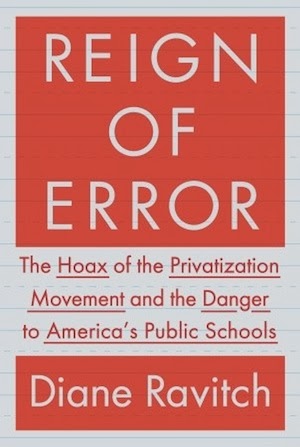
REIGN OF ERROR WHAT DIRECTION SHOULD SCHOOLS FOLLOW?

Privatization is a favorite word of some people, but when it comes to education Diane Ravitch becomes concerned.  As soon as profit motivations are in control the concern for expenses shapes everything.  She finds herself arguing against the likes of Bill Gates, Barrack Obama and Michelle Rhee.  I put myself on Diane's side.

The so called "reform" movement has decided that schools should be held accountable and that the best method is through testing to measure the child, the teacher and the school.  Several objections arise.  Those who are to be accounted will select students who will make them look good, in other words avoid problem students.  Teachers will as much as possible teach to the test as a protection, putting other things to the side.  Furthermore as has been found in several instances cheating goes on (and not just at the student level).  Being accountable through tests can actually deprive youngsters of a true education.

It may be unfair to brand a whole movement as evil and incompetent that has such strong public support as American charter schools.  There are powerful Republican and Democratic government officials in favour of them and I might add powerful corporate figures.  Diane Ravitch used to find their views acceptable, but in "Reign of Error" she attacks them.

My own bias is evoked when powerful or loud people attack teachers.  Are they really the problem? As I read recently everyone was a student and feels they know all they need to know about teachers. At the same time we also personally feel outsiders do not understand our job. 

The author points out that "reformer" advocates claim that improving education will improve poverty. She feels poverty and racial isolation are more basic to the issue and back it up with some studies.  In reality many of the reformers have a hidden agenda.

Conservative reformers do not trust government.  They think schools should be run more as a business.  They believe testing is one tool and another is the ability to fire anyone not measuring up. Some also seem to believe  that teacher training is not as important as picking the right people and getting rid of the wrong.  Some see an opportunity to make money and rationalize the process. Motivations also include religion which in many cases wants to stifle science.

Getting back to my basic bias that teachers deserve more respect.  Many teachers aside from wanting to teach, crave security, so firings can frighten off some prospects.  They are not the most basic part of education--parents are.  If the parents see to the health of their children and provide an atmosphere conducive to learning they will learn more effectively.  With two parents working and more distractions than ever, raising children is a challenging task that few are really excellent at, including myself.

Too many people feel that education should be like a business.  But unlike businesses the job of schools is to work with whatever is available.  In other words they don't get to choose, whether a youngster is dedicated, talented or not, all are to be welcomed and encouraged to develop their talents.

Diane does offer lots of solutions to improving the American education system.

Testing to common standards is desirable, but should not be the only point of school.  When teachers are forced to teach to the test they are limited in meeting the needs of their students.  Testing does help uncover weaknesses, but should not be used as a stick to punish those who do not control all the variables.

Stability is critical to improving schools.  The reformers have caused a lot of turnover, not just by firing, but by discouraging.  It is important to attract good people who are properly trained.  Money attracts stronger candidates, but perhaps as critical is respect.  No teacher (or any professional) is perfect when they start their job, but they can all improve.  Supervision, mentoring, further education can all be helpful.

She disagrees with the premise that poverty and racism are just excuses for education failures.  Of course exceptional people overcome all odds, but by definition most people are not exceptional.  She feels the process starts before birth with pre natal care that is usually lacking amongst poor people.  It continues into the pre school age health care.  Nutrition is very significant.  Poor people are at a disadvantage during the school holidays while their richer student colleagues more often are involved with enriching activities.  To really rectify the imbalance between rich and poor means offering alternatives and at heart really dealing with the bigger issue of poverty.

Diane offers a lot of research and much detail to improve education. She feels teachers are the best source for how to improve education, not relatively uninformed business people, politicians or professionals that often have ulterior motives.  Any nation's most important resources are its young people, for they are the future.

Here in Canada a problem is the entrenchment of retired teachers as supply teachers.  It is natural for school authorities to prefer experienced teachers, especially since they probably know them personally, but how are youngsters to get started?  There are lots of enthusiastic graduates of Teachers' Colleges after having been encouraged to enter find there are few jobs open to them.  The Ontario government has lengthened requirements for teacher training in one effort to alleviate the problem.  Smaller classes are better for students and teachers and should be a higher budget priority.  Mentoring by retired and experienced teachers would open up more opportunities as well help to improve younger teachers. Awaiting these suggestions the immediate priority should be to limit retired teachers from taking the majority of supply openings.

Thursday, February 20, 2014

Eleven Rings

Basketball is just a game, like hockey or baseball or soccer. Each has its peculiarities and we assume they are not as serious as business.  But one thing they have in common is that business involves a group effort that can be optimized with co-operative energy.   Of course at its highest level sports are business enterprises trying to maximize revenue and minimize expenses.

Phil Jackson is unusual in his approach to coaching. A lot of people would consider him weird with his emphasis on spiritual matters and others attribute his success to the luck of having Hall of Fame players to guide.  Bottom line, he has participated in more NBA championship winners than any other person--11 of them referred to in the title.

Phil was born in a remote community in Montana and played high school and university basketball in North Dakota.  Like almost anyone who makes it to the NBA he was a key player at the high school and university level and used to getting a lot of attention.  But he was not a superstar and had to learn to blend in with others with more talent in the NBA.  As a player he won one championship while a reserve player and actually was off a whole season due to an injury when the New York Knicks won a second championship. The injury gave him the opportunity to work with coach Red Holzman who he credits with teaching coaching basics.

In Phil's mind, the NBA has become too glamorized with the marketing strategy concentrating on celebrity players.  This has made too many players shoot for glory rather than fitting in with a team to optimize their effectiveness..

With talent comes a lot of ego. Can you imagine players like Michael Jordan and Kobe Bryant?  Or Dennis Rodman?  Or Shaquille O"Neal?  They were all capable of critical contributions, but they also could demotivate others that were capable of blending their talents towards victory.  Coaches were constantly dealing with the others who felt they were not getting a fair chance.  Phil was fortunate to associate with wealthy club owners, but they all had problems with melding expensive talent to expected championships.

Two of his greatest players, Michael Jordan and Scottie Pippin once felt threatened by the Chicago manager drafting a European player, Toni Kukoc and overpraising him.  They ganged up on Toni at the Olympics, but later teamed up with him under the guidance of Phil.  All three players contributed to a championship ring.

Kobe Bryant came straight from high school with more talent than almost anyone and an exceptionally developed ego.  He resented anything that did not revolve around him getting the shot. Phil teamed him up with Shaquille O'Neal, one of the most physically dominant centers of all time and used to getting a lot of attention.  It was a long time before they became buddies.

Phil studied psychologist Carl Rogers who believed it was virtually impossible for anyone to change unless they thoroughly accept who they are.

Before a game, especially a tough one it is common for coaches to try to rouse up their players' emotions, but Phil preferred to try to quiet their minds.  He encouraged his players to meditate and practice mindfulness.   Yoga and Tai Chi were on his agenda.  He also took from Lakota Indians, including their way of handling anger.

From Red Holzman, "Practice doens't make perfect.  Perfect practice does."  Red also realized the importance of bench players and made a point to warn them when they would be expected to play and to watch the 24 second clock so they wouldn't be caught off guard.

Phil comments that a lot of details are just as important as the ones that get recorded.  An example is the assist which is awarded to the player who makes the pass that leads to a score.  He feels the pass that leads to the pass that leads to a score is just as important.

His approach to basketball is unique.  He was fortunate to have the physical and mental requirements to be a professional basketball player and wise enough to learn how to get others to achieve great success on the court and to find greater meaning in life.

Monday, February 17, 2014

"WINDFALL" WHO BENEFITS FROM CLIMATE CHANGE

Some of us find it difficult to understand how people can be so complacent in the face of scientific evidence of climate change. McKenzie Funk, author of "Windfall" can help explain.  As usual it boils down to money.  While some deny the problem, others see an opportunity.

While acknowledging that many, likely the majority of people are likely to suffer, some investors can see where there are opportunities.  Many of these smart insiders feel there is nothing much they can do to stop climate change, others cold heartedly prefer to maximize the opportunity.  Others are adjusting to changing circumstances.

For instance oil companies.  As Arctic ice melts big international conglomerates have access to more sources of oil and easier transport.

Insurance companies have been burned by climate disasters. However they have discovered they are able to raise their rates plus buyers are more motivated to protect themselves.  Insurance companies have also gotten involved with disaster rehabilitations such as private fire fighting companies.

McKenzie started a story about Alpine ski resorts having serious concerns with declining snow cover. Then he veered off to discuss Gulag camps where desalination was developed amongst Jewish prisoners.  Eventually with an Israeli sidestep this evolved to more sophisticated processes that helped make the Sochi Olympics survive melting weather.

Desalination, now used by Israel, Spain, Australia and others is one method of restoring drinkable water to where it is wanted, but it requires a lot of energy that contributes to climate change.

Canada stands to benefit in a number of ways.  The Northwest Passage is becoming more navigable each year and although foreigners assert it should be international waters Canada will still benefit. Although drought in middle latitudes threaten to increase food commodity prices, Canadian agriculture should be able to expand its growing season and area.  Canada also stands to benefit from increased demand for energy with both the oil sands and Arctic drilling.

Climate refugees may be hard to identify, but drought is a little easier.  High food prices force many to seek better conditions.  There is awareness of this in Europe increasingly threatened by immigrants from Africa and in India from Bangladesh and in the southern US from Mexico.  These can all be expected to increase.  One group that benefits from this are private prisons.

Small islands and coastal cities are most endangered by rising water levels.  One nation with a lot of experience and expertise is the Netherlands.  They offer a variety of water management solutions.

Another consequence of climate change is that insects spreading northward and with water, causing diseases like Dengue, Nile virus.  Big and far seeing corporations are developing strategies such as genetically modified seeds as well as genetically tampered insects.

Geo engineering options are becoming more sophisticated.  Patents are being registered.  One basic source is the fact that major volcanic eruptions have had a cooling effect on earth.   One consequence affected rainfall

Not everyone is concerned about money so much.  Greenland has many monetary opportunities, but underlying it for many is the chance to be independent.  Oil, agriculture, mining, tourism, water are all areas that would help them to independence from a benevolent colonizer, Denmark.

The average person can do very little (but they can do some things such as set an example, educate). They can adjust within their circumstances.  Wealthier people in positions of authority can do more, but there is risk of losing their power.  Then there are opportunists.  Between adjusters and opportunists the rest of us have an uphill battle.  It is not just climate deniers that are the problem.

Some people think they are beyond consequences.  Maybe they are right.  Or maybe there is more than meets anyone's eyes.