Showing posts with label Adam Smith. Show all posts

Monday, March 20, 2023

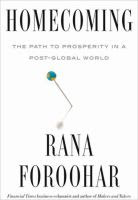
Homecoming by Rana Foroohar

 My previous book blog was depressing about the state of the future world.  Rana Foroohar is well aware of problems, but sees room for hope and strategies.  There is a lot of meat in "Homecoming."

The Covid pandemic revealed weaknesses  and is forcing some rethinking.  The supply chain turned out to expose the global vulnerability.  Capitalism is all about profit and how to increase it.  Rana points out that efficiency is valued and favors single source.  Very often the single source is cheap and far away.  

Rana suggests that America needs resiliency which can be supplied by local and multiple sources as well as innovations.  We have been forced to find new sources and new methods. 

A few complications are the threats of military intervention and the actual one in Ukraine.  Taiwan is an obvious target and is critical as it is the top global provider for essential computer chips and semiconductors.  Rana admires the system of governance adopted by Taiwan that allows its citizens to express their opinion on a wide range of issues.  The government is ready to respond to false information (steady stream from mainland China) within hours.  China was supposed to be freer as they became richer, but that has not happened.

 A big theme is that capitalism with its emphasis on a free market trends to efficiency at the expense of resiliency.  In the name of efficiency businesses gravitate to single sources to increase profits.  In a previous blog it was pointed out a number of innovations brought  dramatic reduction in costs of transportation and communication that opened up modern growth in global wealth.  Lots of scaling up for supplies that had become part of our standard of living.  Now society needs to boost our resiliency to survive..  Check:  http://www.therealjohndavidson.com/2023/02/slouching-towards-utopia.html     Much specialized equipment although designed in America is boosting manufacturing in other countries.

Climate change is the major global issue, but still the world seems content with changes that don't totally  deal with the issue.  The author draws attention to some of the key factors, overlooked.

Agriculture is the greatest threat and it tied into other complicating streams.  Single crops are normal, but harmful for biodiversity and in many cases add to supply chains.  Much of apparel comes from cotton which can be grown very cheaply far away and encourages fashion cycles going faster that in turn leads to much waste.  Many of us are aware of methane being a crucial factor in global warming, but getting food to our tables and seeds and fertilizers to the fields are major transportation inputs.  The author suggests that vertical farms can increase local control while increasing bio diversity and reducing transportation.

Housing is another major cause for climate change.  Building housing and maintaining  them against heat and cold needs to be done more efficiently.  3-D printing appears to offer cheaper costs, environmentally better and higher long term quality.  Personally I see a fundamental problem is human  desires.  Check http://www.therealjohndavidson.com/2021/10/dream-house.html    Much of the housing price increases can be attributed to (foreign) investors who buy houses for the expected price increases.

Jobs are a crucial concern.  Automation and Artificial Intelligence assure traditional jobs will disappear everywhere.  Immigration frightens many, especially from poorer parts of the world.  Inequality is increasing with the rich able to grab a bigger share of resources.   Mankind can have more meaningful lives with a change in attitudes and structure.

Gig workers (work with temporary contracts) are also vulnerable and deserve more protection.  Germany and others have found that working with unions is good for business, but there is a lot of resistance in United States. 

Large corporations concentrate power that by itself promote inequality, but more importantly tends to diminish innovation.  Rana suggests that co-operatives (like Ocean Spray) should be encouraged and anti trust laws should be enforced and expanded as small companies do more innovation.

Two big areas are healthcare and education.

Much of healthcare requires human contact and although long distance diagnosis is increasing it is not possible to ignore human contact.  We learned from the pandemic that health care workers are vital, but they feel under assault.  Prevention is much better than cures as many nations have found, but again there is resistance from Americans to medicare.  Americans are now experiencing a decline in longevity. 

Education is another field where progress can be made for both jobs and leisure enjoyment.  Much of the student debt crisis can be the result of poor direction.  Many prospects feel they have to go to university to get a degree in order to get a job, but the world doesn't need that many degrees.  What the world needs is more vocational training for the newer technical jobs.  The world does need critical thinkers and the world wants to enjoy life more.  Although there will be more online teaching smaller classes are also a boost to education. 

Democracy is assaulted by surveillance states and needs to reassert itself and offer a better life than too many are forced to.  Quadratic voting is a new concept brought forward by Glen Weyl.  It allows voters to have digital tokens that enable them to allocate their preferences among many issues that gives them power to express their priorities.  

Inequality seems to be growing.  The very wealthy have found their best allies are those like Donald Trump who can stir up voters against their own best interests.   The huge tax cuts have enabled many companies to buy back shares.

A quote from Adam Smith that warrants more attention:  "It was not by gold or silver, but by labor, that the wealth of the world was originally purchased."  It is the workers of the world the made everything else possible and they should not be ignored.  

This is a very complex book with lots of encouraging ideas.  Unfortunately the world is full of apathetic and greedy people who stand in the way of a more resilient world that we need to survive.  The ideas are being enacted by many people, but we still need more globally minded earth citizens.  Be one of them.

  Rana Foroohar is someone more people should pay attention to.  She appears in CNN from time to time and has written other books.  Check http://www.therealjohndavidson.com/2016/10/makers-and-takers.html

Monday, July 11, 2022

Benjamin Franklin by Ken Burns

Benjamin Franklin is perhaps the most fascinating character in American history.  His accomplishments are overwhelming, but my interest is his thought process.  Ken Burns captures the essence in a four hour presentation which was shown on PBS stations and is available in DVD format.

He was done with school at age ten and had run away from home as a teen.  He became a very heavy reader.  As he matured he became an organizer and became interested in science.  At one point he became a postmaster and traveled to several states including southern ones.  From this experience he developed a feeling that the colonies should work closer with one another.

As a printer he started "Poor Richard's Almanac" which became very popular.  Partly because he included some sayings that became popular.  One example, "Early to bed, early to rise makes a man healthy, wealthy and rise."  He discussed the path to success analyzing the needed virtues and how to attain them.  He also developed a method for making difficult decisions that became known as the Benjamin Franklin method.

He was always a curious man. Electricity was fascinating and after many experiments he developed the concept of a lightning rod, which as saved many lives.  He also came up with the concept for a battery.  Another project for a relative was to invent a catheter improvement.  He also developed an improved wooden stove and would not accept a patent.  Later in life  he was taken with a musical performance with wine glasses and went on to invent the glass armonica which Mozart composed for.  At one time he was asked about the point of a man bearing balloon and replied "What good is a newborn baby?"

Prejudiced?  Like all humans he soaked in the beliefs of his environment--until he observed the unexpected and questioned them.  He owned slaves at one time and although he had joined anti slave groups for a long time he took it for granted they were incapable of serious discussion.  However when negro youngsters were sent to Philadelphia to learn to read, Franklin appreciated they had thinking ability.  

He also had a low opinion of the indigenous natives, but later was inspired by the Six Nations and their system of government.  He had been involved a little with the French and Indian War that resulted in the French losing territory that included Quebec City and parts of what later became American territory.  He also was involved with the negotiations and was very impressed with how the Six Nations handled themselves feeling that the American colonies should unite and have more power.

The War made the colonies more expensive than earlier thought and the British felt the settlers needed to help pay the extra costs. 

Benjamin Franklin went to London which he found very stimulating, socializing with such luminaries as Adam Smith and David Hume.  He admired the British Empire and wanted it to continue.  He campaigned for his son William and he was named to be governor of New Jersey.  After talking to Lord Howe as a Pennsylvania delegate he was offered state taxation but by this time was too late' he notion of taxation without representation had taken hold.

Maybe not surprising Benjamin Franklin was leaning the Loyalist way, but decided to be a "patriot."  He was the oldest at the Congressional meeting. He had tried to convince Canadians to side with American colonies. 

One of Franklin's contributions was to substitute he phrase "self evident" in place of "sacred" as Jefferson had originally written in the Declaration of Independence.  Part of the effort to separate the state from church.

The War of Independence was really a civil war with many families divided (including Franklin).  His son William remained loyalist.  Franklin was chosen to be envoy to France.  Seeking an alliance in France was very sociable, but he secured some treaties.   Also he met Voltaire, one month before his death.

After the American victory negotiations with England saw Franklin involved.  He dealt with tricky point of not including France in negotiations.  The Indigenous were disappointed with many leaving for Canada leaving a mark not far from where I live.  The Six Nations were granted land along the Grand River.  My two youngsters were born in Joseph Brant Hospital in Burlington.

At the 1787 Constitution conference Franklin was in committee to decide weight of states with different population.  Recognizing the north needed the south for the union he sought compromise.  Each state have 2 senators selected by state.  The House of Representatives membership was to be calculated with members of by population, but allowing blacks to be counted as 3/5 of non slaves.   He recognized faults and proposed agreement to be ratified by states.  He considered democracy an experiment that needed to be tinkered with.

He repaired relations with British friends, but not with son William.   On his 8th ocean crossing Franklin made scientific observations on trip back noting the influence of the Gulf stream.

He died in 1790, April 17th at age 84.  He attracted the largest Philadelphia crowd for his funeral with every church represented.   

A quote I carry with me "For having lived long, I have experienced many instances being obliged by better information or fuller consideration to change opinions, even on important subjects which I once thought right, but found to be otherwise."  Good advice.

My interest was started as a youngster when I was able to watch "Ben and Me" (1951).

A few years ago I was able to have a short Philadelphia visit and checked out Benjamin Franklin.   Check:  http://www.therealjohndavidson.com/2015/07/philadelphia-brief-adventure.html

Monday, December 4, 2017

"A World of Three Zeros" a plan for a better world

We in the rich part of the world don't usually seek advice from poorer parts of the world, but Mohammad Yunnus, the Nobel Peace prize winner from Bangladesh has good credentials.   To some he might seem naive, but in fact he has operated under very difficult circumstances and accomplished what some feel are miracles.

Yunnus was educated in Bangladesh and the United States becoming  a teacher and at one point saw the need of poor women in rural Bangladesh.  Using his resources he started loaning small amounts of money with no collateral.  He established the Grameen Bank in 1983 and it has been replicated in over 100 countries  Surprisingly the rate of re-payment was over 97%.  It turned around local economies and over time got global attention.

Capitalism is worshipped by many people, but if we are honest it has problems.  Under its frame it is inevitable that despite all efforts to restrain it, it leads to income inequality.  It is not hard to see why when you consider that rich people tend to set the rules, a process you can witness with the United States Congress.  It is true that in general most people are better off than people of a century ago, but the gains have been very uneven and many would argue not as closely linked to merit as would be ideal.  Yunnus doesn't think the problem is so much distribution as underlying premises.

One of the academic foundations of capitalism is "The Wealth of Nations" by Adam Smith, written in 1776.  It rationalizes capitalism declaring it is only by catering to the will of what people want that gives us the beauty of free market business.  Not noted as much is another book by the same Adam Smith, "The Theory of Moral Sentiments."  Yunnus quotes Smith, "How selfish soever man may be supposed there are evidence some principles in his nature which interest him in the fortunes of others and render them happiness necessary to him though he derives nothing from it, except the pleasure of seeing it."  Self interest is too often interpreted to mean profit or selfishness, but could be expanded to include our long term collective happiness.

The three zeros that form the author's goal are zero poverty, zero unemployment and zero net carbon emissions.  Might seem the goals are in conflict, the author maintains they reinforce one another.

Social business is defined as meeting a need, developing sustainability, but not great profits.  Sustainability is necessary and Yunnus discusses some examples of how has worked.  One project was Haiti Forest to remedy the great need for forestation.  Money was brought in by the Clinton foundation and Branson Virgin Unite, but is generating benefits through jobs and an improved environment.  They plant one million trees per year.

Another project was in Colombia and involved McCain noted for potatoes in Canada.  One concern was the number of potatoes that were misshapen and ended up being wasted.  Researchers looked for ways to turn these ugly vegetables into something useful  One solution was to use them for soup.

Good governance is essential.  One function Yunnus feels is credible elections.  Criteria should be set up and might be enforced by the United Nations.  Some nations have already sought the services of groups such as the one started by Jimmy Carter that give their election greater acceptance.

Corruption is identified as a critical obstacle.  Yunnus posits that transparency engineered with technology is one tool and another is education.  I think both ideas have merit, but corruption is very basic to humans.  A movie has dealt with the inevitably of corruption and also one hero's solution. You might want to explore the notion: http://www.therealjohndavidson.com/2017/02/madaari-open-movie-about-government.html

Yunnus feels the future will be shaped by today's youth, many of whom reject both capitalism and socialism.  They are better educated, diverse and globally connected.  The poor will have to be involved.  Almost always they are at the end of technological developments

The purpose of life on this planet is not merely to survive, but live in it with grace, beauty and happiness.  It is up to us to make it happen.  We ca create a new civilization based not on greed, button the full range of human values.  Let's begin to-day."

John Maynard Keynes once said that the only purpose (of economics) is so that people could live "wisely, agreeably and well." He didn't restrict that to the rich, but felt income inequality was part of the problem. One of his most famous quotes is "..in the long run we are all dead."  Read more about Keyes at: http://www.therealjohndavidson.com/2012/04/book-on-john-maynard-keynes.html

To me an economic system has to be based on human nature and human aspirations.

Ayn Rand is often thought of as the high priestess of selfishness, but she did make one point I agree with which is that we should think long term more than short term of our interests.  Unfortunately I don't believe she thought about it in enough depth.   http://www.therealjohndavidson.com/2012/08/some-thoughts-on-ayn-rand.html

I do recommend the book. There are lots of ideas and experiences to ponder.   If such ideas are not examined and discussed there is little hope for humankind.

Friday, June 28, 2013

The Darwin Economy

Robert H Frank contends that while Adam Smith is credited as the founder of economics it is really Charles Darwin who is more important.  His concern in this book is about hard right wingers who to paraphrase, are too short sighted for the good of everyone.

Referring to our current economic crisis that started in 2008, he deplores that the rich seem hell bent on lowering expenditures and keeping taxes lower for them.  They claim the deficit is the most critical problem, but many readily admit they hate taxes, big government and regulations.  Robert points out that in fact if roads and bridges are not repaired when men are idle and borrowing is cheap these repairs will cost even more as time goes by.  There are no winners, not even rich people who think they are avoiding another "theft" of their property.

Throughout the book Robert gives examples of short sighted thinking that hurts not only poor people, but also rich people. Perhaps more importantly the author points out some of the psychology and philosophy that erroneously support the resistance of the right wing.

For most humans happiness seems related not so much to what we absolutely have, but how we compare ourselves to our neighbours, relatives, work mates and friends.  Not every issue is "positionally" important, but for many people they measure themselves with such factors as the size of their house, the prestige of their car and with scarce items.  Often the really rich bid up prices on some of these items and in turn that can force up pricing all the way down the line.

As part of the argument Robert uses the example of hockey players choosing not to wear helmets when given the chance, but at the same time would like to see a regulation forcing all players to wear helmets.  They want an edge, but they realize there is a risk.  On another field, armament agreements are made because both sides realize they cannot slow down arming up which gets very expensive and risky.

In fact the rich are in a similar spot as the hockey players and the statesmen.  If they gain more money by lowering taxes they will just bid up the price of scarce desirable goods.  They will also lose out on desirable public goods such as improved roads and bridges, education, science, etc that are necessary and desirable to keep pace with the rest of the world.

Robert assumes that ideologues will not be moved by his arguments, but hopes that rational libertarians will appreciate his perspective.  He realizes progressives think that rich people are greedy and cold hearted, but Robert thinks (and backs up his ideas with solid logic) that it is not just greed in absolute terms, but short sighted greed in relative terms.  There are a lot of cliched myths that are trotted out as truths to be beaten down.  Examples include: "the government is the problem";  "Taxes are theft".

Many rich people dismiss luck, attributing their success to hard work and talent.  The author says there is an element of luck in everyone's success, whether it is genes, nurturing or timing.  Small differences are magnified in a lot of winner take all situations.  Many pursue the large payoffs, but only a few are fortunate to achieve the goals while many worthy pursuits fail to attract talent. Entertainment, major league sports, hedge fund selling attract more interest than science, engineering, education.

He has a host of suggestions that seemed based on the idea that anything that is taxed is discouraged, so we should tax harmful things.  His critics say that is social engineering and he really doesn't deny it, admitting that all laws are forms of social engineering.  We have laws against homicide and theft as an attempt to reduce them.  His favorite idea is a consumption tax that is calculated by reporting income and also reporting savings. The difference is considered consumption and can be taxed on a progressive scale.  More conventionally carbon taxes and sin taxes are suggested.  Those who really want what is taxed will not be regulated out of doing so, but if they value other things to be purchased will quite willingly find ways to reduce taxable expenses.  At the same time we will have public goods paid for.

If you haven't got time to hunt up the book and actually read it, you might find this link http://www.youtube.com/watch?v=M8j1e-oT0UQ to a video very informative and it might persuade you that maybe an extra effort would be worth it.

This book is another inspiration from Steve Paikin on TVO. I don't want to rely on Steve, but he and his team are very good in their selection of worthy topics and how to bring  out interesting perspectives.