Showing posts with label Steve Paikin. Show all posts

Wednesday, May 21, 2025

Immigration Has Become a Politcal Football

Politicians have too often felt anti-immigration to have been an important lever to win elections.  Easy for us to blame vote seekers, but much blame should be laid at voters. 

Yet we in Canada and the United States are nations of immigrants.  Even the indigenous are immigrants from Asia.  The development of needles was essential for Asian migrants to sew together furs to survive the bitter bold of the Arctic.  Immigrants are always looking for something better and most of them deliver benefits for most of us.

Migration is a very complicated.  We have a good idea how many people legally cross a border and a crude idea how many sneak across.  Stats aren't kept for how many people return to their home base or pass onto another destination.  There has always been internal migration, usually from rural areas to the bigger cities or between cities.  Life can be pretty rough for many and a few are determined enough to migrate.

Migration started before the very beginning of history.  Our earliest ancestors soon found a need to move either to find a more reliable source for food or to escape danger. 

America is a classic example of migrations.  When the Europeans first encountered the indigenous they were at first co-operative and later different European leaders aligned with different indigenous tribes.  Over time they overwhelmed the indigenous partly by force of arms, but just as important by disease.   America had been a dumping ground for undesirable Brits (also done to Australia).  Others saw America as an opportunity to get rich or at least get a new start.

Migration is essential for western societies that all have declining birth rates and aging populations.  Immigrants tend to be hard working, innovative and entreprenurial.  Their crime rates are lower than established citizens.  They end up paying taxes at least when they purchase items, but get very few benefits.

As happens the establishment resents intruders, especially if they are "different".  Slavery wasn't invented by Americans, but some ambitious people saw it as a vehicle for riches.  It was morally justified by the notion black Africans were inferior beings.  A driver of migration is the desire for cheap labor by wealthy individuals.  Chinese workers were brought to North America to help build national railways, but forbidden to bring women.  Although Mexicans bravely sneak across the southern American border there is a demand for their willingness to do menial jobs cheaply.  Britain brought large numbers of people from India and the West Indies to provide medical services.    

Another motive for empire nations is to control outlying areas.  Watched a film "Everything will be Alright" (2023) about a third generation family living in Latvia.  This was from a Russian attempt to control other nations within the Russian empire.  This has also been the case in Ukraine and the Russians have found sympathetic reception from some parts of Ukraine.

Donald Trump who had hired illegal migrants identified immigration as a big issue and has succeeded in stirring up hatred which helped win two elections.  Fertility rates and migration had indicated that whites would be in a minority position within a few decades.  He has gone so far as shipping some "illegal" immigrants without due process, but recently allowed a group of white South Africans refugee status.

Unlike the recent Trump regime some Canadian politicians see immigration as a tool for development.   I recall reading about Clifford Sifton encouraging Ukrainians  (and others) to settle western Canada before Americans moved in.  From my youth I remember my country welcoming Hungarians and later Vietnamese and Syrians and more recently Ukrainians.  Personally I benefited from them all.  But too much rapid immigration has caused problems for providing housing and education. 

The future is unpredictable with climate change and tumultuous global politics.  Many people will try to move to safer places.  We all need to understand migrants also have things to offer us.  It is unfortunately a global need, but there is competition between countries and different strategies and ignorance.  

"The Shortest History of Migration" (2024) carries lots of details.  It is not a particularly "short" account, but explains an important part of world history.  The author's family had traveled from Lithuania to England to South Africa and back to England.  He has a very good understanding of migration which will be an ever increasing world phenomenon.

Monday, December 23, 2024

Empty Planet

Over 50 years ago I took a course in demographics.  A lot has changed since then.  Then, we had gone through the baby boomers and a lot of experts agreed there was danger in being overpopulated, but some thought there were some natural brakes 

The two authors studied lots of statistics, but more importantly traveled around the world and talked to a variety not only of experts, but also to ordinary people (if a little better educated).  Recently saw both with Steve Paikin on the tv show "The Agenda" 5 years after publication of "Empty Planet" (2019).

Two factors have emerged in almost every nation to account for declining birth rates:  the education (and empowerment) of women and urbanization.  For ages having children was good for helping on the farm, but in the city children are more of an expense.  Women are at long last learning how to avoid burdensome motherhood and enjoy life more.

The replacement rate for women to replicate themselves is 2.1 meaning they need to have 2 babies each plus a little more to allow for those who don't have any or only 1.  Almost all of the developed world is below that number and even in most of the developing world the number is also declining.  The global population has been climbing because of longevity increases and parts of the world where women have more than two babies.  The authors contend that previous estimates are far higher than the reality and declining population will be dramatic.

It is not necessarily a bad thing, however there will be some negative effects. 

Young people are innovators and older people are expensive with pensions and medical care while fewer people to generate the economy and provide services.

China after their experience with their one child policy are stuck with millions of men unable to find a female partner because when only allowed one child and with the Chinese strong preference for boys and many girls were abandoned.  Many ended up adopted overseas.  During the policy years both men and women learned that sterilization was the most effective birth control. 

Brazil telenovelas effected women of all social classes if they watched them.  The families depicted were small and the women all seemed to have more freedom.  They appealed to both rich and poor.

Infertility is another factor.  Naomi Klein in an effort to get pregnant learned about fertility issues.  Chemical pollution is correlated to infertility, birth defects and miscarriages.  see   http://www.therealjohndavidson.com/2015/02/this-changes-everything-deserves-major.html

Both authors are Canadian and have noticed historical factors that have boosted population.

Clifford Sifton was the Canadian interior cabinet minister from 1896 to 1905 under Wilfrid Laurier and both were concerned that Americans were pushing towards the western border with Canada.  The government took some immigration employees off salary and put on commission.  Under Sifton, immigration authorities approached Scandinavia, Germany, Balkans, and Ukraine enticing many who helped secure the border against Americans.

On the other hand the government stopped Chinese immigrants after they had been instrumental in building the national railway.  Jews from the St Louis ship were sent away and during World War II the Japanese were forced into internment camps.

Eventually the Chinese were allowed to migrate and Canada developed a reputation for helping refugees including Hungarians after 1956, the Vietnamese fleeing war conditions and the Syrians during their Civil War and most recently Ukrainians.  The government uses  a point system that evaluates which refugees or would be immigrants can help Canada.  We also accepted a multi cultural life style that was more comfortable for non English immigrants..

My ancestors came to North America by boat from England, Scotland and Switzerland and some shifted from the United States by horse or on foot.  My wife Sharon's ancestors also came by boat from Italy and Ukraine.

Quebec has a delicate situation because they not only needed to boost population, but wanted to maintain their French culture.  They targeted French west Africa.  My Brother in law, Ali came from Morocco to Ontario for education.  After he married my sister the plan was to go to Morocco, however a stopover in Montreal offered a compatible situation with more Moroccans and as he was fluent in French (English and Arabic) the decision was made to live in Quebec.  Their house proved to be an enjoyable stopover on my way to Nova Scotia to visit my daughter in school and develop a sales job and then he helped me open up Quebec for sales and vacationing.   http://www.therealjohndavidson.com/2012/07/travels-of-salesman-part-3-quebec.html

The U.S. needs immigrants to maintain their standard of living, but some politicians (example Donald Trump) think a key to getting elected is to cater to prejudices.  Most of American Nobel prize winners were immigrants.  Soon America will find it more difficult to attract necessary immigrants as many will find conditions at home better and there will be fewer of them. 

 Incentives do make a difference, but not nearly enough.  Paternity leave, tax deductions even cash bonuses have to compete against other factors.

 IVF is one tool to help slow down the decline.  For those who were without hope there is now hope   http://www.therealjohndavidson.com/2024/11/joy-film-about-ivf.html

Environmentalists have pointed out a major cause of climate change has been the burgeoning over- population.  Urbanization can be good for the environment.  High rise apartments can be more energy efficient and allow traffic to be more manageable.

The population mix has changed gradually, but seems certain to bend towards less with a greater proportion to the older.  The right to work legislation and the generosity of pensions likely will be adjusted.  We truly are all part of this change and perhaps we will act more compassionately as well as rational.  

Thursday, October 6, 2022

Freezing Order

First learned about "Freezing Order" (2022) when author, Bill Browder was interviewed by Steve Paikin.  It does clarify some events noted in earlier blogs.  We all knew that Putin could not be trusted and that somehow he was linked to Donald Trump.  Much has already been public, but much has either been buried or dismissed.

Bill Browder is an investment manager/owner.  He saw an opportunity when the Soviet Union broke up.  He moved to Moscow and set up a fund, the Hermitage Capital Management.  At one time he was the largest foreign investor in Russia.  That ended in 2005. One problem was that he had to deal with corruption that undercut his investments so he developed ways of minimizing corruption, but soon found that authorities weren't on board. 

The Russian government forced Browder out of Russia.  Sergei Magnitsky, a lawyer working with the Hermitage fund stayed and became an annoyance (obstacle) uncovering corruption.  He was imprisoned and tortured and died November 16, 2009.  

Browder took upon himself to fight back and organized to set up the Magnitsky Act as a memorial to the misdeed uncovered by the honest Sergei Magnitsky.  In effect the government could freeze funds that had been illegally obtained and laundered.  Obama signed the Magnitsky Act into law on December 14, 2012 and illegal assets started to be frozen.  Putin reacted by blocking adoption of Russian children by Americans.  He also put Browder and the dead Magnitsky on trial to prove they are the ones that stole money.  In other words they were accused of committing the crimes that they were investigating.

When the Panama Papers came out it was learned that Sergei Rodulgun, a cellist had come across billions of dollars.  It turns he was the closest friend of Putin and perhaps the only one he could trust with his money.  On his job Putin was limited not only by his salary, but any public means of making money.   He is in fact was one of the richest men in the world.  He went to great lengths to keep his source and total wealth secret.

Browder was harassed with the Russians even hiring top notch American lawyers as part of their arsenal.  They made an effort to uncover Browder's Russian contacts.  As you may recall those who crossed Putin tended to fall from high buildings or be poisoned or even be shot.  

One name that crossed Browder in court was Natalia Vaselnitskaya who claimed she worked for private business, but later seemed more likely she worked directly for the Russian government. 

The infamous dossier seems likely to have some truth to it, but has been dismissed.  Browder was told that Russian disinformation sources were able to put in some misinformation that allowed others to focus on the untruths as if they proved the whole thing was false.  

The Helsinki conference where Trump and Putin met, discussed behind closed doors and took part in a press conference revealed another link.  After Robert Mueller indicted 12 GRU agents for interfering in American election Putin was asked if they could be extradited and replied that sure they could be interviewed in Russia, if Bill Browder could be indicted.  Trump remained silent.  Later when told other names to be extradited Trump thought that was "an incredible offer."  What hold did Putin have over Trump--for a few clues check:  http://www.therealjohndavidson.com/2019/06/house-of-trump-house-of-putin.html

The well known Trump Tower meeting had been orchestrated by Natalia Vaselnitskaya the Russians hinting they might have some damaging information on Hillary Clinton.  Clinton had not only criticized Putin, but was also a supporter of the Magnitsky Act.  Paul Manafort noted that Browder's name was a topic, but the underlying concern was the Magnitsky Act.  When revealed the Trump team claimed it was about adoptions.

Browder's legal problems were ongoing and harassment never ending,  At one point Browder was accused of murdering Magnitsky, although earlier they claimed the death had been from natural causes.  Browder was tried in abstentia and of course was guilty and altogether he was sentenced to a few decades of heavy labor.  However he eventually got 34 nations to adopt their own version of the Magnitsky Act.  The Act was not just against Russians, but has been used against the Saudi assassins of Jamal Kashoggi and organizers of Uigher concentration camps in China.

Chrystia Freeland (who speaks Russian) was one of the people behind the scenes among other activities advocating for Canada adopting its own Magnitsky Act.  More on her:  http://www.therealjohndavidson.com/2013/01/plutocrats-by-chrystia-freeland.html

As I write this, Putin has signed legislation that annexes parts of Ukraine, ironically while the Ukrainian army has been steadily reclaiming much of this land.  His unprovoked attack on Ukraine and his disregard for the truth proves he is unworthy to be a leader of a great nation.  Or maybe it just proves if you have enough power you can do anything. 

An earlier blog about Putin and the truth:  http://www.therealjohndavidson.com/2022/03/icarus.html

Sunday, August 7, 2022

Bitter-Sweet

Bias in book selections and even book reviews hits home with this author.  We all identify with those most like us.  Susan Cain lays out much of her personal psyche and it resonates with me.  A previous book, "Quiet" was about introverts and I was pleased to read that I wasn't alone, nor as unimportant as I sometimes felt.

 With "Bitter-sweet" a few references to cellos hit home.  Until my son took violin lessons I had no particular interest in cello music, but a concert changed that.  Not an accident if one believes Susan.  Some of us (more than suspected) actually feel joy in sad music.

I apologize for all the use of "I" in the beginning, but this is really a confession.  Like you, I feel most comfortable with the familiar.  I maintain that it is in my best interest if more people can better understand people like me.  I do believe whatever side of the spectrum you land on, you will find merit in her book.

Of course I am not exactly like Susan Cain, in fact none of us are exactly like anyone else.  Still, we categorize people which can lead to misunderstandings, but sometimes we can understand ourselves better when another human describes the similarities.  If we look hard enough there are similarities with everyone and the search would make for a better world.

The title Bitter-sweet indicates that there is often a connection between sadness and joy.  She recounts the story of "Inside Out" (2015) which was planned as an animated drama of the importance of emotions.  As Peter Docter got into the topic he realized that humans need a balance of emotions after first rejecting sadness , but late in production discovered it was necessary.  The film was actually re scripted to reflect this new insight.  My daughter Heather had recommended this film often enough that we finally succumbed and watched it. 

Our mortality and suffering provide a source for sadness.  It isn't just our mortality and suffering, but that of others that results in much bereavement and regrets.  Everyone and everything has to die, but the author suggests that maybe living forever isn't ideal either using references to "Gilgamesh" and "The Flying Dutchman" to make her point.  Both Hinduism and Buddhism advocate the goal of life is to be free of rebirth.  

Charles Darwin is quoted:  "We are impelled to relieve the suffering of another in order that our own painful feelings may at the same time be relieved."

Susan  believes "...sorrow, longing and even mortality itself a unifying force, a pathway to love and that our greatest and most difficult task is learning how to walk it."

One of the sources of sadness is disappointment.  Alain de Botton points out that none of us are perfect and neither are our partners.  It is easy to focus on the faults of others, but we need to accept them for who they are and fix what is wrong with us and that is a life long project. 

Susan argues that as we all die, we all have something in common and pretending otherwise detracts from our ability to enjoy life.  Marcus Aurelius:  "You could leave life right now.  Let that determine what you do and say and think."

Finding meaning in life is what helps us to deal with suffering.  Dr. William Breitbart works with dying cancer patients to build a sense of meaning.  He quotes Friedrich Nietzsche:  "We who have a why to live can bear almost any how."

For many readers the contrast between sadness and joy is strange while for others it seems very natural.  Susan discusses many contrasting views as presented by philosophers, psychologists and others.  Readers will find views they have shared, but many will find new perspectives.  Well worth the effort.

An earlier blog is about her book on introverts which is worth reading whether you think you are one or not:  http://www.therealjohndavidson.com/2012/05/quiet-power-of-introverts-in-world-that.html

Another book reminded of by a Steve Paikin interview.

If you check out her website you can take a Bitter-sweet quiz,  listen to her TED talk and among other things get a playlist of Bitter-sweet music:  www.susancain.net

Friday, April 22, 2022

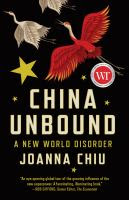
China Unbound

 Joanna Chiu, a Canadian journalist born in Hong Kong is in a unique position to explore our relation with China.   A big issue for Canadians was labeled "the two Michaels," (Michael Spavor, Michael Kovrig) with one of them being an acquaintance of hers.  The American White House wanted to extradite a Chinese national, Meng Wanzhou who they suspected was defying their Iranian sanctions.  With an agreement to honor, Canada started the legal procedure to extradite her from her Canadian home.  China was very upset with this and shortly after took two Canadians into their jurisdiction, meaning prison after what were charged with spurious spying claims.  That situation was not resolved when the book was published, but Joanna commented on their release in a tv program with Steve Paikin that inspired this post.  

China has the longest history of any modern country.  At one time they felt haughty and resistant to the outside world.  Then they went through a period of humiliation.  The Opium Wars signaled their weakness.  The British managed to hold onto Hong Kong which offered a sort of beacon to the rest of China, but was seen as further humiliation.  Through hard work and careful planning they have become an economic and political force for the whole world to acknowledge and deal with.

She traveled to a multitude of countries following a Chinese connection, including of course China itself.  Perhaps like many other nations China had spies, but it seemed many espionage efforts were aimed at Chinese people.

One of her destinations was Australia.  China buys a great deal of iron ore from there.  Without dealing with the federal government the Chinese were able to  get a management agreement for 99 years with Port Darwin.  This was criticized because it gives China a strategic tool they could use in the South China Seas disputes.

An illuminating story from Australia.  Badiucao, a pseudonym was a law student in Shanghai who quit to study art in Australia.  He became a satirical cartoonist specializing in criticism of China.  The Chinese government found his true identify and was able to curtail some of his activities and that of his family in the mainland.  One day in Melbourne he was followed by four Asians, (Chinese agents ?) eventually he confronted them.  He revealed his identity in a film and felt he no longer had to hide. 

Turkey has become  favorite destination for many Uyghurs who are able to escape.  It is a Muslim country and with a related language.  But Turkey is trying to develop a more positive trade relationship with China.  So far they have mostly resisted demands to repatriate Uyghurs.  The Uyghurs have been imprisoned (supposedly for re-education) and are surveilled with high technology.

A major Chinese project intended to replace American hegemony is labeled the Silk Road.  Reaching out to Europe which was very resistant they encountered success in Greece who was in an economic dilemma.  China agreed to invest a huge amount of money with much going to Piraeus, a major Mediterranean port.  Greece has been voting Chinese preferred way at the United Nations.

China is Russia's biggest oil customer.  As autocrats with a history of Communism they seem to recognize unity at least in public is in their mutual interest.  The situation in Ukraine  (post publication) creates a difficult decision for China.  They have good relations with Ukraine, sending students there and having vital trade interests (food).  Russia made their first military moves before China's Paralympics had started. They have tried to stay neutral.  The resistance and with American support must give China pause regarding their plans for Taiwan.  China could make a crucial difference in the Ukraine crisis with widespread ramifications.

The United States finds that China is catching up and stirs a lot of emotion.   Disinformation flows from both directions.  Donald Trump used racist language to detract from his poor management of the pandemic and cast aspersions on the government.  They have imposed sanctions on China, but at the same time American corporations are seeking more trade and investment ties.  Obama had attempted a "Pivot to East Asia," but Trump undid much of that effort.  Trump was unconcerned about human rights and according to John Bolton at least twice had told Xi that he was okay with the Uyghur concentration camps.

More post publication news:  China has made a secret deal with the Solomon Islands.  Neither side is supposed to release details without written permission from the other side.  Awhile back Solomon Islands declared Taiwan to be part of China.  It is easy to speculate that China has identified a weak country that can be of strategic interest to it.  

Biden has attempted to co-ordinate efforts against China.  He made a blunder when he suggested that of course the U.S. would repel a Chinese attack on Taiwan. The State department  amended the remarks to maintain the status of ambiguity preferred by the government.

What can we do?   

Joanna points out that anti-Asian incidents and words give China a distraction from their human rights abuses.  Too many westerners treat Chinese citizens and Chinese looking people as part of the Chinese government.  

The Chinese were quick to criticize the January 6th insurrection.  They pointed out that Americans say one thing, but do something else. Unfortunately every nation has elements that are undemocratic, but voters need to support democracy and not be distracted by racism, homophobia or other social maladies.

Although it is easy to make efforts to placate the unreasonable demands of China we need to bear in mind that there are opposing views among the Chinese people.  They need to see a better model of western democracy.

There are problems that need to be dealt with through global co-operation.  Climate change and dealing with pandemics are two that are very dangerous for everyone.  Trump spent much of his administration breaking up relations and insulting allies.  Biden has been fairly successful in fixing, but still has much to do.   

There is much to ponder in the book and we all need to keep our eyes open.

A recent blog on China:  http://www.therealjohndavidson.com/2022/01/better-pay-attention-to-chinas-role-in.html

Thursday, October 14, 2021

Dream House

As a clever blogger I avoid using the first person pronoun as it turns off readers.   For this blog which stirs strong emotional feelings I feel I must state my personal stake in the game.  I am 73 and have owned my current home for almost 40 years and before that owned two other houses for shorter periods of time.  My income and that of my wife never was high enough to get out of the first tax bracket.  We were given breaks by relatives, but were not able to live in the more expensive locations in any town.  My current house is two stories with a finished basement, a small pond in the back yard and lots of flowers.  I can easily walk downtown or to Bayfront Park.

Times have changed.  The value of my house has gone up well over ten fold, but the people bidding up the prices are coming from further away and in most cases commuting a distance to afford.  If I were to give in to the real estate agents that pester me, I would have to find another house and it is not likely to be better located or offer as much space.

That is my situation and I fear the future will be a bigger challenge for those coming behind me.  In Hamilton (as elsewhere) we are having a big debate about the future.  Recently there was a big campaign to protest possible plans to expand housing including to farm land.  Not surprisingly many residents are horrified.  Building developers and some politicians are fighting back and have a case.  I noticed that the signs protesting urban sprawl were at single dwelling houses.  One of the politicians backed by a developer pointed out that the survey was very biased and offered their own supposedly less biased poll.  See below for a different political view.

The problem boils down to we who have an established house (relatively speaking"dream houses") don't want to rock the boat.  We don't want big huge buildings with multitudes in our neighborhood and we don't like the idea of farm land being turned over to greedy developers.  I fit into that category.  BUT everyone agrees that more people are coming. 

Where are these people supposed to go?  I don't envy their choices.  Cramped in an apartment or condo might be one choice.  Another would be way out in the suburbs requiring longer commuting.  Another choice to somehow get more money (an unhealthy pressure in itself) or accept that a higher percentage of their income is going to be devoted to housing. 

The basis of the frustration is the pursuit of the "dream house".  More "dream houses" can be built, but yes they will be more expensive, further away, maybe not quite as ideal and yes they will cut into our precious farm land and add pollution and accelerate climate change.

Anther political view was picked up from John-Paul Danko to Steve Paikin.  My phrasing:  The government empowered by greedy developers has extended the time frame, hyped up population projections and taken on a larger planning function.  I agree there needs to be a wider view of the problem, but hopefully not financed solely by "special interests".

Are there solutions to the dilemma?  There are ideas, but they are dependent on people who can help work out the big plan and the little details that impinge on them.  There will have to be adjustments or not only will people be unhappy, but they may not have much of a planet left.

Cars are part of the problem, especially as more people may be commuting further and on more crowded roads.  Extended infrastructure will also add another element of pollution and attack our climate.  Transit is cheaper and more environmentally friendly.  If people insist on living in detached houses far from city centers can we somehow put them into the transit network?  Better yet, in the future will more of us be able to do most of our work from home?  Working from home has mixed blessing in that human contact is still vital for many interactions.  We may be aggravating inequality as some will have the luxury of working from home while others can't.

At bottom the real pressure comes from population.  Some have a vested interest in ever growing population which really are markets for whatever they are trying to sell.  Part of a dream for many families is deferred because they don't have the resources to bring up another human.  We would like to support families as they are the base of society as we know it.  Large families may be difficult to maintain, and for the world as a whole and individual families some disincentives should be established.   Part of the strategy to curb excessive population growth would include sex education, availability of contraceptives, but more basic is our attitudes.

Compromise is how we have traditionally dealt with conflicts.  I learned that the city of Hamilton has limited downtown buildings to a height that does not obstruct the view of the escarpment.  I would keep that sort of restriction but perhaps we need to examine other building restrictions.  Along with that would be improved transit which always seems to run against budget concerns.  Farmland could well be our saviour, but we need to expand our food growing resources which have been done in some urban centers. Many compromises would be easier if more money was included.  That of course relates right back to inequality.  An earlier blog on taxation has some relevance:  http://www.therealjohndavidson.com/2021/05/taxation-necessary-tool-for.html

Happiness is being satisfied with what you have while unhappiness is not being satisfied with what you have.  Having said that, human progress has come from those overcoming dissatisfaction.  What can we do to make life more satisfying.  Make living spaces more livable with more community space and also concern for privacy.  We take for granted that more people can mean more cultural opportunities, etc.  Each of us needs to examine what is really important including independence, relationships and purpose.  What joy can we find?   It might be too much to put this burden on education, but that has to be an important component.  Schools needs to be more than learning job skills.

It is good that the issues are being raised, but each of us needs to be open minded.  We have to acknowledge other people have their needs.  We should admit that we have achieved at least part of our dream and that others have not been quite as lucky. 

Friday, July 16, 2021

THE VALUE OF EVERYTHING

 Price and Value seem almost like synonyms.  Mariana Mazzucato feels there have been distortions that are not in our best interests.   Spotted her on Steve Paikin with a new book.  Previously learned of her first book on the same show:  http://www.therealjohndavidson.com/2015/07/the-entreprenurial-state.html

What the market determines is the price of any commodity is generally considered its value.  Mariana feels this is not always reliable.  As she points out once value was thought to be the time and effort required to produce an object, but as markets are imperfect prices and wages are often set by the powerful and paid by the weak.

There is a lot more meat in the book than I can convey in a short post, but below are some random thoughts gleaned.

Gold was considered value and that anything could be valued by how much gold could be exchanged.  Spain brought back huge amounts of gold stolen from the New World, but in reality did not make Spain more productive.

Conservatives feel government is an impediment to business, perhaps because they are focused on profits more than the environment they help create.  Productivity has increased since the 1960's in industrial countries, but the standard of living for most has not improved as much. 

Financialization has crept into our economy, not only through expansion of financial institutions, but also by the productive sector.   For example Ford in the 2000's made more money from selling loans to buy cars than from selling the actual cars.  

Another practice that distorts value is the practice of buying back shares which in effect increase price of shares, but without putting money into production.  Too often other stakeholders, such as employees, municipalities and taxpayers receive at best secondary consideration, even though they are crucial to the economy.

John Maynard Keynes is one who understood that the government is the spender of last resort.  He advocated for more spending (even it means borrowing) during economic down times, while in "normal" times to accumulate surpluses for the inevitable downturns.  More information on his thinking:  http://www.therealjohndavidson.com/2012/04/book-on-john-maynard-keynes.html

One sobering thought: if you find something free online, you are not the customer, you are the product.  A closing thought from the author: "The question of growth must thus focus less on the rate of growth and more on its direction."

The thinking expressed in this book should be of concern to everyone concerned about the future.  What do you value?

Saturday, May 8, 2021

LANGUISHING: A NEW WORD AND A NEW REALITY

Actually, "languishing" is not a new word, it has been kicking around for a long time and has recently gained some momentum.  But it does have a new and personal meaning for all of us.  Most of us are not actually depressed (although more of us probably are), but we feel helpless and unfocused.  We have been teased with restrictions being lifted and then brought back.  The weather has been easing, but inconsistent.  For me a Steve Paikin episode gave the notion of how one feels, some articulation.

Update:  Languishing is when a person loses hope and loses much of their motivation.

Time management has been altered for everyone.  I had once preached that you can not fully enjoy two activities at the same time, but these days multi-tasking is the normal, but truly no task is quite as satisfying as we hoped.  Blogging is one coping mechanism for me, but will confess there are many posts in draft and I dilly dally between them without the focus that could make any of them more satisfying.  An earlier blog when I was focused on selling, but everyday living as well:  http://www.therealjohndavidson.com/2011/05/time-management-for-sales-other-people.html

Personally (and for some this is even more excruciating) two funerals have affected me.  A close friend of the family, Helen Rigby died from cancer during one of the semi lockdowns.  A memorial service was held, semi outdoors, masks, temperatures checked, some social distancing.  Under normal circumstances a lot more people would have showed to pay their respects and remember the good times with her.  Through the newspaper obituary we learned of the death of an uncle, Raymond Oleskiw who once had a significant role in the family.  Although he was elderly and had other health issues, the Covid 19 pandemic was the deciding factor.  No mention of a funeral and apparently the opportunity to renew family ties has been missed.

Resentment which we all seem powerless to really express is now part of our psyches.  Guessing most of my readers resent those "idiots" who are not strictly abiding by restrictions and holding the rest of us hostage.  On the other hand they resent us because we are putting a damper on their enjoyment of life.  Amongst my crowd there is resentment between those who had early access to vaccinations and those who didn't, many of whom were exposed to greater risk.

Donald Trump and his supporters are especially resented.  We can see his selfish decision to sideline an intelligent response to the pandemic.  Too many blindly follow his words and example, not realizing he has already screwed them and is now compounding the problem.  Somewhere in the future there may be a reaction against science deniers that are really protecting their greedy interests.  Climate change, gun control, mental health, inequality, etc.may eventually be viewed more reasonably and dealt with more effectively.

Another resentment is that the rich are doing better than ever.  More of us are forced to buy online as we are unable to get what we need (and want) through our regular suppliers.  The big grocery stores are able to adjust, while too many of their smaller competitors are either closed or severely restricted.  This trend will likely carry on and we will all have a different purchasing life.

To my way of thinking there have been events that changed society profoundly, but few as severely as the current pandemic.  My parents were brought up during the Great Depression and went through some deprivations and a great release to help start the baby boom.  Their parents (my grandparents) were the ones who felt the shock of a standard of living being suddenly lowered.  World Wars created for many a different adjustment, due to fear.  Young people, especially those active or close to active fighting, felt life and plans could be ended abruptly so you might as well enjoy life to the fullest for the moment.

Other blogs that made me think of our precarious existence: 

When the Covid 19 shutdowns I started exploring my city within walking distance seemed like a good idea.  This link has several other links for these walks which resulted in lots of photos that you might find interesting and a few observations:  http://www.therealjohndavidson.com/2020/04/the-shutdown-continues.html

A CBC radio clip got my attention about luck.  A book written by Jeffrey S. Rosenthal, a statistician followed.  He was debunking a lot of luck notions while at the same time urging us to pay more attention to statistical odds.  More recently there has been a fuss about blood clots caused by some vaccines that has caused some policy changes and more critically public fear.  Looking at the odds there is more danger of getting Covid 19.  It is worth some consideration:   http://www.therealjohndavidson.com/2021/03/knock-on-wood.html

 Watching Michelle Gelfand, a guest on Fareed Zakaria the discussion started on loose and tight societies and how they affected coping with the Covid 19 pandemic.  There has been a definite link and the same mechanism affects much more:  http://www.therealjohndavidson.com/2021/04/rule-makers-rule-breakers.html

What will we bequeath to those that follow?  Life is not certain and thus we might appreciate it more.  People can be very greedy and thoughtless.  Other people can be very caring.  The rich can survive better than the rest of us, but even they can be hurt.  Above all I hope future generations will realize that we are all CONNECTED.

 If you found this blog more disjointed than usual, you could be right.  Blogging still is something I enjoy and has become part of my coping strategy.  An explanation of my joy:  http://www.therealjohndavidson.com/2020/09/what-keeps-me-blogging-and-what-i-have.html

An explanation of how I chose my title:  http://www.therealjohndavidson.com/2013/07/the-real-john-davidson.html


Saturday, December 14, 2019

An Antidote to Chaos: A series of rules from my experience

Another rules book!  Most if not all humans lack discipline to just do the right thing without some guidance.  Perhaps I am just projecting, but I feel the same way.  Maybe this one will be easier to follow and guide me to happiness.  OR remind me of some habits that may have waned or even give me some new idea to hook on to.

My life has been like others--a search to find the right path to success, happiness and a sense of purpose.  It has been a struggle, but there has been lots of advice requiring some discipline and overcoming temptations.  Many books have influenced me, even causing me to modify my behaviour, but so have many other books and experiences.

The 10 Commandments were given at a young age.  No particular complaint, but they seemed a series of things not to do.

Dale Carnegie did make a difference.  I read the books, but with the encouragement of my father took the course.The course was designed in a sequence that helped build up self confidence.  Learning how to memorize names not only was useful, but motivating.  For lesson 5, I thought I had an unfair advantage in that we were requested to bring some newspapers and at the time I worked for a newspaper and fancied myself clever at improvising.  However I was wrong.  It had nothing to do with reading the paper, but rather used the paper as a tool to unleash our inhibitions.  It turned out to be a big breakthrough for me, allowing me to feel more comfortable speaking to a crowd.  I had read the two main books, "How to Make Friends and Influence People," and "How to Stop worrying and Start Living" with lots of good ideas.  One fairly new concept for me was the importance of listening.

I didn't want to take the course, even having read the books lying around my home.  My father would refer to it in positive tones.  I felt that my father was a poor example of what the course could do, but I came to appreciate a new concept.  It is not how good you are at the end, but how much better you became.  My father was aware of his shortcomings.  Read about my father and the course:
http://www.therealjohndavidson.com/2012/06/remembering-my-father.html

Ben Franklin was brought to my attention through different means, but I think Dale Carnegie might have been the first.  It was very simple.  When confronted with a difficult decision one should write down a list of the reasons for and the reasons against and weigh them, not just with quantity, but also with quality.  Many years later I read another book that didn't dismiss the notion, but suggested it was inadequate.  http://www.therealjohndavidson.com/2016/08/decisions-are-path-to-success.html.---counter argument-

At a sales meeting I was shown a video about Alan Lakein,  "How to Get Control of Your Time and Your Life"  Bought the book, underlined dozens of passage and years later gave it away to someone who I thought needed it.  Quite a bit penetrated my thinking with the key concept that time is the essence of life.  It is better to be early.  Every minute is important, but concedes that rest is crucial.  A way to set goals is to decide what you would most want to do if you had a short time to live and then work backwards to start prioritizing tasks that move you towards your goal.


'
A few years later my daughter Heather's gifted me  "The Time Paradox." that had a different perspective.  Most time management books focus on setting goals and planning the future.  The suggestion of this book was that you should not focus on your failures, but on your successes--the ones that build your confidence and remind you how to overcome difficulties.

Time management became an obsession of mine, particularly as I had chosen a series of sales positions, although only moderately successful.  I learned from many many mistakes and failings, but also did have successes and worked to multiply them. http://www.therealjohndavidson.com/2011/05/time-management-for-sales-other-people.html

Often as a parent I felt inadequate. I stumbled on a book by Dr Wayne Dyer (raising children),  The original motive was to know how to train my kids to be better.  His method was to model whatever behaviour you desired, but that meant a lot of effort.  But it did give a different focus.  Wayne had good ideas for how one might steer their children to turn out and most were agreeable.  Because I wanted my children to be better than myself I was forced to consider how to make myself better.  Some of the chapter headings:  "I want my children to value themselves," "I want my children to be risk takers,"I want my children to fulfill their higher needs."


Stephen R. Covey did impact me.  I read the book, multi times and listened to his tapes for literally hundreds of hours (my daughter memorized much of it as I drove her to swim practice).  I actually set up goals and plans as best I could handle his ideas.  They were all good.  My favourite was you must seek first to understand before seeking to be understood.
http://www.therealjohndavidson.com/2012/07/stephen-r-covey-pointed-way.html


A modern set of rules was brought to my attention by my sister Jennifer, "get your SH*T together."  A lot of books serve to remind me of things I had slacked off a bit and primarily this accomplished that, but in a different style.  One point she made was that fear of uncomfortable conversations delays resolution giving a personal awkward example as to how she overcame bullima.   There was one slight apparent contrast to my favorite Stephen R. Covey which is covered in my post:  http://www.therealjohndavidson.com/2018/03/get-your-sht-together.html


With "Twelve Rules For Life: An Antidote to Chaos" Jordan Peterson views life as chaos overcome by order.  Oversimplified as he sees some merit in chaos.  There is a lot of suffering in life no matter our circumstances.  We can be happy and successful, but it works best if we pay heed to his 12 rules.

Remembered Jordan Peterson as a guest with Steve Paikin offering a psychological perspective and always seemed to make sense.  Jordan is a psycho analyst who recounts some of his experiences with patients in a non invasive manner while giving some perspectives on psychoanalysis.

What sets this book apart from the others is that the goal is not so much happiness and success, but a deeper meaning to life.  A quote, "If we each live properly, we will collectively flourish."

Some of his rules are humorously expressed, but supported by both psychological and philosophical ideas are familiar. There are differences and he gives a few different perspectives.

To get an accurate feeling for his rules you need to read the whole book.  Here I am interested to glean something interesting and maybe useful.  His rules are backed up by well presented arguments.

One rule (#5) is  "Do not let your children do anything that makes you dislike them."  He believes that if a child is not taught to behave properly before age 4 they are doomed to have difficulties to make friends.  At that age socialization is mainly through peers.  You need rules for your children, but 1) they should be limited; 2) the least force necessary to enforce should be used and 3). parents should come in pairs.

Rule #7 reads "Pursue what is meaningful (not what is expedient).  Control your impulses.  Peterson believes success comes from delayed gratification.

Rule #9 reads "Assume the Person you are listening to might know something you don't."  Listening is how you learn things.  Peterson suggests you summarize what was said before you make your point.

Rule #10 reads "Be precise in your speech."  As he says "it is very difficult to make sense of the inter-connected chaos of reality just by looking at it.  We see enough to function.

In his justification for some of the rules he reminds me of the concerns about evolution  I read in "Super Cooperators" which gives many practical examples of how humans evolved to cooperate and organize out of chaos. http://www.therealjohndavidson.com/2019/11/the-only-thing-that-will-redeem-mankind.html

He has some leftist sympathies, but seems basically conservative which fits in with his idea that the world we encounter is chaotic and we have evolved into a pragmatic organization in which inequality is inevitable if often unfair.  It is true that aggression is learned, but much of it is natural and the result of evolution and has served a purpose.

Do we really need rules?  I would say yes.  Do we need to think about them?  Habits can be good, but also bad, so we need to examine what we really want and how best to achieve our aims.  Many new titles are useful as much for reminders, but also bearing in mind there are often different ways to accomplish tasks and that a different perspective might hit us more effectively.  I prefer "guidelines"--other people have given great thought to their rules, but I have the option to choose, partly for comfort and partly for what is most appropriate for my talents and disposition.  I am grateful to all those covered in this post.

Saturday, September 5, 2015

"The Upside of Stress" can help you handle inevitable stress better

Awhile back I recommended "The Willpower Instinct" as a book well worth reading.  Once again Kelly McGonigal appeared on "The Agenda" hosted by Steve Paikin and she had a new book out that is worthy of another recommendation.

You are all familiar with stress, often times with a raised heart beat, heavier breathing and feelings of anxiety.  We have been taught, including by Kelly that stress is bad and should be avoided as much as possible.  Once that idea is examined Kelly has found stress can be very useful.

Kelly had some colleagues that pointed to statistics that indicated many people actually responded to stress in a positive manner and had positive outcomes.  She then explored many different studies and became a convert.  It turns out when the body is stressed certain chemicals that can be measured are released to help you cope with the situation.

It is impossible to totally avoid stress; in fact a meaningful life is stressful and a happy life is not stress free.  Stress can be helpful.  Avoiding stress has a cost:  missed opportunities  Stress response is more than fight or flight

Nietsche paraphrased--what doesn't kill you will make you stronger.  The author is not suggesting you seek very risky stress situations, but take a positive view of the ones that confront you.

A key to maximizing stress is the mindset you start with. You can retain the mindset that stress is bad or you can adopt the mindset that stress helps you to improve.  Do you see situations as threats or as challenges.

For some when confronted with a stressful situation retreat into themselves to cope with it.  A different approach labeled "tend and befriend" seems to produce better results.  When you can focus your attention on others it helps you cope better.  Caring for others triggers the biology of courage and hope

People who believe stress can be helpful are more apt: to accept stressful events as real; to plan a strategy to deal with it; seek information, help or advice; to try to make the best of the situation.

Everyone sometimes feels they are the only one suffering, but in fact others often put on  a face.  Realize you are not the only one and seek help.

Kelly is not concerned that her readers remember every example, but hopes they will feel differently about stress.

You can watch a You Tube version of her TED talk that altogether has been seen by over 10 million people.  https://www.youtube.com/watch?v=RcGyVTAoXEU  Not as detailed as the book, but graphic

Kelly also had some interesting views on willpower and you can read my review of her book at http://www.therealjohndavidson.com/2012/09/the-willpower-instinct.html

Thursday, July 23, 2015

The Entreprenurial State


It has become common to believe that the government should keep its hands off business and job creators.  This idea is amplified by the right wing.  It is very true that individuals have intelligently, persistently, luckily and perhaps above all courageously brought civilization forward in an economic sense.  Real innovation is often against the status quo.  It also is true that when people band together they can accomplish more things.

There will always be a delicate balance between individuals and the collectivity.  It is true that we are all pressurized by our peers not to step too far out of line.  Status quo is comforting for many people.

I first saw Mariana Mazzucato on TVO's The Agenda with Steve Paikin.  Her comments stood in stark contrast to what I consider blow-hard opinions.  The blow-hards are basically self righteous individuals who have achieved success or visualized it, as separate from government.  They overlook their good fortune and the support they received from many quarters including government.

She links herself to John Maynard Keynes and Joseph Schumpeter.  Keynes is the one known for advocating increased government spending when the economy is depressed and Schumpeter is the one known for advocating innovation as the key to growth.  When times are tough private businesses curtail their spending including research leaving the government, if willing, to pick up the slack.  In good times Mariana finds that private business is really only interested in the short term.

Risk is a term used a lot, particularly to justify higher returns.  Another term Mariana likes to draw attention to is "uncertain."  There are many factors (including risks) that can be gauged as probabilities, but there are many other factors (unknown unknowns) that are not at all predictable.  These other factors can have a positive or negative impact on success, but in the field of basic research they can lead in new directions.

World War II provided an opportunity.  During the war scientists were gathered together to work on many military tasks perhaps culminating with the the Manhattan Project.  Working together and across disciplines they pointed the way to maintain military superiority.  After the war, groups developed to maintain competitive strength.  Defense Advanced Research Projects Agency known as  DARPA was one result.  Sputnik spurred even more research funds as the whole country felt threatened.  The Japanese were a few steps ahead regarding semi-conductor research and this was also a concern.

Their research provided the basic building blocks for iPhone, iPad, GPS, many pharmaceuticals, etc. etc.  After the expensive and risky steps had been taken some sharp people like Steve Jobs and many others were able to put products together that were commercially viable.  In fact most businesses and even venture funds shied away from expensive risky research, especially where they could not see a quick commercial application.

Today many see climate change as the number one priority.  Usually successful new technologies are disruptive to old technologies, i.e. creative destruction. The fossil fuel industry (oil, natural gas and coal) have had a long development (entrenchment) with large very significant sunk costs.  They have all the power to resist and the comfort of consumers on their side.

Bottom line:  do innovators give back to the community that supported them when it was needed?  Apple is used as an example--much of the basic research and development was done through government resources. But jobs go where they can be done cheapest and the company has developed strategies for minimizing taxes.  They are not unique.

A few conclusions.  The government can have a critical role in innovation and is in a position to take necessary risks on behalf of its citizens.  The government needs to recover some of its costs from developing innovations in part to continue its role in innovation.  Taxation is one way and even equity positions might be another.  The government above all needs to be recognized for its role.  Marianna makes many too often overlooked points and some useful suggestions.

I would add one more detail that the government provides towards innovation and that is education.  Some will point out innovators who dropped out of school and to be sure there are plenty to be found.   There are just as many innovators who were inspired by a teacher (in the formal system or outside).   To communicate their discoveries someone needs to read, write and understand, skills most often acquired in formal education.

The lion and the pussy cat on the cover were inspired by some words of John Maynard Keynes who was talking about animal spirits with regard to business.  The question is which animal represents business and which the state.

Friday, August 22, 2014

"The End of Power"

At a Toastmaster's meeting one speaker suggested you don't actually need to read a book to be able to talk about it in a social setting.  He felt that reading the reviews in the New York Times Book Review allows the reader to project a knowledgeable sophisticated image to those he wanted to impress.  We all want to leave good impressions, but sometimes a real deep understanding can only come through serious study.

"The End of Power," originally brought to my attention by Fareed Zakaria is such a book that helps explain why the world is different in so many critical ways than a few generations ago.  The explanation deals with a lot of simple beliefs, but goes deeper.

Power is defined as the ability to direct or prevent the current or future actions of others groups and individuals.  It can manifest itself as force or the threat of force, a moral code, persuasiveness, or rewards.  All of these means are weakening.

Moises believes there are three revolutions in progress that have liberated people and removed barriers to power.  One he calls the More Revolution which stems from there being more of everything, especially people, making them harder to control.  The Mobile Revolution adds to the dynamic with people and money and ideas flowing much easier offering more options for people not satisfied with their lot in life.  The Mentality Revolution refers to expectations and education being higher than ever so that those with power find it more difficult to satisfy.  He concedes that social media plays a role, but the three revolutions are more critical.

What we see is the emergence of micro powers.  They were always there, but with so many barriers that mostly they have not had much impact.  American politicians are more apt to have to go through a primary to reach power and many factions have a say.  Businesses now have access to other sources of financing.  One interesting example occurred when the Soviet Union collapsed Russia had a television vacuum that would be filled with movies and programs from other countries including novellas from Columbia.  Huge armies still have an impact but most military action is more like guerilla.

A few weeks ago I reviewed "Selected" about how leaders are selected.  In pre historic times leaders were literally selected and to a significant degree also controlled by followers.  Then the Agricultural Revolution and later the Industrial Revolution allowed for a system where leaders were not chosen by the masses, but by elites.  Now, as Moises explains times are changing in a different direction.  Check:  http://www.therealjohndavidson.com/2014/07/selected.html

There have always been barriers to power and those who have power have been able to take advantage of the barriers to create more barriers. The three revolutions are all contributing to breaking down the barriers and most of us would agree that there are a lot of benefits.  There are still many powerful people and groups that seem well entrenched, but cracks are showing everywhere.

There are dangers when power is diffused. "Terrible simplifiers," becoming more common offering simple solutions that in the end only worsen the problems.  Moises offers little in the way of concrete suggestions, but points out that while NGO's (i.e. non government organizations) have increased in popularity and trust, political parties are trusted less and less.  He gave Obama's campaigns in 2008 as an exception and hoped that other political movements could capture the enthusiasm of large numbers of people who might otherwise become single issue people.  The world needs to solve problems.  Balance between totalitarianism and anarchy is difficult, but intelligent people with power should be able to work towards one.

Moises is confident that as in almost all other fields our political processes will be subjected to innovations that will assure both individual freedom and intelligent collective decisions.   In some ways this review is a platform for my beliefs, and can be a small springboard for solutions.

My feeling is that this will have to involve education and giving people real voting choices.   By education it is necessary that our youngest citizens need to be aware of how the political process works (along with alternatives), history, science, logic and the arts.  Too many politicians are able to twist logic to attract voters.

Politicians have also been able to strategize around splitting opposition or able to drown out logical alternatives with massive spending.  We are often bribed with our own money and have our natural selfish interests used against us.  To me proportional voting helps alleviate some of this abuse.   The American practice of gerrymandering (with similar practices elsewhere) should be minimized.

There is a lot of food for thought at his website, http://moisesnaim.com/books/the-end-of-power/

Update:  I watched Moises being interviewed by Steve Paikin and learned a few things.  I had forgotten that Moises speaks from experience--a cabinet minister in Venezuela he was upset at the lack of real power he had.  Steve asked what should be done.  Moises pointed out that our lives have been changing with the internet and he anticipates there will be political innovations within a few years because the people will have the power and will demand change.  June 2, 2015

Friday, June 28, 2013

The Darwin Economy

Robert H Frank contends that while Adam Smith is credited as the founder of economics it is really Charles Darwin who is more important.  His concern in this book is about hard right wingers who to paraphrase, are too short sighted for the good of everyone.

Referring to our current economic crisis that started in 2008, he deplores that the rich seem hell bent on lowering expenditures and keeping taxes lower for them.  They claim the deficit is the most critical problem, but many readily admit they hate taxes, big government and regulations.  Robert points out that in fact if roads and bridges are not repaired when men are idle and borrowing is cheap these repairs will cost even more as time goes by.  There are no winners, not even rich people who think they are avoiding another "theft" of their property.

Throughout the book Robert gives examples of short sighted thinking that hurts not only poor people, but also rich people. Perhaps more importantly the author points out some of the psychology and philosophy that erroneously support the resistance of the right wing.

For most humans happiness seems related not so much to what we absolutely have, but how we compare ourselves to our neighbours, relatives, work mates and friends.  Not every issue is "positionally" important, but for many people they measure themselves with such factors as the size of their house, the prestige of their car and with scarce items.  Often the really rich bid up prices on some of these items and in turn that can force up pricing all the way down the line.

As part of the argument Robert uses the example of hockey players choosing not to wear helmets when given the chance, but at the same time would like to see a regulation forcing all players to wear helmets.  They want an edge, but they realize there is a risk.  On another field, armament agreements are made because both sides realize they cannot slow down arming up which gets very expensive and risky.

In fact the rich are in a similar spot as the hockey players and the statesmen.  If they gain more money by lowering taxes they will just bid up the price of scarce desirable goods.  They will also lose out on desirable public goods such as improved roads and bridges, education, science, etc that are necessary and desirable to keep pace with the rest of the world.

Robert assumes that ideologues will not be moved by his arguments, but hopes that rational libertarians will appreciate his perspective.  He realizes progressives think that rich people are greedy and cold hearted, but Robert thinks (and backs up his ideas with solid logic) that it is not just greed in absolute terms, but short sighted greed in relative terms.  There are a lot of cliched myths that are trotted out as truths to be beaten down.  Examples include: "the government is the problem";  "Taxes are theft".

Many rich people dismiss luck, attributing their success to hard work and talent.  The author says there is an element of luck in everyone's success, whether it is genes, nurturing or timing.  Small differences are magnified in a lot of winner take all situations.  Many pursue the large payoffs, but only a few are fortunate to achieve the goals while many worthy pursuits fail to attract talent. Entertainment, major league sports, hedge fund selling attract more interest than science, engineering, education.

He has a host of suggestions that seemed based on the idea that anything that is taxed is discouraged, so we should tax harmful things.  His critics say that is social engineering and he really doesn't deny it, admitting that all laws are forms of social engineering.  We have laws against homicide and theft as an attempt to reduce them.  His favorite idea is a consumption tax that is calculated by reporting income and also reporting savings. The difference is considered consumption and can be taxed on a progressive scale.  More conventionally carbon taxes and sin taxes are suggested.  Those who really want what is taxed will not be regulated out of doing so, but if they value other things to be purchased will quite willingly find ways to reduce taxable expenses.  At the same time we will have public goods paid for.

If you haven't got time to hunt up the book and actually read it, you might find this link http://www.youtube.com/watch?v=M8j1e-oT0UQ to a video very informative and it might persuade you that maybe an extra effort would be worth it.

This book is another inspiration from Steve Paikin on TVO. I don't want to rely on Steve, but he and his team are very good in their selection of worthy topics and how to bring  out interesting perspectives.

Wednesday, June 26, 2013

AGAINST FAIRNESS

The philosopher author, Stephen Asma appeared on TVO with Steve Paikin a few weeks ago.  His premise for his new book stunned me and an investigation seemed in order.  It seemed to me that the problems of the world boil down to the fact that it is not fair.  Anything that can be done to make it a somewhat more fair world is worth doing.  The next few paragraphs are about the baggage I carried to this investigation.

At University one of the things that still affects me was Plato's "Republic" At the time it seemed a solution to the world's problems.  Basically children were not raised by their parents but by the community itself.  Who was given the opportunity to make money and who made decisions affecting the community was not decided by family connections, but by tests given at critical ages.  The idea was to separate money from power and as Stephen Asma  points out that reasonably assures disinterested (and therefore more just) decisions to be made. In other words your career options would be decided on merit not nepotism.

I grew up in a fairly typical Canadian family.  I knew my grandparents (have lived with both grandmothers at various stages) my aunts and uncles and cousins.  With six siblings we now live in 5 different cities (at one time 6).  I felt family connections, but nothing like what I married into.  Family is everything.  At times I have felt it suffocating, but on the whole I love it.  I have benefited immensely from the support and concerns of my in-laws and I am not alone.  They have all benefited from close connections.  There is a feeling that no matter what the outside world does we will stick together just like we enjoy each other's company whenever practical.

A previous blog on "Fairness and Freedom" resonated my feeling that some cultures are superior because they (in this case New Zealand) are focused on treating everyone fairly whereas other cultures are focused on freedom supposedly emphasizing merit  (in this case United States.)  There was a  bit in there about how too great an emphasis on fairness could create destructive envy, but on the whole a fair society was more attractive.  You can read my post here:  http://www.therealjohndavidson.com/2012/06/fairness-and-freedom-book-review.html

Any social system has to accommodate human nature.  The idea of equality may have some merit in an abstract sense, but in practice it doesn't always work.  The author, Stephen Asma, admits that there is no one more precious to him than his son and the rest of his family.  Favoring your relatives is noted as nepotism and is considered a form of corruption when it comes to business and politics.  Ethnic networking has helped many deserving individuals crack the establishment.  Other forms of networking might seem artificial, but as we align ourselves with a wider group of people who share  something in common (sometimes only by attending a networking group) we extend our own power.  Aside from social pressure another factor in nepotism is that people naturally trust people they know more than strangers.

There is a natural chemical bonding established just after birth, usually between mother and child.   These bonds are critical for survival.  We humans retain a capacity to bond with others throughout our life, but family bonds are very strong.

Stephen has used examples from China and India to point out that in these societies family loyalty does come first and they look askance at suggestions that we treat strangers better than family.  From other reading I am conscious that in fact societies can only grow if we find ways to avoid killing strangers.  In our complex cities it is common to walk by hundreds of strangers every day which in other cultures would cause a great deal of anxiety.

One of the themes seems to be that in our egalitarian society we have developed the concept of charity, but Stephen asserts that favoristic societies can also develop the concept of charity and acceptance of those different or worse off than ourselves.

Every day we make countless choices, most of which impact on both our families (plus other favorites) and society in general.  You may feel an obligation to one goal or another, but I now think it is legitimate to give your family first consideration, but probably not a good or fair idea to ignore the greater good.

Wednesday, September 26, 2012

The Willpower Instinct

This is not the first book I have read to try to boost my own willpower, but in some ways it is the most practical.  I had watched Kelly McGonigal, the author on a TV Ontario program hosted by Steve Paikin and was quite impressed with her ideas to stiffen our resolve.


Self control is more critical than intelligence, charisma or empathy.  We all, one way or another realize that to get what we want we have to overcome our impulses that run counter to our goals.  Still our impulses come from our evolutionary past as ways to survive so they will not just disappear on their own even though our circumstances are different from our ancestors.  It is seldom that fight or flight will effectively deal with most of the problems of the modern world.

We want willpower for different purposes.  I will do something, I won't do something and I want something.  The key one is you want something, an over-riding goal that will help you deal with the everyday urgent temptations and procrastinations we all deal with.  I will exercise and I won't eat bad foods so that I can get the body that I want for myself is a classic example of willpower dynamics.

Kelly's first advice is to see how and why you lose control.  Determine what you do just before giving into temptation.   This is almost always a decision to relieve tension.  You need to recognize that at one point you have made a decision.

Good health stemming from exercise, diet and proper rest is an important foundation for developing self-control.  Stress is a willpower drainer.

The idea of meditation has appealed to me for a number of years.  Like many of my readers I have become a multi tasker even though I am well aware it is counter productive.  The emotional element is that there are so many things you can do, but so little time that you feel cheated.  Trying to do something constructive, such as for work, watch tv (with channel surfing), on the computer, eating, a book on the side.  I have read several books regarding meditation and even once took a class.  Didn't really feel I got far, but Kelly's description was more encouraging and I think I am headed in the right direction.

Often to reward ourselves after achieving some task we will indulge in something that is often counter-productive for example eating  a fattening treat after achieving a diet goal.   This is viewed as a goal-sabotaging strategy.  We should view success as proof we are on our way to reaching our goals and try to reinforce our progress.  Look for alternatives (healthier, but tasty snacks, healthier, but enjoyable activities) as rewards.

Kelly teaches a class at Stanford University on the topic of willpower which is a two way process.  She conveys what she knows and she gets lots of feedback from her students.  Some of what we know about willpower is counter-intuitive.

One recounted experiment was about how people could not stop thinking about white polar bears once the idea was suggested.  A strategy that works is to accept the thought.  One of Kelly's strategies is to "surf the urge"which means to accept the thought that is tempting and just surf with it for awhile.  Eventually it will seem less important and you can move on.

One suggestion she made was to email yourself (through www.Futureme.com) from the future.  The point is that we have an ideal of how we would like to be in the future, but it seems so strange in comparison to all the temptations at hand.  Get to feel more comfortable with your future self and it will be easier to resist both temptation and procrastination.

Ultimately the only way to increase willpower is to stretch it.  When you feel like giving up just hang on for a little bit more and the next time a little bit more on to that.

Every person reading this book will be unique in some way.  There are so many tidbits of advice many of which will hit home, but it cannot be predicted which will have the most impact on you.

Her ending advice is worth repeating.  You must pay attention when making choices.  Self awareness is something you can use to help do what matters most.

If you are interested to learn more about "The Willpower Instinct" and the author Kelly McGonigal you can visit her website at http://kellymcgonigal.com/