Showing posts with label Covid-19 pandemic. Show all posts

Wednesday, April 2, 2025

A Map of the New Normal from Jeff Rubin

Previous blog on this book was accidentally deleted.  Actually read the book for a 2nd time.  The circumstances have changed a bit, but I understand a bit better what the author was trying to point out.

The world certainly has changed in the last few years.  The Covid 19 Pandemic and the Russian assault on Ukraine are two factors.  Jeff Rubin contends between sanctions, the Russian invasion and inflation we have made a new world that will affect everyone.

 One movement identified by Rubin was that nations that have been sanctioned by the United States have been forming new relationships.  Trump has made tariffs a big part of his economic warfare.  Canada and Mexico have been targeted although they are allies and have their economies tied into America.  They are being forced to consider alternatives.

Covid 19 cut supply chains and governments decided to print money and we have been adjusting since.  One of the adjustments was inflation.

The Russian invasion of Ukraine has spurred sanctions, but it is no longer like in the past.  Russia can now join other countries with sanctions such as Iran and China.  The BRICS group has greatly increased and the members take advantage of new ties at the expense of the United States and other western powers.  Now Canada finds itself looking for new trade connections.

Russia and Ukraine are both major food exporters.  Ukrainian wheat and other agricultural products are necessities for many third world countries.  Climate change, although considered a "hoax" by Donald Trump is having an impact on food supplies and very much on immigration patterns.  Continued avoidance will lead to ever increasing consequences.  China is buying up farmland in Africa.

At one time the United States had an arrangement with Saudi Arabia that all purchases of their oil were in American dollars.  Other oil producers took up the same arrangement that boosted the American currency.  Now however that is no longer the case and the oil producers led by Saudi Arabia accept a wide variety of currencies.

China is becoming the major money lender and they no longer are favoring the United States as in the past.  They are also dominant in rare earth metals buying up mining rights in Democratic Republic of the Congo and Indonesia.  Chinese cheap skilled labor is still critical for many companies such as Apple.

Trump became president since completion of the book.  Rubin predicted that Ukraine would lose leverage.

The map of the world is now topsy turvey and going in different directions.  Jeff Rubin keeps an eye on it.  Good to read his books.

Sunday, December 10, 2023

The Bill of Obligations

Everyone seems to have a concept of rights.  Rights are fundamental, but too often they clash.  Obligations cannot be enforced, but can hold a nation together.  The author rather than just offering a list of obligations wants to stimulate discussion.  The concepts are not all unique, but are worthy of action,

A quote from the author, "The most urgent and significant threat to American security and stability stems not from abroad but from within, from political divisions that for only the second time in U.S. history have raised questions about the future of American democracy and even the United States itself".

Rights are too often in conflict, for instance, the rights of the unborn baby against reproductive rights.  Stephen Breyer, Supreme Court Justice claims that "...the most difficult cases are not right vs. wrong, but right vs. right".

The U.S. Constitution has built a tyranny of the minority through the Electoral College that allows small states disproportionate power that affects all sorts of issues.  Before setting out his bill of obligations, Haass draws our attention to inequality which is most serious with regard to economic opportunity.

The first obligation is to be informed.  Barrack Obama stated "This democracy doesn't work if we don't have an informed citizenry".  Seek credible information.  He suggests ways to keep informed and to understand the historical background.  PBS, NPR and newspapers with a good reputation help us to learn facts.  We need to be aware of misinformation so it is important to use more than one source. 

The second obligation is to get involved.  Voting is critical and learning back to the first obligation getting informed makes your vote more potent.  Corporations have been instrumental in many positive efforts.  To support democracy they could offer employees time off to vote, with-hold advertising from media that spread misinformation and of course where they donate their money.  Consumers can help steer these efforts.

The third obligation is to be open to compromise.  Compromise has become a dirty word in many circles and can be risky.  On the other hand negotiating compromises is an effective way of overcoming conflicts.

The fourth obligation is to remain civil.  Civility reduces the likelihood of violence.  Questioning motives or belligerent insults can inflame emotions.  Congressional members in recent years have tended to spend less time in Washington and thus cut down interaction with their opposition.

The fifth obligation is to reject violence .  The government is supposed to have an almost monopoly on violence.  Some feel violence is justified against a repressive government.  Civil Disobedience may have been initiated by Henry David Thoreau who refused to pay some taxes and allowed himself to be jailed as a protest against slavery and the Mexican-American War.  Other leaders such as Mohandas Gandhi and Martin Luther King Jr. found non violent protests could be effective to make sweeping political changes.  Showing restraint against provocative actions demonstrates a resolve that attracts attention and breaks down barriers.

From an earlier blog;  Satyaha is a word coined by Gandhi shaming some one by setting a moral example.  Protesting was done assuming the participants would be beaten.  I can appreciate it takes more courage than attacking someone even as you realize they might attack back.  Gandhi was not a pacifist, he was very proactive.

Richard Haass feels the January 6 insurrection should not just be attributed to those doing the violence, but also to those who encouraged it. 

The sixth obligation is to value norms.  Obeying laws is necessary for an orderly society.  Accepting election results (there are legal ways to protect against election abuses) is critical.  Winners must be seen as legitimate.  A norm that was violated was when Trump refused to release his tax returns.  It could be argued that the practice is an invasion of privacy, but voters need to know if there are conflicts and if there are any issues of character.  After all the voters will be granting power over them to a candidate.

The seventh obligation is to promote the common good.  We have all a stake in the well being of our fellow citizens.  John Donne:  "No man is an island entire of itself' every man is a piece of the continent, a part of the main".  A more modern quote comes from Martin Luther King Jr., "We are caught in an inescapable network of mutuality tied in a single garment of destiny.  Whatever affects are directly (felt) affects all indirectly".

An anonymous quote, "Your right to swing your arm ends where the other person's nose begins".  I would expand that there are many ways to harm an individual such as a bullet, fraud or a sneeze.  Here in Canada we had to deal with the Freedom Convoy who were adamant that vaccinations were harmful to them and reflect a restricition on their freedom.   People died as consequence of their message.  Going back a few years cigarette smoke was identified as harmful to the individual smoking and soon second hand smoke was revealed as harmful to non smokers.  Laws have enacted to restrict smoking from many public places. prolonging countless lives. 

Other examples come from driving where laws have restricted speed and coerced us to obey traffic lights.  Most can understand that otherwise we would have more (fatal) accidents.  Legislating seat belts was resisted with the thought only the driver would be affected.  Not only is control lessened without a seat belt, accidents would affect passengers and other people hit by an uncontrolled car.  The death of anyone causes extra expense that affects car insurance and productivity of those affected.  

Other issues deal with the lack of equal opportunities mean the most qualified are not positioned to help the rest of us.  Inheritance taxes are one way of evening opportunities for all our benefit.  The government chosen by the voters has responsibility for all its citizens.

The eighth obligation is to respect government service.  Ronald Reagan put forth the idea that it is the government that should be feared.  There is a lot of mistrust (some perhaps deserved) of voters and the government.  But we need to realize that the government is the entity that protects us whether from criminals or foreign governments.  Governments also are responsible for infrastructure such as bridges, roads and much more.

Haass thinks some of this distrust could be alleviated if young people could be incentivized to get involved with government services such as ameliorating climate change.  The military has encouraged people to join their forces.

An earlier blog dealt with myths about the government.  http://www.therealjohndavidson.com/2015/07/the-entreprenurial-state.html

The ninth obligation is to support the teaching of civics.  We have many other bits of knowledge we need to learn to get jobs or even just to enjoy life.   Ideally civics should not be optional, but something basic needs to be mandatory.  Content is subject to dispute.  As a start the mechanics of local, state and federal governments, how they get elected and the judicial system up to the Supreme Court.  A lot of American (and Canadian) history is sensitive.  Displacement of the indigenous, slavery, Jim Crow, immigration restrictions are often avoided.  An understanding for today requires an understanding of our history.  I recall being told that Louis Riel was mentally ill, but I now suspect that view was tainted.

The tenth obligation is to put country first.  Perhaps it is easier to give examples of when this wasn't done.  A few years back Barrack Obama was given the duty to pick a Supreme Court Justice to replace Antonin Scalia who had recently died.  The Republican senate decided it was too close to an election and refused to co-operate.  A little over four years later the situation was reversed with the Republicans in charge of the presidency and and with even less time before the next election decided it was appropriate to appoint a new justice.  The result only a few months later was the reversal of the established national abortion policy despite the fact that the majority of voters were against this.

Another example from the author was when Trump made a phone call to Volodymyr  Zelenskyy and tried to trade military aid for a personal political advantage.

Haass left us with a good example of someone sacrificing a fairly certain political future in order to protest an insurrection.  That was Liz Cheney who did the right thing.

How can we pressure politicians to adopt the principle of obligations.  Those who accept the concept of obligations need to organize.  We are consumers and voters and need to articulate what we want.  There are a lot of people who are unconcerned, who accept misinformation or have their own vested interests.  We need to talk to them and try to understand their motivations (without judgment).  Our consumer choices can be directed to those corporations that share our goals.  Corporations, celebrities and religious leaders all have power that can be directed to our goals.

A last quote from the author, "American democracy will endure only if obligations join rights at the core of a widely shared understanding of citizenship...obligations are behaviors that should happen, but are not required as a matter of law".

We Canadians need not be self righteous as these obligations would make our procedures run more smoothly.  In Canada there are profound differences between the Alberta government and our federal government.  Regarding the oil industry, Albertans are protective and not perceived to be as concerned about climate change.  During the Covid pandemic Alberta was resistant to masking and vaccinations.  My wife and I picked up Covid during a trip to Edmonton, Alberta. 

A blog that helped to open me up to different views:  http://www.therealjohndavidson.com/2019/08/dont-label-me-is-for-everyone_11.html

An earlier book by Richard Haass.  http://www.therealjohndavidson.com/2017/06/a-world-in-disarray.html

Friday, June 30, 2023

The Ransomware Hunters

The inter net has opened a Pandora's Box.  It has made many billionaires and definitely made life more pleasant for more people than almost any other invention.  We have become so dependent on it that it can upend our lives.  Some have mastered its innermost secrets, at least enough to manipulate the masses.  Using mammoth amounts of details some made fortunes analyzing, refining and developing strategies to make more profit.  Stealing information was another way to make money.  More recently another way was developed by blocking access to information and demanding a ransom to restore it.  And beyond that others could unravel blockages.

 The book starts with some people who might be called misfits as alluded to in the subtitle.  They were obsessed with what computers and the inter net allowed them to do.  They developed skills, but the time required combined with their personalities assured they were not popular.  Of course when they were able to apply their knowledge for the benefit of others they did gain a sort of popularity.

While some turned their skills to exploiting others for profit, a few loved the challenge of developing their skills further.  For some this meant stealing information for those willing to pay.  Eventually some learned they could make easy money by blocking access to computers and the internet.

Still others wanting to help enjoyed the challenge of breaking the puzzle.  Some of them found each other and worked as a team.   Initially they were sometimes able to decipher the blocking and restore the original information and save the ransom.  Sometimes they were able to determine the address of the perpetrators and if they were not in a country with no extradition they could be arrested.  

The internet has opened up the whole world and hackers are very adept at exploring internationally for opportunities as well as support.  It was thought Russian gangsters were involved at early stages.

As ransomware became more common, legal authorities became concerned and did take steps.  The F.B.I. was interested, but their setup offered limitations.  They tried to train established agents, but found in the first place they were not skilled enough.  Even more they ran into a culture problem.  Taken from other cases, agents found they were often ridiculed because even when successful there were seldom arrests and the crimes seemed less serious.  Promotions were largely based on arrests.  When the F.B.I. tried to recruit the really skilled, there was no interest in the regular training program and no desire to carry a gun.  Over time some rules were bent and a strategy of contracting skilled operators for specific projects.

In the Netherlands, a different strategy developed.  The started a branch called the High Tech Crime Unit.  Soon they actually recruited skilled hackers and paired them with regular trained officers.  The high tech people were part of the culture.  Another development occurred when an autistic person was directed to them which at first was resisted, but persistence resulted in training that paid off.  Pairing an autistic with a regular agent worked better as there was respect on both sides.

The ransomware hackers at first had money sent to safe accounts in places like Panama, but realizing they might be traced discovered bitcoin which was much harder to trace.  Iran, Russia and North Korea are almost impossible to penetrate as they do not have extradition to the U.S.

COVID increased society's dependence on the inter-net.  Schools were shifting to online instruction which could be disrupted.. 

Recovery companies saw an opportunity to help victims.  Unfortunately many of them were exploitative.   Some companies would negotiate a lower demand and keep the difference without telling the client.  Sometimes making a working relationship with the attackers to their mutual benefit.

Insurance companies are finding it more difficult to insure with the ransomware amounts escalated.   Negotiations original demand

As defenses get more sophisticated so also do offenses.  This book was published in 2022 and is excellent to bringing you up to that date.

This account is told by investigative reporter Renee Dudley and Pulitzer Prize winner Daniel Golden.

Monday, March 20, 2023

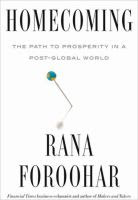
Homecoming by Rana Foroohar

 My previous book blog was depressing about the state of the future world.  Rana Foroohar is well aware of problems, but sees room for hope and strategies.  There is a lot of meat in "Homecoming."

The Covid pandemic revealed weaknesses  and is forcing some rethinking.  The supply chain turned out to expose the global vulnerability.  Capitalism is all about profit and how to increase it.  Rana points out that efficiency is valued and favors single source.  Very often the single source is cheap and far away.  

Rana suggests that America needs resiliency which can be supplied by local and multiple sources as well as innovations.  We have been forced to find new sources and new methods. 

A few complications are the threats of military intervention and the actual one in Ukraine.  Taiwan is an obvious target and is critical as it is the top global provider for essential computer chips and semiconductors.  Rana admires the system of governance adopted by Taiwan that allows its citizens to express their opinion on a wide range of issues.  The government is ready to respond to false information (steady stream from mainland China) within hours.  China was supposed to be freer as they became richer, but that has not happened.

 A big theme is that capitalism with its emphasis on a free market trends to efficiency at the expense of resiliency.  In the name of efficiency businesses gravitate to single sources to increase profits.  In a previous blog it was pointed out a number of innovations brought  dramatic reduction in costs of transportation and communication that opened up modern growth in global wealth.  Lots of scaling up for supplies that had become part of our standard of living.  Now society needs to boost our resiliency to survive..  Check:  http://www.therealjohndavidson.com/2023/02/slouching-towards-utopia.html     Much specialized equipment although designed in America is boosting manufacturing in other countries.

Climate change is the major global issue, but still the world seems content with changes that don't totally  deal with the issue.  The author draws attention to some of the key factors, overlooked.

Agriculture is the greatest threat and it tied into other complicating streams.  Single crops are normal, but harmful for biodiversity and in many cases add to supply chains.  Much of apparel comes from cotton which can be grown very cheaply far away and encourages fashion cycles going faster that in turn leads to much waste.  Many of us are aware of methane being a crucial factor in global warming, but getting food to our tables and seeds and fertilizers to the fields are major transportation inputs.  The author suggests that vertical farms can increase local control while increasing bio diversity and reducing transportation.

Housing is another major cause for climate change.  Building housing and maintaining  them against heat and cold needs to be done more efficiently.  3-D printing appears to offer cheaper costs, environmentally better and higher long term quality.  Personally I see a fundamental problem is human  desires.  Check http://www.therealjohndavidson.com/2021/10/dream-house.html    Much of the housing price increases can be attributed to (foreign) investors who buy houses for the expected price increases.

Jobs are a crucial concern.  Automation and Artificial Intelligence assure traditional jobs will disappear everywhere.  Immigration frightens many, especially from poorer parts of the world.  Inequality is increasing with the rich able to grab a bigger share of resources.   Mankind can have more meaningful lives with a change in attitudes and structure.

Gig workers (work with temporary contracts) are also vulnerable and deserve more protection.  Germany and others have found that working with unions is good for business, but there is a lot of resistance in United States. 

Large corporations concentrate power that by itself promote inequality, but more importantly tends to diminish innovation.  Rana suggests that co-operatives (like Ocean Spray) should be encouraged and anti trust laws should be enforced and expanded as small companies do more innovation.

Two big areas are healthcare and education.

Much of healthcare requires human contact and although long distance diagnosis is increasing it is not possible to ignore human contact.  We learned from the pandemic that health care workers are vital, but they feel under assault.  Prevention is much better than cures as many nations have found, but again there is resistance from Americans to medicare.  Americans are now experiencing a decline in longevity. 

Education is another field where progress can be made for both jobs and leisure enjoyment.  Much of the student debt crisis can be the result of poor direction.  Many prospects feel they have to go to university to get a degree in order to get a job, but the world doesn't need that many degrees.  What the world needs is more vocational training for the newer technical jobs.  The world does need critical thinkers and the world wants to enjoy life more.  Although there will be more online teaching smaller classes are also a boost to education. 

Democracy is assaulted by surveillance states and needs to reassert itself and offer a better life than too many are forced to.  Quadratic voting is a new concept brought forward by Glen Weyl.  It allows voters to have digital tokens that enable them to allocate their preferences among many issues that gives them power to express their priorities.  

Inequality seems to be growing.  The very wealthy have found their best allies are those like Donald Trump who can stir up voters against their own best interests.   The huge tax cuts have enabled many companies to buy back shares.

A quote from Adam Smith that warrants more attention:  "It was not by gold or silver, but by labor, that the wealth of the world was originally purchased."  It is the workers of the world the made everything else possible and they should not be ignored.  

This is a very complex book with lots of encouraging ideas.  Unfortunately the world is full of apathetic and greedy people who stand in the way of a more resilient world that we need to survive.  The ideas are being enacted by many people, but we still need more globally minded earth citizens.  Be one of them.

  Rana Foroohar is someone more people should pay attention to.  She appears in CNN from time to time and has written other books.  Check http://www.therealjohndavidson.com/2016/10/makers-and-takers.html

Thursday, March 9, 2023

The Next Civil War

A civil war is pretty serious business.  As Abraham Lincoln said, "A house divided cannot stand."Stephen Marcuse contends "The United States is near its end.  The question is how"?  His book explores the atmosphere and suggests a few scenarios that could burst out in a more active war

As I write this blog, a few months after the book was published there is news that quotes from an interview with Rupert Murdoch in which he admits that he believes there was no election fraud in 2020.  Furthermore we are hearing evidence that many of the Fox personalities off air also admitted there was no election fraud, but on air were promoting the big lie.  Apparently a good portion of Americans accept the lie and would vote for Trump all over again.

Do I think they are stupid?  Or are they too proud to admit they were wrong?  I believe the problem is they don't care--some are pleased Trump restricted immigration, or turned the tide against abortion, or pushed against blacks, gays and transgenders, or they dislike high taxes and onerous regulations.  That is a measure of a divided country.  The trends foreseen by Stephen Marche seem to be progressing.  A small part of his research is reflected in the following observations.

The level of violence, both rhetorically and physically has been increasing.  Groups are preparing for armed combat with training and weapons.  Domestic extremists killed 42 people in 2019.  Police brutality, one measure might be shootings, ranks much higher than other countries.

Disrespect for government authority.  Joseph Arpaio had been admonished for illegal immigrant raids, but continued until arrested and convicted, but pardoned by Trump.  Michael German, a former FBI undercover agent points out that white supremacy sympathies among police hurt domestic terrorism cases.  Killers like Dylan Roof and Kyle Rittenhouse are lauded as heroes.  Marche states "The greatest threat to the United States is not the hard right.  It is the general decline of legitimacy of the government that underlies the rise of the hard right."

Gun ownership is growing and already is well beyond any other nation.  That is through registered guns, but "ghost" guns (made from kits, 3-D printers) already account for 30% of seized guns.  Most owners claim bought for protection and for some that means from the government.

Alex Newhouse a researcher into extremist violence points out "...online radicalization starts with alienation... Social alienation comes with anger at their lot in life...the contrarian will often provide an explanation...for why they are feeling that way."  Population projections point that the United States will be a minority white nation by 2045.

The United States Constitution was a compromise.  The slave holding states were concerned the industrial north would outvote them on important issues.  Their white male propertied population was too small to compete with the north so they insisted upon counting their slaves as 3/5 of a person and combined with the electoral college it gave them parity with the north.  Those rules allowed Thomas Jefferson to defeat John Adams in the 1800 election.  The electoral college has given the south disproportionate power ever since with a notable exception during the Civil War.  After the Civil War, the south was able to institute Jim Crow which could only increase black resentments and southern resistance.  Five of the current Supreme Court justices were appointed by presidents who lost the popular vote.

A study in India focused on Hindu-Muslim conflicts.  "An increase in Muslim expenditures generates a large and significant future religious conflict.  An increase in Hindu expenditures has a negative or no effect.  The dominant culture, Hindu feels more impacted by a change in relative standing.  Whites in America also seem to feel most threatened by changes in the status quo. 

Inequality as it increases leads nations closer to war and revolution.  The Covid pandemic underlies the effects of inequality.  A comparison of nations with over 5 million population and an average of over $25,000 gross income reveals that the United States did the worst.  Not masking, not practicing social distancing and not vaccinating were political issues.  The world is inevitably going to provide other crises.  Inequality leads to a lack of co-operation needed to deal with global crises.

 Many politicians do not care about issues accept to use them for power.  Cater to and even inflame the mass prejudices.  Big money is needed to hide the desire for power.

Secession within a nation has been written into legislation for only two nations.  Canada recognizing Quebec represents a distinct ethnic population.  Also Britain recognizing a similar ethnic identity for Scotland.  Texas, essentially a one party state has generated a secession movement that prominent politicians cater to, but not quite endorse as they also have presidential ambitions.

The American people are capable of solving the big problems such as the electoral system, the legitimacy of their courts, police reform, even inequality and climate change.  The author contends "The United States, if it is to survive, requires a Constitutional Convention.  The loathing overtaking the country makes that possibility more remote every day."

The author and I are both Canadians, in other words, outsiders.  But like the whole world we will be affected how the American dilemma plays out.  Without America the world will not solve many crises such as climate change, pandemics, inequality, justice, etc.

Read the book for more scary details and citations.

Sunday, October 30, 2022

Inflation is a concern

Yes, inflation is a concern and should be.  But the focus needs to be much deeper.  First it is a global problem.  Blaming Joe Biden for the global inflation is extremely short sighted and virtually pointless.  His opponents are very vocal criticizing, but very short on realistic solutions.  We need to take a closer look.

We are not yet out of the Covid pandemic.  A lot of fear and resentment has been generated.  Some politicians tried to ignore it and one mocked honest efforts to control it.  That one person was Donald Trump.  There was already in motion other results from the pandemic that could only be mitigated.  Many people died and others were fearful and governments around the world took steps before we understood many details.  Social distancing had proven to be effective which meant controlling both crowd situation, consumer and retailer contacts and even walking down the street.  Masking was mandated to minimize risks.  These steps were resented and resisted by many people, especially those following the lead of Donald Trump.

There was a race to develop a vaccine and that already had resistance with those who felt vaccines were unsafe and many who just plain feared them.  Donald Trump apparently did get vaccinated, but it was relatively quiet and not supported by many of his followers.

Supply chains were disrupted, partially due to consumers cutting their spending.  Another problem was workers who either couldn't get to work or were too fearful.  Restrictions and practicalities on international trade caused further supply chain tightening.  Many companies, mostly relatively small went out of business.  Even some crops were not picked.

Many governments around the world felt they had to protect both consumers and retailers and gave out money which had to be borrowed.  The large companies that survived found they could increase their prices disproportionately and the government would be blamed.  Reports coming from companies on stock exchanges are of increased profits.  What most of them are doing with this extra money is stock buybacks and increased dividends.  CEOs on many companies have been able to increase their share of the profits at the expense of their lesser employees.  Again another factor increasing inequality.  Their reduced taxes increased their leverage.

It turns out inflation is a mechanism for increasing inequality.  Those in the bottom 90% find themselves with squeezed budgets forcing difficult decisions.  Those at the top are well insulated from such stresses.  There are no pain free solutions.  One strategy is to curb consumer spending which means higher interest rates as one tool.  It is very easy to criticize governments, but very short sighted.  The wealthier families did better with education than their poorer counterparts which has long term consequences for everyone.

Politicians  in opposition parties are very willing to criticize.  One of their solutions is to stop spending.  It is true that is important, but who is going to decide where the cuts should come from.  Many Republicans for example feel free to suggest social programs that benefit the masses, climate change efforts, inspectors, etc.  They are always pushing tax cuts and deregulation pointing out that the wealthy are the job creators.  Actually job creators are consumers.

Compounding the situation has been the unprovoked invasion of Ukraine.  It will push energy prices everywhere.  It also will have a direct impact on wheat and sunflower oil, but that will most hurt poor countries. 

There are no easy answers, but listening to the critics is counter productive.  Some of them should look in their mirror.  Higher tax rates on the wealthy have had a positive influence on inflation.  With extreme high tax rates for the very wealthy it makes more sense to keep employees happy. 

In the meantime the pandemic has not disappeared.  The virus has mutated with new variants.  We need long term solutions, not the short term  that too many resist.  Respect for scientific experts needs to be enhanced.    

Friday, April 8, 2022

Move

"Move" is about human geography, that is, about where humans live and the author contends that humans have always been on the move.  In the beginning we were nomadic, seeking where food was readily available. Later we moved to where the jobs were.  Now more people are seeking freedom, security and sustainability.

Parag constructs a formula depicting a trend:  demographic imbalances+ political upheaval+ economic dislocation+ technological disruption+ climate change X connectivity= accelerated mobility.  Many details factor in.  One irony is that "advanced" nations are having a declining birth rate (i.e. they are aging) while less developed nations have higher birth rates that trap many in poverty.  While we are aging we will need younger people to take care of our elderly and replace job vacancies. Some powerful voting blocks are resistant to newcomers especially those who are not white or have strange customs.

Donald Trump used anti-immigration policies to get elected.  To limit the number of Indians migrating they imposed restrictions on H1-B visas.  This encouraged Silicon Valley to outsource work to Asia and develop digital mobility.  Many skilled Asians chose other countries to migrate to.  Violence, poor health care and inequality have forced different choices for many prospective immigrants.

The job market will be drastically changing.  Automation bolstered by computer power will lead to further traditional labor reductions.  This will lead to new jobs, but requiring new skills.  Another area of opportunities is agriculture to feed our increasing populations.  Some lands will be opened up in northern countries and many cities will adopt massive hydroponics. As jobs relocate people have to be able to move to where opportunities are open, but workers will have to keep their skills up to date..

Climate change will increasingly be a reason to seek a more livable location.   Two directions are basic:  inland and north.  Some major areas that will be suitable are Canada and Russia with increased fertile land.  Surprised to learn that he thought the Great Lakes Region of North America is relatively safe.  The Arctic with some adjustments will be more livable.  The author thinks the adaptions will involve new cities (or olds ones changed) with environmentally friendly enhancements.  He mentions that air conditioning will be necessary to live in major parts of the world, but can be made climate friendly and of course plants should be more than decorations. Desalination will need to provide drinkable water.

The Covid 19 pandemic has encouraged a new dynamic.  Many are seeking where science is not trumped by politics and where technology is tied to public health.  The pandemic, following the 2008 financial collapse has disrupted retirement plans and many are looking for a lower cost of living with such countries as Mexico and Costa Rica.

In our past home ownership has been a motivating dream for most of us.  The author suggests our dream house should be replaced by a dream of mobility.  Renting will be part of increasing mobility.  To survive one needs to go where the jobs are and develop the skills that society wants.  Portable homes are already becoming more common.  Climate change will make some places unsafe to be.  A few thoughts on what pursuit of the dream:  http://www.therealjohndavidson.com/2021/10/dream-house.html

There is much resistance to immigrants even though they are necessary for our survival.  Assimilation needs to be emphasized to avoid segregation.  Germany is one that has made an effort.  Language courses and job training are two programs.  Education should increase our awareness about human similarities as well as differences. Parag feels the world needs a global immigration policy.  Forces of nature and man made problems will assure that mobility is essential.   We each will have our own traditions, many of which we will be able to pass on.

The more we open up the better.  Citizenship passports for those with money or skills.  migrant rights resisted by many countries (and citizens)  New Zealand allows all permanent residents (i.e. stakeholders) to vote.  My son, Michael when he was unable to get a job in Canada matching his skills he decided to take a chance in New Zealand where he knew no one, with only a friend of a friend to guide him.  Since then he has enhanced his skills and has achieved a satisfying position

Politically we live in a divided world, but in reality we live on one planet.  Borders make it difficult to co-ordinate jurisdiction over lands that transcend man made lines.  A few countries have managed it such as Botswana with Zambia and Mozambique and South Africa.  International agencies have managed to have 15% of the earth's land surface set aside as protected eco zones.  E.O. Wilson has advocated for 50% to be set aside.  For some enlightened views of our past and future check:  http://www.therealjohndavidson.com/2016/11/edward-o-wilson-tackles-meaning-of.html

 There is much useful discussion in this book.  The future has many challenges that are only being partially addressed.

An earlier book by Parag Khanna that helped me change my pension investments.  http://www.therealjohndavidson.com/2019/07/the-future-is-asia.html

Friday, October 29, 2021

Can Mankind change in time?

 Most people would agree we live in a crazy world.  Many are worried that we are going in the wrong direction.  We haven't really handled the pandemic while climate change is accelerating.  A possible nuclear war has not been eliminated.  We are squabbling over all these issues.

Carl Sagan, searching for an extra terrestrial civilization with no result.  Many would think that meant we are the only ones in the universe, but another interpretation is that civilizations self destruct before they are able to communicate across the universe.  Carl was egotistical, but humbled.  http://www.therealjohndavidson.com/2012/10/carl-sagan-and-our-future.html

What is intelligence?  If a being can differentiate between darkness and light or if a being can seek nutrition, is that the base for intelligence?  We know evolution moves with mutations that gradually take over from previous life forms.  Life started in its simplist form, but somehow over a long period of time elevated to Isaac Newton and Albert Einstein.  Recorded history is only a slice of earth history and infinitesimal against solar history.  Eternity is incomprehensible to humans

Individualism is growing and most of us prize the freedom that allowed it.  A good example might be with homosexuals.  Only a few decades ago in western countries it was a life and death matter.  It is still a life and death matter in much of the world, but homosexuals have emerged perhaps first in the arts, but also in politics and really in all fields of life.  We have always admired those individuals who successfully bucked the establishment.  There are many more voices that we need to pay attention to.  There is resistance to authoritarianism while elites have found ways to mobilize large crowds.  Other small groups see the dangers outlined below and although their voices are being heard they are not yet being heeded enough.

Evolution has been depicted as survival of the fittest and we have taken that to mean the strongest and the fastest.  More recently we have come to realize that group dynamics played a role.  Many hunts depended on a group.  Wars for that matter depended upon co-operation and trust among allies.  Finding better ways to survive requires the effort of many.  Consider:  http://www.therealjohndavidson.com/2014/07/selected.html

There has been such a thing as tyranny of the majority that held back progress and human rights.  Another reality is that small wealthy elites have been able to manipulate the rest of us for their increasing greed.

The Covid 19 pandemic is really a health crisis.  While we have been complaining about the high cost of drugs and medical services, the pandemic is recognized as truly universal and there is no cost for vaccinations.  Some might argue that the drug companies are benefiting from the panic and are probably helping to fan it.  At the same time the rest of us are at the mercy of those who are resisting.  The resisters are often just afraid or lazy, but for others it is a political decision.

Climate change is no longer a theory, but is hurting millions around the globe.  Climate refugees are mingling with genuine political refugees.  What some might consider economic migrants are at least partially motivated by loss of opportunities due to climate change.  Economically, storms, floods and droughts have resulted in a loss of productivity.  Some very wealthy people are still trying squeeze as much profits as possible.  Other people fear for their jobs and economic security.

What has stopped nuclear war has been fear of MAD i.e. mutual assured destruction.  But many nations have the bombs and others are seeking them.  There are some who believe they can survive a nuclear war, others who believe if they bomb first they will win and there are others who don't care.  Should a mad man get control we are all in danger.  One must recall that Donald Trump had access to the bomb. 

Underlying all these crises is inequality.  It is possible inequality will be exacerbated, but it is also possible there will be a resetting of the status quo.  Check how inequality has been leveled in the past:  http://www.therealjohndavidson.com/2020/01/the-great-leveler-violence-and.html

The crisis is human made including Climate, pollution, drugs, wars and pandemics.  The problems cannot be solved by any individual, but by a collective understanding and action.

Solutions??  

We are dealing with human nature which is ego centric.  We have separated ourselves through languages, racism, sexism, homophobia and countless other criteria.  Despite those limitations mankind could only have survived to this point as there was a part of everyone that cares for others. and we learned co-operation is necessary.

To me the greatest need is for education with some attention to critical thinking.  An earlier blog still explains the scope:  http://www.therealjohndavidson.com/2011/11/education-and-our-future.html Education has been politicized and a budget bargaining item.  There are so many perspectives on it, but my hope is that more people will realize its critical importance for our group survival that barriers will fall and purse strings will loosen.  The more "rational" education the better we will all be.   http://www.therealjohndavidson.com/2012/11/what-teachers-make-by-taylor-mali.html

I have only a crude understanding of Game Theory, but believe there may be some lessons to be learned.  The best results are when an individual chooses what is best for themselves and the group.  It depends on rationality.  Making the first move encourages others to take a risk.

Rationality boils down to enlightened self interest.  We can pull ourselves over top of others, but the best long term benefits come when everyone benefits.  As a salesman one mantra was the "win-win" solution.

Trust is sadly lacking in the world mainly because some people have put their interests above that of others.  However it is vital, so that without it we will let suspicions lead to fear which cuts off rational discussion.  Earlier blogs have tackled this issue.  One with lots of useful links is:  http://www.therealjohndavidson.com/2020/05/trust-crucial-foundation-for-democrarcy.html

If no one makes the first move, nothing will get done.  Fortunately a few have made that first move.  Now it is your turn.

Wednesday, August 25, 2021

THE NON VACCINATED ARE IMPOSING ON MY FREEDOM

Those of us who have taken the trouble to be vaccinated and have and still wear masks when appropriate are starting to get a little perturbed by those who dismiss our concerns.  One of their arguments is that the rest of us do not have the right to infringe their "freedom."  BULLSHIT!

Freedom is an abstract concept that we all like to talk about and to be honest are always trying to increase by getting more money, getting more fit and by being smarter.  That should tell you that you don't already have unlimited freedom.  There are the physical limitations of your body (strength, gender, health, etc) and of your circumstances (housing, air, transportation networks, access to electricity, wealth, and yes, education).  On top of that society (that we have a small say in) has imposed lots of restrictions supposedly for our own protection.  When someone has been injured, say by a drunk driver, society sets up laws that limit your alcohol intake to a percentage before you start driving and we have programs to test this as we aren't at all convinced every driver would avoid going over their alcohol limit.  There are literally millions of legal restrictions on what we are allowed to do.   Some earlier thoughts on regulations:  http://www.therealjohndavidson.com/2015/10/regulation-how-we-protect-ourselves.html

There is a another restriction we place on ourselves.  We are intimidated by society.  The sight of a gun makes one aware not to offend.  The law threatens with fines, public notice of our crimes and ultimately jail.  Beyond this most of us (including you) dislike ridicule which can range from a disapproving society to a family member.  Some of us have worked ourselves into a corner where we need to prove how tough we are or loyal to someone.  There is suspicion that many of those refusing to comply with Covid-19 protocols are too proud to admit they are wrong.

I am doubly vaccinated, wear a mask when appropriate, try to keep my 2 meter distance and even wash my hands more often.  I am not so worried that I might suffer the Covid 19 disease, but realistically I have two sets of concerns.  First, we were told that not 100% of those vaccinated are actually immune and we are hearing about some vaccinated individuals who have tested positive, but with very few of them actually dying.  We are also are wondering about why we might need a booster--is it because the first two doses might not last more than a few months?

Second it appears some of the vaccinated might pass on the disease, especially to the more vulnerable such as children under 12 or those with compromising conditions.  That bothers me and should bother you.  Aside from those close to us, what kind of society would we be left with as all sorts of people die or suffer serious consequences?

Complicating the matter the Covid-19 has developed new variants such as Delta that is not particularly threatening, except it is more contagious.   There are other variations and the longer the pandemic lasts there are certain to be other variants that require a different set of protocols with greater restrictions on our behaviour that will surely impinge on our freedom.

In the meantime the situation has become so bad that medical resources are reaching and in some areas passed their limits.   If you have a heart attack or stroke or an accident you may have to wait in line, a line that creeps along as someone dies.

You can be part of the solution to this nightmare one way or another.  One way you can edge us closer to herd immunity by adhering to the established protocols including vaccinations.  Or you can edge us towards herd immunity by dying.  If enough people die the rest of us will be safe from this particular calamity.  

We in Canada have an election coming up.  I will not be voting for anyone who advocates banning mask mandates or is against vaccination passports.  I will not support businesses that do not take Covid-19 seriously.  It used to be said that your freedom ends at my nose, but today it should be recognized that if an un-vaccinated person not wearing a mask wants to intrude within two meters of my nose that freedom needs to be restricted at least as much as a person drinking over the limit.

Some of you may not have much of a choice.  Masks may be medically inadvisable and vaccination might be unsafe.  There are few alternatives--shields are said to be effective and two meter rule seems to be working.

Tuesday, August 10, 2021

2020 Olympics: The setup and frame

This is not a detailed professional analysis of a massive sports festival but more an obsessed fan's observations that revolve around the festival that occurs every (mostly) two years. This has been difficult time for me to get anything done.  Of course being retired means there are many options and few deadlines, but the Three Ring Circus is very distracting.  To be honest like many people I would ordinarily not go out of my way for 90% of what I do feel compelled to watch during the Olympics.  In some cases there is a novelty, in other cases there is something significant.  Other times it is a time filler, but the whole is  more important than the pieces.

My obsession began in 1960 at age 12 for the Rome Olympics.  I was a news carrier and would take a look at the paper before actually starting delivery.  I ended up cutting out the stories and results.  There wasn't much television coverage and certainly none live.  The 2020 Olympics was very unique.  For starters it didn't happen in 2020.  Despite the delay the pandemic was still a major concern.  While that was very obvious, only slightly less obvious was that climate change can no longer be ignored.

The pandemic caused a lot of adjustments.  Almost all athletes had their training  disrupted--a few got Covid 19 and recovered to participate, but others didn't recover good enough.  Some decided it was too risky and participating would send the wrong message.  In a sense everyone has been affected.  In some team sports they allowed rosters to increase from 18 to 22.  Also reduced the amount of social interaction between athletes and support staff.  The stands were to be empty with no paying customers.  The other athletes and staff coming to cheer on their team mates were forbidden to sing or cheer and of course were expected to wear a mask.  Although protocols seemed to have been adhered to, the Olympics cannot avoid being a spreader event.  In fact Japan was in the midst of another pandemic wave.

When showing the Canadian winners of women's synchronized diving because the presenter is not permitted to place the medals around the neck of the winners, the two women in turn put them over each other with this procedure becoming normal wherever possible.  

The heat often reached 30 degrees Centigrade.  Heat management is a key to improving one's performance when it most counts--in the final.  Most noticeable in track especially in the longer distances.  It is always position that qualifies for the next step, but time also may qualify.  The wisest movement is not extend yourself more than necessary, but is subject to risk that someone else will extend themselves enough to qualify at your expense.  This strategy probably effected the final outcomes more than usual.

Confused about Sapporo being the site for the marathon and long distance walking events as it is well north of Tokyo on another island.  It was a complicated issue at first seemingly dictated by health concerns for athletes.  Television was a major factor as organizers realized previous long distance running and walking events in 30 + degree weather resulted in massive withdrawals during the event and great suffering of those who survived.  Late July and early August are normally the hottest time of the year, but avoided overlapping with major sporting events in Europe and America.  Again television dictates important details.

Because of the heat many outdoor events had to be rescheduled.  At one point there was talk of changing sailing events because of a possible cyclone which hit China.

For most of us the only access was through television.  Canadians are fortunate in that the CBC traditionally goes all out.  NBC was a lot more restrained in hours, but most Canadians had access to whatever might be of interest there.   NBC was more worried about upsetting their regular advertisers. This year CBC really expanded, using other networks like TSN to co-ordinate coverage plus offering free streaming services for many events.  Not quite 24 hours, but sort of.  As Tokyo is 13 hours ahead the Eastern Time Zone found 10 am to about 7 am. with no live events, but plenty of tapes, interviews, analysis. The challenge of coverage and accessibility was more difficult because of more events.

Actually staying at home with television has advantages over actually attending.  We can flip from event to event almost as our fancy dictates.  The camera has become more innovative than ever with more tantalizing views than ever with lots of replays.   

I was struck by underwater and slow motion views that apparently are denied to diving judges.  Water polo sometimes included underwater shots of what goes on which often is more violent that what we see on the surface.  Check out  http://www.therealjohndavidson.com/2016/04/in-praise-of-water-polo.html  Perhaps I am just jealous, but at home you can appreciate the athleticism and artistry better, but of course the emotions of the crowd are irreplaceable.

This is the most gender equality Olympics yet  There were mixed gender events with a track relay, and with shooting and tennis among others.  Male and female flag bearers for most nations.  Altogether 49% of the athletes were women.  Equestrian is the only event where the sexes compete as equals with women often winning as it takes  more than brute strength to control a horse that might weigh half a ton.

For the first time openly transgender women were included, but it's complicated.  Some of the inclusions were a New Zealand weightlifter, a Brazilian volleyball player, a  member of Canadian gold medal soccer team.  In these cases consideration is given to hormone treatment focusing on testosterone levels allowing that some is natural in women.  Another factor is time from transition as in many cases there is a temporary muscle retention.  There is also a concern over cis females (those normally considered female) with their testosterone levels.  Two teenagers from Namibia had such high testosterone levels they were not allowed to run the 400 her best event, but one of them did win silver in 200 meters.  The International Olympic Committee  is attempting to balance inclusiveness and fairness.  It seems likely there will be further classifications in the future.

Sexism is prominent.  Women's Beach Volleyball requires skimpy bikini like outfits.  Prior to the Olympics the Norwegian handball team was fined for rejecting the skimpy outfits that had been standard.  An American celebrity offered to pay the fine, but fortunately the handball association retracted the fine.   The German gymnastics team protested with full length leotards.  Ironically other women, especially in the past had been required to cover more of their bodies.  I assume that skimpy outfits used in other women's sports are for their comfort.  Although men will always enjoy bare skin and form fitting outfits we are starting to better appreciate the skills and efforts required.

Back in 2011 the World Anti-Doping Agency banned Russia from international sporting activities including the Olympics.   As a compromise the IOC allowed Russian athletes to participate as the Russian Olympic Committee with a few restrictions.  They cannot use the Russia name, or use their flag or have their national anthem played.  It was suggested that should one of them win a gold medal  they could play the Tchaikowski Piano Concerto Number One (which is much more impressive).  The Russians missed a few athletes, but maintained some of their national prestige with a respectable haul of medals.

Surprised to learn that Hong Kong participates (since 1952) including 2021.  Puerto Rico has long had its own team.   Refugee Olympic team was first allowed in 2016 and has continued with limited success in medal events, but are making a statement.  

Taiwan presents a special problem for the IOC because China objects strongly to any implication that Taiwan is an independent country.  They were banned for several years, but in 1981 agreed to a compromise that required them to use the name Chinese Taipei and forgo use of the national anthem and flag for medal presentations.  A few foreign media have decided to use "Taiwan" in their coverage of the games, but this rouses stern rebukes from Beijing authorities.

Tokyo not only wanted to represent Japanese culture, but wanted to incorporate more environmentally friendly elements.  The torch lit in Greece was designed with a cherry blossom motif and made partly from recycled aluminum.  The cauldron that houses the Olympic flame was designed by Canadian architect, Oki Sato.  It was made to represent five separate flames coming from a flower.  For the first time it was fueled by hydrogen which does not emit carbon dioxide.

For the medals, electronic devices such as mobile phones were collected from Japanese citizens and metals drawn from there including gold, silver and red brass (95% copper and 5% zinc).  Junichi Kawanishi designed the medals.  Each of the medal winners was also given a small bouquet made from flowers that had been grown in the areas affected by the tsunami and nuclear disaster symbolizing Japan rising again.

Perhaps music has been considered masculine for too long, but it adds enjoyment to some of the women's events such as gymnastics and synchronized swimming. 

The Olympics has inspired a lot of memorable music.  I remember the Celine Dion choice for the Atlanta Games in 1996 was criticized, but the organizers defended saying they wanted the best.  I think the best and the most appropriate was Whitney Houston singing "One Moment in Time."  Unless I missed it on a bathroom break there were no catchy original songs.  I had read that the composer had been charged with a sexual crime and his music taken out of the program.  

Personally I decided to do musical posts on Facebook to commemorate gold medal winners from countries that don't always get a lot of attention.  Ones I found time and space for were the Netherlands, Philippines, Jamaica, Morocco, Ethiopia, Latvia, Italy, Puerto Rico and Fiji.

The opening ceremony was more subdued than in the past.  The athletes paraded in and speeches were made.  Naomi Osaka lit the flame.  A moment of silence was observed for the first time during the Opening Ceremonies for the murder of 11 Israeli team members (plus one German police officer) during the 1972 Munich Olympics.  At the time this caused the first disruption of 34 hours, overcoming some opposition to continuing.  Palestinians used the Olympic platform to make a violent political statement that backfired on them.  But it made security a much higher priority for future Olympics.

The marathon did attract a lot of spectators behind guard rails, but they all have masks on.  With the walking events it provided opportunities for local and visitors to watch something without buying tickets.  The Japanese were encouraged to watch on television.

For the closing athletes paraded in and speeches were made with the Olympic flag being handed over by the female Tokyo mayor to the female Paris mayor.  There was some entertainment by dancers and singers (I think lip synched).  The French part of the closing was very impressive, a big part of it staged in Paris, itself with jets leaving colored streams for their flag around the Eiffel Tower.  Skateboarding around the skyline and with break dancing (to be added 2024).  To me the ceremony seemed more subdued from the point of view of athlete's participation which has traditionally been rollicking.

Tokyo will be paying off the debt for decades.  They had hoped to present themselves as a modern city with many attractions for visitors.   One aspect that is unique is that the Japanese have a fondness for forest or tree bathing and have integrated elements into Tokyo itself.

Fareed Zakaria commented on the logistical masterpiece of organizing.  Many athletes and officials had no direct flights, supplies from different parts of the world (eg. sand from Vietnam), horses.  It demonstrates that international co-operation can be impressive.  Fareed wishes that dealing with the Covid-19 pandemic was as good.

For my post on Brazilian Olympics/Paralympics  http://www.therealjohndavidson.com/2016/09/olympic-impressions-for-2016.html

There is too much for one post so if you are interested in my humble opinions there will be a second post. within a day or so.  Followup here:  http://www.therealjohndavidson.com/2021/08/2021-olympics-part-two-people-who-made.html

Saturday, May 8, 2021

LANGUISHING: A NEW WORD AND A NEW REALITY

Actually, "languishing" is not a new word, it has been kicking around for a long time and has recently gained some momentum.  But it does have a new and personal meaning for all of us.  Most of us are not actually depressed (although more of us probably are), but we feel helpless and unfocused.  We have been teased with restrictions being lifted and then brought back.  The weather has been easing, but inconsistent.  For me a Steve Paikin episode gave the notion of how one feels, some articulation.

Update:  Languishing is when a person loses hope and loses much of their motivation.

Time management has been altered for everyone.  I had once preached that you can not fully enjoy two activities at the same time, but these days multi-tasking is the normal, but truly no task is quite as satisfying as we hoped.  Blogging is one coping mechanism for me, but will confess there are many posts in draft and I dilly dally between them without the focus that could make any of them more satisfying.  An earlier blog when I was focused on selling, but everyday living as well:  http://www.therealjohndavidson.com/2011/05/time-management-for-sales-other-people.html

Personally (and for some this is even more excruciating) two funerals have affected me.  A close friend of the family, Helen Rigby died from cancer during one of the semi lockdowns.  A memorial service was held, semi outdoors, masks, temperatures checked, some social distancing.  Under normal circumstances a lot more people would have showed to pay their respects and remember the good times with her.  Through the newspaper obituary we learned of the death of an uncle, Raymond Oleskiw who once had a significant role in the family.  Although he was elderly and had other health issues, the Covid 19 pandemic was the deciding factor.  No mention of a funeral and apparently the opportunity to renew family ties has been missed.

Resentment which we all seem powerless to really express is now part of our psyches.  Guessing most of my readers resent those "idiots" who are not strictly abiding by restrictions and holding the rest of us hostage.  On the other hand they resent us because we are putting a damper on their enjoyment of life.  Amongst my crowd there is resentment between those who had early access to vaccinations and those who didn't, many of whom were exposed to greater risk.

Donald Trump and his supporters are especially resented.  We can see his selfish decision to sideline an intelligent response to the pandemic.  Too many blindly follow his words and example, not realizing he has already screwed them and is now compounding the problem.  Somewhere in the future there may be a reaction against science deniers that are really protecting their greedy interests.  Climate change, gun control, mental health, inequality, etc.may eventually be viewed more reasonably and dealt with more effectively.

Another resentment is that the rich are doing better than ever.  More of us are forced to buy online as we are unable to get what we need (and want) through our regular suppliers.  The big grocery stores are able to adjust, while too many of their smaller competitors are either closed or severely restricted.  This trend will likely carry on and we will all have a different purchasing life.

To my way of thinking there have been events that changed society profoundly, but few as severely as the current pandemic.  My parents were brought up during the Great Depression and went through some deprivations and a great release to help start the baby boom.  Their parents (my grandparents) were the ones who felt the shock of a standard of living being suddenly lowered.  World Wars created for many a different adjustment, due to fear.  Young people, especially those active or close to active fighting, felt life and plans could be ended abruptly so you might as well enjoy life to the fullest for the moment.

Other blogs that made me think of our precarious existence: 

When the Covid 19 shutdowns I started exploring my city within walking distance seemed like a good idea.  This link has several other links for these walks which resulted in lots of photos that you might find interesting and a few observations:  http://www.therealjohndavidson.com/2020/04/the-shutdown-continues.html

A CBC radio clip got my attention about luck.  A book written by Jeffrey S. Rosenthal, a statistician followed.  He was debunking a lot of luck notions while at the same time urging us to pay more attention to statistical odds.  More recently there has been a fuss about blood clots caused by some vaccines that has caused some policy changes and more critically public fear.  Looking at the odds there is more danger of getting Covid 19.  It is worth some consideration:   http://www.therealjohndavidson.com/2021/03/knock-on-wood.html

 Watching Michelle Gelfand, a guest on Fareed Zakaria the discussion started on loose and tight societies and how they affected coping with the Covid 19 pandemic.  There has been a definite link and the same mechanism affects much more:  http://www.therealjohndavidson.com/2021/04/rule-makers-rule-breakers.html

What will we bequeath to those that follow?  Life is not certain and thus we might appreciate it more.  People can be very greedy and thoughtless.  Other people can be very caring.  The rich can survive better than the rest of us, but even they can be hurt.  Above all I hope future generations will realize that we are all CONNECTED.

 If you found this blog more disjointed than usual, you could be right.  Blogging still is something I enjoy and has become part of my coping strategy.  An explanation of my joy:  http://www.therealjohndavidson.com/2020/09/what-keeps-me-blogging-and-what-i-have.html

An explanation of how I chose my title:  http://www.therealjohndavidson.com/2013/07/the-real-john-davidson.html


Wednesday, April 28, 2021

Rule Makers, Rule Breakers

Social norms are so normal we don't notice them very often.  But they control us, or at least influence us or some might say they are there to be challenged or ignored.  Social scientists are dissecting the world and it seems continually identifying new ways to divide us into useful bits that others can use to better understand (and manipulate) our behavior.  Michelle Gelfand has identified a continuum that is both a result and cause of many other factors namely, looseness and tightness and has a few ideas how to balance them.  She also includes that social norms are what binds groups together.

When the author talks of tightness she is referring to social norms that are restrictive, regimented and conformative.  When she refers to looseness it is the disregard for strict rules and more relaxed.  The tightness-looseness scale is a continuum with the extremes at either ends and what passes for normal in between.  

Surveyed 33 countries to determine how they fit on a continuum between tightness and looseness.  The tightest nations include Pakistan, Singapore, Norway, India and Malaysia.  At the other end the loosest nations include Ukraine, Israel, New Zealand, Brazil, Netherlands and the United States.  Corporations and individuals have many variables.

Why are some nations tighter than others?  Generally an outside threat unites the population and they accept restrictions for the common good.  Outside threats include invaders, drought, turbulent weather, pandemics, scarcities, etc.  Orderliness is highly valued.  With the lessening of outside threats people have less need for order and restrictions.  The author relates her scale to companies and individuals allowing that each group has variations.  As individuals we are tight about different things, but most of us feel a need for looseness with other activities.

The benefits of tightness are a regimented power to get something done.  The benefit of looseness is innovation (I would add more fun, at least in the short view).  The truth is taken to an extreme either factor can hurt society extremely.  Finding the balance, as the author puts it, the Goldilocks principle is an ongoing battle.  You might remember Goldilocks found one porridge bowl too hot, another too cold and another just right. 

She points out that early American settlers from Scotland and Ireland were very concerned about honor, but generous until they felt insulted.  That attitude helped set the tone for United States and also Canada.  Diversity opened up looseness, until some felt conflict.  Gelfand suggests there might be some genetic flows as people tend to associate (and mate) with similar people.

An experiment highlighted in this book that demonstrated that people tended to conform to the majority, reminded me of an embarrassment that haunts me.  At university I majored in sociology and we were encouraged to do experiments to understand better.   Simply a vertical line was shown on the left side and the participant was to determine which of three lines matched it.  Simple enough, except that all but one of the participants had been instructed to give false declarations to see if the test subject would bend to the majority judgment.  In many cases they did.  My group decided to see if women were more compliant then men which in general they were (this was before 1970).  Why I feel guilty is that I recruited the sister of a good friend.  She was intelligent and well educated, but had been raised in a Central American culture that was even more male dominated than our own.  She caved almost right away despite the others being blatantly wrong.  She was a decent person who was willing to do me a favor and I am sure she felt humiliated.

Quote from the author "From the time we wake up to the moment we go to bed, we experience the ebb and flow of tight and loose mind-sets... Each of us has a default setting."  Another quote, this time from Dov Frohman of Intel Israel, "If you aren't aware that the people in the organization disagree with you, then you are in trouble."  Dissent indicates a looseness that can benefit the corporation.

The tightness-looseness continuum relates closely to other traits in what she labels a curvilinear relationship such as diversity, mental health, happiness, even life expectancy.  As we are all tied to global concerns it will be necessary for loose and tight societies to co-operate.  The author offers examples of how this has worked and might work in the future.

The book was published in 2018, but I learned of it through a recent television interview between Fareed Zakaria and Michelle Gelfand that focused on how different cultures were reacting to the Covid 19 pandemic.  Tight cultures established control much quicker, but were not as able to adapt to changing variants while the loose cultures were more adaptive.  It was concluded that a mixture would be better.

From the Acknowledgements we learn a conversation with her father helped expand her interests.  Studied to be a doctor, but became interested in cultural matters.  Has pulled together a variety of academic disciplines.  In the end she marvels that with her husband and two daughters she personally has achieved the Goldilocks Principle.

Friday, January 1, 2021

2020 A year in remembrance

Not what one expected at the begininng of the year, but life has always been full of surprises.  Retirement gives one lots of time to reflect.  I can acknowledge that I have lived over half my life and of course want to enjoy what is left as best I can.  Part of that is looking back and remember the good times and learn from the not so good.

Unfortunately some will not share the future with us, but our memories of them are important as they were a part of our lives.  For me it is important to remember those who had a positive impact on my life.  Recounted in chronological order.

Hank Bulir is someone I knew as his wife and mine were very close friends.  His wedding to Debbie Linke was outdoors at scenic Webster's Falls.  Looking back we visited each other fairly often,   I remember some anniversaries, New Years Eve and visits for no particular reason. But Hank became ill and the visits became rarer, although we frequently saw Debbie.  I remember Hank as always in a pleasant mood and a good host who liked to cook.  He raised three good boys (now men) Matthew, Andrew and David.


For several months I acted as a sort of chauffeur for a special lady, Audrey Erica King who died in January.  In short conversations I learned a lot about her and her family.  Her middle name came from the family doctor, Eric who delivered her at birth.  She had been born in Sheffield, England, but moved to Canada when her husband had a job opportunity.  She enjoyed identifying unusual license plate numbers and got me doing it.  I also got to meet her sister Ann who flew over from Sheffield, England and found we shared a lot of tv favorites, in fact steering me to one of my all time favorites.  I knew one son and his daughter who were both very nice and obviously been brought up that way.


A long ago neighbor, George Harrison died in July.  He and his wife Shirley lived on the opposite corner to our house.  He had a quiet sense of humor; one of my favorite of his sayings was "When I get up the morning one of my first things is to look at my garden."  He is not actually talking about his own garden, but my wife's across from his bedroom window.  George and Shirley had two dogs and Sharon liked to give them biscuits and loved their reaction--George had to point out that he thought the biscuits were the big attraction.  George had lost a lung and had bought a snowblower to take care of the snow for his corner lot and when he moved he gave it to me as he didn't think he would need it.  Eventually I ended up giving it to another neighbor who had storage and had helped shovel snow for neighbors.


Add caption
Helen Rigby had been a neighbor to my wife, Sharon when she was growing up and while my mother in law and Helen became close friends.  Many years ago Helen left for England, but there remained close  ties with visits on both sides of the Atlantic involving my wife.  When her partner died Helen moved back to Burlington, but also spent much of her time visiting her daughter Janet in Tampa, Florida sometimes accompanied by Sharon.  I remember Helen and my sister Rebecca had a friendly rivalry over making banana bread (I was one of the winners).  Helen was quite the knitter and at least twice gave us knitted goods to give out in Cuba and another time donated knitted goods for a class my son was teaching in New Zealand.  All that was normal as she donated to many charities.  Favorite photos of our two youngsters were taken in Helen's sweaters.  Into her 80's enjoyed long walks from Burlington to Hamilton.  She also golfed, swam with the dolphins and para sailed.

Another death impacted me even though I never me her.  Ruth Bader Ginsberg was a person easy to admire.  I had watched two different films on her and was anxious about her health.

A Christmas gift from Heather.  In the Dead of Winter at Merit Brewery was an event with good food, beverage and conversation.   Fortunately for us it is within walking distance.


A little quieter (?) birthday for Florence for number 91.  Three great grandchildren join in the fun.


The Covid-19 pandemic was a life changer.  Sharon was in Florida when it became a serious concern and cut her trip short and then went into a 14 day self imposed isolation.  Stores and restaurants closed.  We will never go back to what is remembered as "normal" and it could be worse, but it could also be better.

On Earth Day I went on one of my walks dropping by Peter Ormond who likes to do something special on what he thinks of as eARTh Day.    Read more with more photos:  http://www.therealjohndavidson.com/2020/04/earth-day-during-covid-19-shutdown.html

A gift from a young boy three doors away.


Early in the morning to set up Heather's birthday party.  Honking horns was one way of celebrating when large indoor parties were discouraged.


In the afternoon a party outdoors on a deck with limited party goers including two dogs.


Our first restaurant outing after the Covid-19 shutdown. We had a gift card we had intended to use much earlier, but for Sharon's birthday, an Italian restaurant Castelli in walking distance seemed appropriate.  The food and service was wonderful.  As a final touch when we ordered their famous canoli for dessert they marked her birthday on a presentation board.


Some old friends dropped by and we had a open air meeting at LaSalle Park.  Josie and John were moving from South Carolina on their way to a new home in Oregon.  Roberta, Sharon, Barb, Mike, Josie and John


Sharon had gotten some gift cards from work for Lake House Restaurant in Vineland Station.  The food was especially good and with an enjoyable view of Lake Ontario.


There was no MS walk this year, but we took part in the special day from A & W burger day for MS,  Here I am wearing a T shirt from a previous MS walk.


I received a surprise gift in October that brought back a lot of memories.  About 50 years ago I had driven from work in Barrie to attend night school at York University, parked at a shopping mall where I was approached by a young man who talked me into buying a membership in the Canadian Automobile Association.  I have done my share of impulsive things in life, but that turned out to be one of my best investments.  I have calculated that I have probably driven over a million kilometers with many pleasant experiences and challenging moments, but it was made possible by being rescued numerous times by their road service.  Also occasionally used their tourist and travel insurance services to to add to my enjoyment.   They gave me a lovely clock which will be a memory aid.

Sharon is a part of a group of women who all went to the same high school and get together each month for socializing.  This year they had to forgo a yearly trip to Erie, Pennsylvania which was originally picked when one of their members moved to Ohio.  Here they are in our back yard with their jackets on.


Here we are at Merit Brewery with some American guests.  Janet came to help her mother, Helen Rigby going through some surgery.  Unfortunately Helen did nor survive after her surgery and Janet invited her daughter Kristen and her husband Rob to come up from Tampa to help sort things out.  They had just finished their quarantine period and we all celebrated.


 Noting favorite restaurants is a tradition for me:  Berkley North, Twins Elephants,  Bread Bar (on James), Mesa,  Pho Dui Bo, Bul and Golgi, Gate of India, and Castelli all contributed to our enjoyment in this difficult year.

My most popular blogs:   

A little family history:  http://www.therealjohndavidson.com/2020/12/two-grandmothers.html

Small details in your history can have a profound effect.  For me being born cross eyed was one.  http://www.therealjohndavidson.com/2020/08/cross-eyed.html

I like to think I am free of prejudice, but really the truth is that we all pre-judge when confronted with something new and it goes back to survival.  Spending some of my high school years in a rural setting helps me understand one of the more critical divides in Canada (and the rest of the world).   http://www.therealjohndavidson.com/2020/10/what-about-those-hicks.html

Favorite English speaking movies:  http://www.therealjohndavidson.com/2020/09/2020-movies-english-language.html

Favorite subtitled movies:  http://www.therealjohndavidson.com/2020/09/watching-movies-from-around-world-2020.html

Favorite reading of the year :  http://www.therealjohndavidson.com/2020/09/reading-through-2020.html

Check out last year:  http://www.therealjohndavidson.com/2019/12/memories-of-2019.html

Looking forward to 2021.  How about you?